The search landscape is changing faster than ever. For years, businesses focused primarily on Search Engine Optimization (SEO) to rank higher on search engines and attract website visitors. While SEO remains important, the rise of artificial intelligence is transforming how people discover information online.
Today, users are increasingly receiving direct answers from AI-powered search experiences instead of browsing through multiple websites. Google’s AI Overview, AI assistants, chatbots, and generative search engines are changing the way content is found and consumed. This shift has introduced two emerging strategies that every business should understand: Answer Engine Optimization (AEO) and Generative Engine Optimization (GEO).
Companies that adapt early can gain a significant advantage by increasing their visibility within AI-generated answers and AI Overviews. By leveraging modern AI tools, businesses can create content that not only ranks in search results but also becomes the source AI platforms use when generating responses.
Understanding AEO and GEO: The Future of Search Optimization
As the digital landscape evolves, the way people search for information is changing rapidly. Traditional search engines are no longer the only source of answers. Today, users are increasingly relying on AI-powered assistants and generative search tools to get instant, personalized responses. This shift has given rise to two important concepts: AEO (Answer Engine Optimization) and GEO (Generative Engine Optimization).
What is AEO (Answer Engine Optimization)?
Answer Engine Optimization is the practice of optimizing content so that it can be directly selected and presented as an answer by search engines, voice assistants, and AI-powered answer engines.
Instead of simply aiming to rank on the first page of search results, AEO focuses on providing clear, concise, and accurate answers to users’ questions.
Key Features of AEO:
- Targets featured snippets and direct answer boxes.
- Optimizes content for voice search.
- Uses structured data and schema markup.
- Focuses on question-based content.
- Prioritizes clarity and relevance.
Example:
When someone asks, “What is AEO?” on a search engine or voice assistant, a well-optimized page may provide the exact answer directly without requiring the user to click through multiple websites.
What is GEO (Generative Engine Optimization)?
Generative Engine Optimization is a newer approach that focuses on optimizing content for AI-driven platforms such as ChatGPT, Google AI Overviews, Gemini, and other generative search engines.
These systems generate responses by analyzing information from multiple sources rather than displaying a simple list of links. GEO aims to make content more discoverable, trustworthy, and useful for AI models when generating answers.
Key Features of GEO:
- Optimizes content for AI-generated responses.
- Emphasizes expertise, authority, and trustworthiness.
- Provides comprehensive and context-rich information.
- Uses natural language and conversational content.
- Focuses on topical depth rather than keyword density.
Example:
If a user asks an AI assistant, “What are the benefits of AEO and GEO?”, the AI may generate a response using information gathered from multiple high-quality sources. GEO helps increase the likelihood that your content contributes to that response.
AEO vs GEO: What’s the Difference?
| Aspect | AEO | GEO |
|---|---|---|
| Primary Goal | Provide direct answers | Influence AI-generated responses |
| Target Platform | Search engines and voice assistants | Generative AI platforms |
| Content Style | Concise and question-focused | Detailed and context-rich |
| Optimization Focus | Featured snippets and answer boxes | AI comprehension and citation potential |
| User Experience | Instant answers | Conversational and personalized responses |
Why Both Matter Today
Search behavior is evolving. Users now expect immediate answers, whether they are searching on Google, speaking to a voice assistant, or interacting with AI chatbots. Businesses and content creators that adapt to both AEO and GEO can improve their visibility across traditional and AI-powered search experiences.
By combining AEO and GEO strategies, organizations can:
- Reach users across multiple search channels.
- Improve content visibility and discoverability.
- Build authority and trust online.
- Stay competitive as AI-driven search continues to grow.
AEO and GEO represent the next stage of search optimization. While AEO focuses on helping search engines deliver direct answers, GEO focuses on making content valuable for AI-generated responses. Together, they create a powerful strategy for increasing online visibility in a world where search is becoming more conversational, intelligent, and user-focused.
Businesses that invest in both approaches today will be better positioned to succeed in the future of digital search.
What is Answer Engine Optimization (AEO)?
AEO focuses on optimizing content to provide direct, concise, and authoritative answers to user questions. Instead of simply ranking for keywords, AEO aims to make your content the preferred answer that search engines and AI systems display when users ask specific questions. Examples include:
- Featured snippets
- Voice search results
- FAQ responses
- Knowledge panels
- AI-generated answer summaries
What is Generative Engine Optimization (GEO)?
GEO is the practice of optimizing content for AI-powered generative platforms that create comprehensive answers using information gathered from multiple sources. Generative search engines analyze large amounts of content and generate human-like responses.
GEO helps ensure your content becomes part of those AI-generated answers. As AI-powered search continues to expand, GEO is becoming just as important as traditional SEO.
Why AI Overview Matters for Businesses
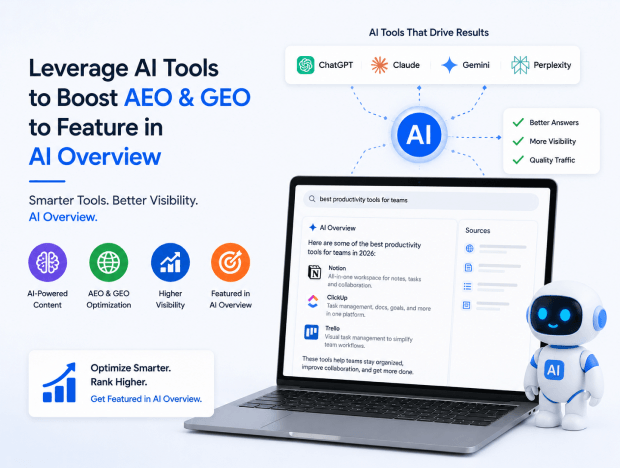
Google’s AI Overview provides users with instant summaries directly within search results.
Instead of clicking multiple links, users receive:
- Quick explanations
- Product recommendations
- Comparisons
- Step-by-step guidance
- Industry insights
When your content contributes to these AI-generated summaries, your brand gains exceptional visibility and credibility. Appearing in AI Overview can help businesses:
- Increase brand awareness
- Build authority
- Improve trust
- Drive qualified traffic
- Generate more leads
- Enhance customer engagement
This makes AI visibility one of the most valuable digital marketing opportunities available today.
The Role of AI Tools in AEO and GEO
Creating AI-friendly content manually can be time-consuming. Modern AI tools help businesses identify opportunities, optimize content structure, improve readability, and increase relevance. These tools streamline the entire optimization process while helping marketers better understand how AI systems interpret content.
Key AI Tools That Support AEO and GEO
Content Research Tools
AI-powered research tools analyze search trends, user intent, and common questions. They help marketers discover:
- Frequently asked questions
- Emerging topics
- Search intent patterns
- Long-tail keyword opportunities
- Conversational queries
Understanding what users are asking is the foundation of effective AEO.
AI Content Optimization Platforms
Advanced optimization tools evaluate content and recommend improvements that align with search engine and AI expectations. These platforms help improve:
- Content structure
- Semantic relevance
- Readability
- Topical authority
- Entity optimization
Well-structured content is easier for AI systems to understand and reference.
AI Writing Assistants
AI writing tools assist with creating comprehensive and user-focused content. They help generate:
- FAQs
- Blog posts
- Topic clusters
- How-to guides
- Product descriptions
- Knowledge-base articles
These content formats are particularly effective for AEO and GEO strategies.
AI-Powered Analytics Tools
Analytics platforms provide insights into user behavior and content performance. Businesses can identify:
- Which questions drive traffic
- High-performing pages
- User engagement metrics
- Content gaps
- Optimization opportunities
This data helps refine content strategies over time.
Features of AI Tools That Improve AEO and GEO
Artificial Intelligence has become a powerful ally for marketers, content creators, and SEO professionals looking to improve both Answer Engine Optimization (AEO) and Generative Engine Optimization (GEO). Modern AI tools help create content that not only ranks well but also serves as a reliable source for search engines and AI-powered platforms.
1. Content Generation and Optimization
AI tools can quickly generate high-quality content based on user intent and search queries. They help create clear, informative, and well-structured content that is easier for answer engines and generative AI systems to understand and use.
Benefits:
- Faster content creation
- Improved readability
- Better alignment with user questions
- Enhanced content consistency
2. Natural Language Processing (NLP)
Advanced AI tools use Natural Language Processing (NLP) to understand how people naturally communicate. This enables businesses to create conversational content that mirrors real user queries.
Benefits:
- Supports voice search optimization
- Improves content relevance
- Enhances user engagement
- Helps AI systems interpret content accurately
3. Question and Answer Identification
Many AI-powered platforms can identify common questions users ask about a topic and suggest relevant answers. This feature is especially valuable for AEO because it helps content match the format answer engines prefer.
Benefits:
- Better featured snippet opportunities
- Stronger FAQ sections
- Increased chances of appearing in direct answers
- Improved user experience
4. Semantic Keyword Analysis
Instead of focusing only on exact-match keywords, AI tools analyze related terms, topics, and search intent. This helps create content that covers a subject comprehensively.
Benefits:
- Stronger topical authority
- Improved GEO performance
- Better contextual relevance
- Enhanced search visibility
5. Content Gap Detection
AI tools can compare your content with competitors and identify missing information or topics that users are searching for.
Benefits:
- More complete content coverage
- Increased authority on a subject
- Better chances of being referenced by AI-generated responses
- Competitive advantage in search results
6. Structured Data Recommendations
Some AI-powered SEO platforms suggest schema markup and structured data improvements, helping search engines better understand content.
Benefits:
- Enhanced search result visibility
- Improved eligibility for rich snippets
- Better answer engine recognition
- Stronger content organization
7. Search Intent Analysis
Understanding why users search is critical for both AEO and GEO. AI tools analyze search patterns and user behavior to identify informational, navigational, transactional, and conversational intent.
Benefits:
- More relevant content creation
- Improved user satisfaction
- Higher engagement rates
- Better AI-generated answer inclusion
8. Content Personalization
AI can tailor content recommendations based on audience preferences, behavior, and interests. Personalized content often performs better because it addresses specific user needs.
Benefits:
- Increased engagement
- Improved user retention
- Better audience targeting
- Enhanced content effectiveness
9. Real-Time Content Insights
AI tools continuously monitor trends, search behavior, and performance metrics, allowing businesses to update content based on changing user interests.
Benefits:
- Keeps content current and relevant
- Supports emerging search trends
- Improves long-term visibility
- Increases content accuracy
10. Authority and Credibility Enhancement
Many AI platforms evaluate content quality, source reliability, and expertise indicators. This encourages the creation of trustworthy content that AI systems are more likely to reference.
Benefits:
- Builds brand trust
- Strengthens E-E-A-T (Experience, Expertise, Authoritativeness, and Trustworthiness)
- Improves GEO effectiveness
- Increases citation potential in AI-generated responses
AI tools are transforming how businesses approach search optimization. From understanding user intent and generating high-quality content to improving topical authority and content structure, these tools play a crucial role in enhancing both AEO and GEO strategies.
By leveraging AI effectively, organizations can create content that is not only discoverable by search engines but also valuable enough to be included in AI-generated answers and recommendations.
Question-Based Content Discovery
One of the most valuable features of AI tools is their ability to uncover real user questions. Since AI Overviews often respond directly to questions, creating content around these queries significantly improves visibility. Examples include:
- What is digital marketing?
- How does solar energy work?
- Why is local SEO important?
Answering questions clearly increases the likelihood of being featured.
Semantic Analysis
AI tools evaluate content context rather than focusing solely on keywords. They help identify:
- Related topics
- Supporting concepts
- Relevant entities
- Contextual relationships
This improves content depth and helps AI systems better understand your expertise.
Content Structuring Recommendations
AI prefers content that is organized logically. Optimization tools recommend:
- Clear headings
- Subheadings
- Bullet points
- Numbered lists
- FAQ sections
Structured content is easier for AI engines to extract and summarize.
Entity Recognition
Modern AI systems rely heavily on entities such as brands, products, industries, locations, and people. AI tools help identify important entities and ensure they are naturally integrated into content. This strengthens topical relevance and authority.
Search Intent Mapping
Not every search query has the same purpose. AI tools classify intent into categories such as:
- Informational
- Navigational
- Transactional
- Commercial investigation
Matching content to user intent increases the chances of being selected for AI-generated responses.
Benefits of Leveraging AI Tools for AEO and GEO
Increased Visibility in AI Overviews
The most obvious benefit is improved visibility within AI-generated search experiences. Being featured in AI Overviews places your brand in front of users before they even click on traditional search results.
Higher Organic Traffic
When AI systems reference your content as a trusted source, users are more likely to visit your website for additional information. This can drive highly qualified traffic.
Improved Brand Authority
AI-generated answers prioritize trustworthy and authoritative sources. Consistently appearing in AI responses positions your business as an industry leader.
Better User Experience
AI tools help create content that directly answers user questions. This improves:
- Readability
- Relevance
- Engagement
- Customer satisfaction
Users appreciate content that solves problems quickly.
Enhanced Lead Generation
When users find valuable answers from your content, they are more likely to trust your brand and take action. This can result in:
- More inquiries
- More consultation requests
- More form submissions
- More sales opportunities
Greater Content Efficiency
AI tools reduce the time required for:
- Research
- Writing
- Optimization
- Content audits
This allows marketing teams to produce higher-quality content more efficiently.
Best Practices to Feature in AI Overview
Focus on E-E-A-T Principles
Google prioritizes content demonstrating:
- Experience
- Expertise
- Authoritativeness
- Trustworthiness
Showcase industry knowledge, credentials, case studies, and real-world examples whenever possible.
Create Comprehensive Yet Clear Content
AI systems favor content that answers questions completely while remaining easy to understand. Avoid unnecessary jargon and focus on providing value.
Add FAQ Sections
FAQ sections align perfectly with AEO strategies because they directly address user questions. Include concise and informative answers.
Use Structured Data
Schema markup helps search engines better understand content. Consider implementing:
- FAQ Schema
- Article Schema
- Product Schema
- Local Business Schema
Structured data improves content interpretation and indexing.
Build Topic Clusters
Instead of publishing isolated articles, create interconnected content around major topics. This strengthens topical authority and helps AI engines recognize your expertise.
Update Content Regularly
Fresh and accurate information is essential for AI-generated responses. Review and update content periodically to maintain relevance.
The Future of Search Is AI-Driven
The evolution of AI-powered search is reshaping digital marketing. Businesses can no longer rely solely on traditional SEO techniques. As AI Overviews, generative search engines, and conversational assistants become more common, AEO and GEO will play a critical role in online visibility. Organizations that invest in AI-friendly content today will be better positioned to capture future search opportunities.
Conclusion
AI is transforming how users discover information online, and businesses must adapt accordingly. Leveraging AI tools for Answer Engine Optimization (AEO) and Generative Engine Optimization (GEO) enables organizations to create content that not only ranks well but also becomes part of AI-generated answers and Google AI Overviews.
By using AI-powered research, optimization, writing, and analytics tools, businesses can improve content quality, better understand user intent, and increase their chances of being featured in AI-driven search experiences.
The brands that embrace AEO and GEO today will be the ones leading tomorrow’s digital landscape. Rather than simply chasing rankings, the focus should be on becoming the most trusted and useful source of information for both users and AI systems alike.