Search Engine Optimization (SEO) has changed dramatically over the last few years. Gone are the days when simply stuffing keywords into a webpage could help you rank on Google. Today’s search engines prioritize high-quality, relevant, and user-focused content. As search algorithms become more intelligent, businesses need smarter strategies to stay ahead of the competition.
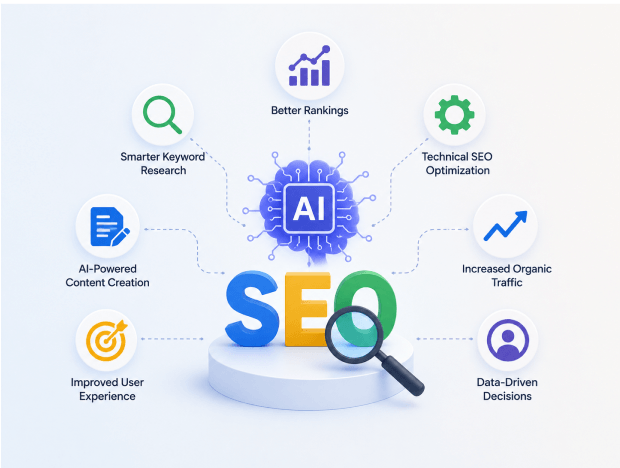
This is where Artificial Intelligence (AI) is transforming SEO. AI has become one of the most powerful tools for improving search rankings, increasing website traffic, and enhancing online visibility. From keyword research and content creation to technical SEO and user experience optimization, AI helps businesses make data-driven decisions faster and more accurately than ever before.
Whether you’re a startup, an eCommerce store, or an established enterprise, integrating AI into your SEO strategy can help you attract more qualified visitors, improve search engine rankings, and achieve sustainable growth.
Think of AI in SEO not as a replacement for human creativity, but as the ultimate data partner. For years, optimization meant guessing what search engines wanted; today, AI analyzes search patterns and user behavior in real time, taking the guesswork out of the equation.
By handling the heavy lifting, like uncovering hidden keyword opportunities, auditing site structures, and analyzing competitor gaps, AI frees up creators to focus on what matters most: telling compelling stories.
It helps you understand exactly what your audience is searching for and how they want to consume it. Ultimately, AI doesn’t just help you rank higher; it helps you connect faster and more meaningfully with the right people online.
In this guide, we’ll explore how AI helps SEO boost online visibility, its key features, benefits, practical applications, and best practices for achieving long-term success.
What Is AI in SEO?
AI in SEO refers to using Artificial Intelligence technologies to automate, analyze, and improve various search engine optimization tasks. Instead of relying solely on manual research and guesswork, AI processes massive amounts of search data, identifies patterns, predicts trends, and provides actionable recommendations.
At its core, AI in SEO is the practice of using artificial intelligence and machine learning to analyze, automate, and optimize your website’s search engine performance.
Instead of relying solely on manual research and guesswork, AI uses smart algorithms to process massive amounts of search data in seconds, helping you understand exactly what search engines, and more importantly, real people, are looking for. Here is a quick look at how it shifts the traditional workflow:
| Traditional SEO | AI-Driven SEO |
| Manual keyword tracking and spreadsheet sorting. | Real-time intent clustering and predictive keyword trends. |
| Guessing content gaps based on basic competitor audits. | Automated gap analysis mapping user queries to content shortages. |
| Fixed optimization based on rigid search engine rules. | Dynamic optimization tailored to conversational search and AI answer engines. |
The Three Main Pillars
Content Intelligence: AI tools look at top-ranking pages to tell you exactly what subtopics, semantic keywords (related terms), and questions your content needs to cover to be considered an “authoritative” source.
Predictive Analytics & Technical Audits: AI can scan thousands of pages simultaneously to flag broken links, indexing issues, or shifting search algorithms before they tank your traffic.
Search Intent Mapping: Modern search engines use AI (like Google’s RankBrain and MUM) to understand the meaning behind a search, not just the exact words typed. AI SEO tools help you align your content perfectly with that underlying human intent.
The Big Shift: AI has changed SEO from a game of “matching keywords” to a game of answering user intent accurately. It handles the data crunching so you can focus on building authentic strategy and a great user experience.
Modern AI-powered SEO tools help marketers:
- Discover high-performing keywords
- Analyze competitors
- Generate content ideas
- Improve on-page SEO
- Optimize website structure
- Enhance user experience
- Detect technical SEO issues
- Monitor ranking performance
- Predict future SEO opportunities
Rather than replacing SEO professionals, AI makes them more productive by automating repetitive tasks and providing deeper insights.
Why AI Matters for Online Visibility
Online visibility isn’t just about ranking page one for a couple of static keywords anymore. With the rise of AI-powered search engines like Google’s AI Overviews, Perplexity, and ChatGPT Search, the way people find information has completely changed.
AI matters for online visibility because search itself has evolved from a simple directory of links into an active answer engine. If your brand isn’t optimized for how these smart systems think, you risk becoming invisible. Online visibility means how easily potential customers can discover your business through search engines like Google.
The higher your visibility, the greater your chances of:
- Increasing website traffic
- Building brand awareness
- Generating qualified leads
- Improving conversions
- Growing sales
- Establishing industry authority
Since Google’s algorithms now evaluate hundreds of ranking factors, manually optimizing every aspect of SEO can be overwhelming. AI simplifies this process by identifying exactly what improvements will have the biggest impact.
How AI Helps SEO to Boost Online Visibility
1. Smarter Keyword Research
Keyword research is the foundation of successful SEO. AI tools analyze:
- Search intent
- Keyword difficulty
- Monthly search volume
- User behavior
- Competitor rankings
- Long-tail keyword opportunities
Instead of focusing only on high-volume keywords, AI identifies terms that have better conversion potential and lower competition. This allows businesses to target users who are more likely to become customers.
2. Better Understanding of Search Intent
Google no longer ranks pages based only on keywords. It wants to understand what users are actually looking for. AI helps identify different search intents:
- Informational
- Navigational
- Commercial
- Transactional
By matching content with user intent, businesses create pages that satisfy visitors and improve rankings naturally.
3. AI-Assisted Content Creation
Creating high-quality content consistently can be challenging. AI helps by:
- Generating content outlines
- Suggesting headings
- Creating topic clusters
- Recommending related keywords
- Improving readability
- Eliminating grammar mistakes
- Maintaining consistency
Human expertise is still essential for adding originality, experience, and credibility, but AI significantly speeds up the writing process.
4. Content Optimization
Publishing content is only the beginning. AI analyzes your pages and recommends improvements such as:
- Better title tags
- Optimized meta descriptions
- Improved heading structure
- Internal linking opportunities
- Image optimization
- Keyword placement
- Content depth
These enhancements make your content easier for both users and search engines to understand.
5. Predictive SEO Analytics
One of AI’s biggest strengths is predicting future trends. AI can forecast:
- Seasonal keyword demand
- Emerging search trends
- Content opportunities
- Competitor movements
- Ranking fluctuations
Businesses can create content before competitors recognize new opportunities.
6. Technical SEO Improvements
Many websites lose rankings due to technical issues. AI-powered SEO tools automatically detect:
- Broken links
- Crawl errors
- Duplicate content
- Missing metadata
- Slow-loading pages
- Mobile usability issues
- Indexing problems
Fixing these issues improves website performance and search engine visibility.
7. Enhanced User Experience (UX)
Google rewards websites that provide excellent user experiences. AI analyzes user behavior, including:
- Bounce rate
- Session duration
- Click patterns
- Navigation paths
- Conversion funnels
These insights help businesses create websites that keep visitors engaged longer.
8. Competitor Analysis
Understanding competitors is easier with AI. It can identify:
- Their top-performing pages
- Ranking keywords
- Backlink profiles
- Content gaps
- SEO strengths
- Weaknesses
Businesses can then create better content and develop stronger SEO strategies.
9. Automated SEO Audits
Instead of manually reviewing hundreds of pages, AI performs complete website audits within minutes. These audits evaluate:
- On-page SEO
- Technical health
- Mobile optimization
- Internal linking
- Duplicate pages
- Core Web Vitals
- Security issues
Regular audits help maintain consistent SEO performance.
10. Personalized Search Experiences
AI enables businesses to deliver personalized experiences based on:
- User location
- Search history
- Device type
- Interests
- Behavior
Personalization improves engagement, increases conversions, and encourages repeat visits.
Features of AI-Powered SEO
Modern AI SEO platforms offer numerous advanced capabilities.
Intelligent Keyword Discovery
AI identifies profitable keywords that align with your business goals instead of focusing solely on search volume.
Content Suggestions
It recommends relevant topics, frequently asked questions, semantic keywords, and content improvements.
Automated Optimization
AI continuously monitors website performance and recommends real-time improvements.
Natural Language Processing (NLP)
AI understands how people naturally search, helping businesses create conversational, user-friendly content.
Competitor Monitoring
Receive updates whenever competitors gain rankings or publish new content.
Content Gap Analysis
Identify valuable topics your competitors cover but your website is missing.
Technical Issue Detection
Automatically identify and prioritize technical SEO problems affecting rankings.
Performance Tracking
Monitor rankings, traffic, conversions, and keyword performance through AI-driven dashboards.
Benefits of Using AI for SEO
Integrating AI into your SEO toolkit completely shifts how you scale growth. Instead of burning hours on manual analysis and execution, AI introduces speed, deep data modeling, and predictive accuracy into your workflow.
Businesses adopting AI-driven SEO strategies report substantial gains, including an average 65-70% uplift in content marketing ROI and drastically accelerated ranking times.
Saves Time
AI automates repetitive SEO tasks, allowing teams to focus on strategy and creativity.
Improves Content Quality
AI recommendations make content more readable, comprehensive, and aligned with user intent.
Better Keyword Targeting
Businesses can identify keywords with stronger conversion potential rather than chasing only high-volume searches.
Faster Decision-Making
Real-time insights help marketers adapt quickly to search engine changes.
Increases Organic Traffic
Well-optimized content ranks higher, bringing in more qualified visitors.
Boosts Online Visibility
Improved rankings mean more people discover your business through search engines.
Reduces Manual Errors
Automation minimizes common SEO mistakes such as missing metadata or duplicate content.
Supports Scalable Growth
AI allows businesses to manage hundreds or even thousands of webpages efficiently.
Enhances User Experience
Optimized websites load faster, are easier to navigate, and provide better experiences for visitors.
Delivers Better ROI
More organic traffic means lower customer acquisition costs and higher long-term returns.
Best Practices for Using AI in SEO
Although AI is incredibly powerful, it works best when combined with human expertise.
Follow these best practices:
- Create original, experience-based content.
- Prioritize user intent over keyword density.
- Regularly update existing content.
- Optimize for mobile devices.
- Improve website speed.
- Build high-quality backlinks naturally.
- Use AI for research rather than copying content.
- Review AI-generated content for accuracy.
- Follow Google’s E-E-A-T principles (Experience, Expertise, Authoritativeness, and Trustworthiness).
- Track SEO performance consistently and refine your strategy based on results.
Common Mistakes to Avoid
Many businesses misuse AI and fail to achieve good results. Avoid these common mistakes:
- Publishing AI-generated content without editing.
- Ignoring search intent.
- Overusing keywords.
- Neglecting technical SEO.
- Forgetting internal linking.
- Creating duplicate content.
- Relying entirely on automation.
- Ignoring user experience.
- Not updating older content.
- Focusing only on rankings instead of conversions.
The Future of AI in SEO
The future of SEO isn’t about moving away from search engines, it’s about adjusting to how search engines have evolved. We are moving firmly out of the era of the “list of blue links” and into an ecosystem dominated by Retrieval-Augmented Generation (RAG), where engines like Google Gemini, ChatGPT Search, and Perplexity synthesize answers in real time.
In this new landscape, the core definition of success is shifting from ranking share to citation share. If your brand isn’t structured to be easily extracted and cited by large language models (LLMs), you risk becoming invisible to a massive portion of online traffic.
AI will continue to reshape how businesses approach search optimization. Future developments may include:
- More advanced voice search optimization
- Hyper-personalized search experiences
- Smarter predictive analytics
- Automated content optimization in real time
- Enhanced visual and video search capabilities
- Deeper integration with generative AI and search assistants
As search engines evolve, businesses that embrace AI while maintaining a strong focus on quality, trust, and user value will be better positioned to achieve long-term success.
Why Businesses Should Combine AI with Human Expertise
AI can process enormous amounts of data and automate complex tasks, but it cannot fully replace human creativity, critical thinking, or industry experience. The most effective SEO strategies combine AI’s efficiency with human insight to create authentic, engaging, and trustworthy content.
By using AI for research, analysis, and optimization while relying on experts for strategy and storytelling, businesses can produce content that not only ranks well but also builds meaningful relationships with their audience.
Conclusion
Artificial Intelligence is transforming SEO from a manual, time-consuming process into a smarter, more strategic approach. From advanced keyword research and content optimization to technical SEO audits and predictive analytics, AI helps businesses improve their online visibility, attract qualified traffic, and stay competitive in an ever-changing digital landscape.
However, AI should be viewed as a powerful assistant, not a replacement for human expertise. Success in modern SEO comes from blending AI-driven insights with high-quality, people-first content that demonstrates real experience and authority. Businesses that embrace this balanced approach can strengthen their search presence, improve user engagement, and achieve sustainable long-term growth in organic search.
FAQs On How AI Helps SEO to Boost Online Visibility
1. How does AI help improve SEO?
AI helps SEO by analyzing large amounts of search data, identifying keyword opportunities, understanding user intent, and suggesting content improvements. It also automates repetitive SEO tasks, allowing businesses to focus on creating valuable content that attracts more organic traffic.
2. Can AI improve my website’s Google rankings?
AI can support higher Google rankings by helping you optimize content, identify technical SEO issues, improve keyword targeting, and better understand what users are searching for. However, rankings ultimately depend on the quality of your website, helpful content, backlinks, and overall SEO strategy.
3. Is AI-generated content good for SEO?
AI-generated content can be beneficial when it’s reviewed, edited, and enhanced by human experts. Google values original, accurate, and helpful content rather than whether it was written by AI or a person. The best results come from combining AI efficiency with human expertise and industry knowledge.
4. How does AI help with keyword research?
AI tools analyze search trends, user behavior, and competitor data to discover relevant keywords, long-tail phrases, and content opportunities. This helps businesses target the right audience and create content that matches what potential customers are actively searching for.
5. Can AI help create SEO-friendly content?
Yes. AI can assist with generating content ideas, creating outlines, improving readability, optimizing headings, and naturally incorporating keywords. Human editing is still essential to ensure the content is accurate, engaging, and reflects your brand’s expertise.
6. Does AI help with technical SEO?
Absolutely. AI-powered SEO tools can detect crawl errors, broken links, duplicate content, slow-loading pages, and other technical issues that may affect your website’s search performance. Identifying these problems early helps improve your site’s overall health and user experience.
7. Can AI improve local SEO?
Yes. AI can help optimize Google Business Profiles, identify location-based keywords, monitor customer reviews, and create locally relevant content. These improvements can increase your visibility in local search results and help nearby customers find your business more easily.
8. Will AI replace SEO professionals?
No. AI is a powerful assistant, but it cannot replace experienced SEO professionals. Successful SEO requires strategic planning, industry expertise, creativity, and an understanding of customer behavior. AI makes SEO more efficient, while human specialists make informed decisions and ensure long-term success.
9. What are the biggest benefits of using AI for SEO?
AI helps save time, speeds up research, improves content optimization, identifies ranking opportunities, analyzes competitors, and provides valuable insights from large datasets. These advantages allow businesses to make smarter SEO decisions and strengthen their online presence.
10. Is AI SEO suitable for small businesses?
Yes. AI-powered SEO tools can help small businesses compete more effectively by simplifying keyword research, content optimization, technical audits, and performance analysis. When combined with a well-planned SEO strategy, AI can help small businesses attract more qualified traffic and grow their online visibility without requiring a large marketing team.