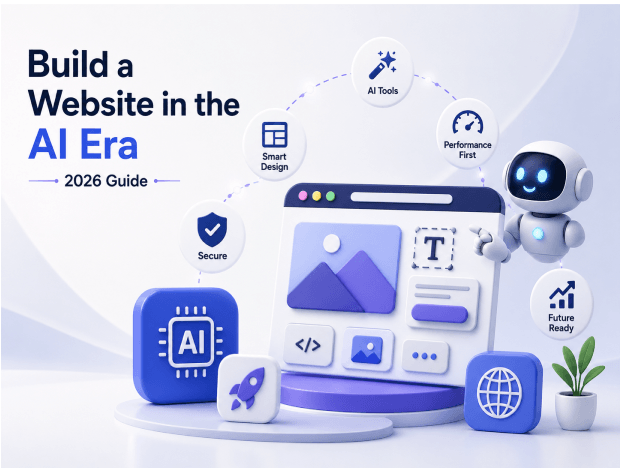
The way websites are built has changed dramatically over the past few years. What once required weeks of coding, multiple developers, and extensive design work can now be accomplished in a matter of hours with the help of Artificial Intelligence (AI). Whether you’re a startup founder, small business owner, freelancer, or enterprise, AI has made website development faster, smarter, and more accessible than ever before.
But here’s the important thing to remember, AI doesn’t replace good strategy. It enhances it. A beautiful AI-generated website means very little if it doesn’t reflect your brand, attract visitors, or convert them into customers. The most successful websites in the AI era combine intelligent automation with thoughtful planning, user experience, and digital marketing.
In this guide, we’ll explore the most promising ways to build a website in the AI era, along with their features, benefits, and how to choose the right approach for your business.
Why AI is Transforming Website Development
AI is changing the way websites are built, making the entire development process faster, smarter, and more accessible than ever before. Tasks that once took weeks of coding and design can now be completed in hours with the help of AI-powered tools. From generating layouts and writing website copy to optimizing images and improving user experiences, AI allows businesses to create professional websites with less time and effort.
More importantly, AI isn’t replacing creativity, it enhances it. Designers and developers can spend less time on repetitive tasks and focus more on building engaging, user-friendly digital experiences. Whether you’re a startup launching your first website or an established business looking to upgrade your online presence, AI-powered website development offers a cost-effective, efficient, and scalable way to stay competitive in today’s digital world.
Artificial Intelligence is no longer just a buzzword. It has become a practical tool that helps businesses build websites faster while reducing development costs. Modern AI tools can:
- Generate website layouts
- Write website copy
- Create professional images
- Suggest color palettes
- Optimize SEO
- Improve website performance
- Personalize user experiences
- Automate testing and maintenance
Instead of spending weeks designing every page from scratch, businesses can now launch professional websites much faster while still maintaining high quality.
1. AI Website Builders
AI-powered website builders have become one of the easiest ways to create professional websites. These platforms ask a few questions about your business, industry, and goals before automatically generating a complete website. Popular examples include:
- Wix AI
- Hostinger AI Website Builder
- Squarespace AI
- Durable AI
- Framer AI
Features
- AI-generated website layouts
- Automatic content generation
- Drag-and-drop editing
- Built-in SEO tools
- Mobile-responsive designs
- AI image generation
- AI logo creation
- Integrated hosting
Benefits
Extremely Fast Development
A website that once took weeks can now be built in less than an hour.
Beginner Friendly
No coding experience is required.
Cost Effective
Perfect for startups and small businesses with limited budgets.
Continuous AI Assistance
AI can continue suggesting improvements even after the website goes live.
2. WordPress with AI Plugins
WordPress remains the world’s most popular CMS, and AI has made it even more powerful. Instead of replacing WordPress, AI enhances its capabilities through plugins that simplify content creation, SEO, and website management. Popular AI integrations include:
- AI content writers
- AI SEO assistants
- AI image generators
- AI chatbots
- AI security plugins
Features
- Full customization
- Thousands of plugins
- AI-assisted blogging
- SEO optimization
- WooCommerce integration
- Scalable architecture
- Multi-language support
Benefits
Complete Ownership
Unlike many AI website builders, you own your website and data.
Highly Scalable
Suitable for businesses of every size.
Better SEO Flexibility
WordPress provides complete control over technical SEO.
Future-Proof
As AI evolves, WordPress continues adding new AI-powered tools.
3. No-Code and Low-Code Platforms
No-code platforms allow anyone to create websites without writing code. These platforms are becoming increasingly intelligent by incorporating AI into their workflows. Popular platforms include:
- Webflow
- Bubble
- Softr
- Glide
- Notion Sites
Features
- Visual website editing
- AI workflow automation
- Responsive design
- CMS integration
- API connectivity
- Database management
Benefits
Faster Development
Projects can be completed significantly quicker than traditional coding.
Lower Development Costs
Businesses can launch products without hiring large development teams.
Easy Updates
Content and layouts can be updated without technical expertise.
4. Custom AI-Assisted Website Development
Many businesses still require fully customized websites. Instead of manually writing every line of code, developers now use AI coding assistants that improve productivity. Popular AI coding tools include:
- GitHub Copilot
- Cursor AI
- ChatGPT
- Claude
- Amazon CodeWhisperer
Features
- AI code generation
- Bug detection
- Code optimization
- Faster debugging
- Automated documentation
- Intelligent code suggestions
Benefits
Maximum Flexibility
Developers can create virtually any functionality.
Better Performance
Custom websites are often faster than template-based websites.
Enhanced Security
Security measures can be tailored to business requirements.
Unique Brand Identity
Every design element can be customized.
5. Headless CMS with AI Integration
Large organizations increasingly use Headless CMS platforms that separate the website’s frontend from its backend. AI further enhances these platforms through intelligent content management. Popular platforms include:
- Contentful
- Strapi
- Sanity
- Storyblok
Features
- API-first architecture
- AI content suggestions
- Multi-platform publishing
- Scalable infrastructure
- Personalized content delivery
Benefits
Exceptional Speed
Headless websites are often much faster than traditional CMS websites.
Omnichannel Publishing
Content can be published across websites, mobile apps, kiosks, and more.
Improved User Experience
AI helps deliver personalized experiences to different audiences.
6. AI-Powered E-commerce Website Development
E-commerce has become one of the biggest beneficiaries of AI. Modern online stores now leverage AI to optimize nearly every aspect of the customer journey.
Features
- AI product recommendations
- Smart search
- Personalized shopping experiences
- AI chatbots
- Dynamic pricing
- Inventory forecasting
- AI-generated product descriptions
Benefits
Higher Sales
Personalized recommendations encourage larger purchases.
Better Customer Experience
Visitors can find products more quickly and receive instant support.
Reduced Manual Work
AI automates repetitive tasks such as product content creation and inventory management.
7. Hybrid Human + AI Website Development
Perhaps the most promising approach is combining AI with human expertise. AI handles repetitive tasks, while designers, developers, SEO specialists, and marketers focus on creativity, strategy, and business goals. This approach delivers the best balance between speed and quality.
Features
- AI-assisted design
- Human UX optimization
- Professional SEO
- Conversion optimization
- Custom branding
- AI automation
- Manual quality assurance
Benefits
Better User Experience
Human designers understand emotions, usability, and customer behavior better than AI alone.
Stronger Branding
Businesses maintain a unique identity instead of looking like every other AI-generated website.
Higher Search Rankings
SEO experts optimize technical performance, content strategy, and search intent alongside AI tools.
Better Conversions
A strategically designed website converts more visitors into customers.
Essential AI Features Every Modern Website Should Have
Regardless of how you build your website, several AI-powered features have become almost essential. Modern websites are no longer just digital brochures, they are intelligent platforms designed to deliver personalized, engaging, and seamless user experiences.
By integrating AI-powered features, businesses can improve customer satisfaction, boost conversions, and simplify everyday operations. Here are some of the most important AI features every modern website should consider:
1. AI Chatbots and Virtual Assistants
AI-powered chatbots provide instant responses to customer inquiries, offer product recommendations, schedule appointments, and provide 24/7 support. This ensures visitors receive immediate assistance, improving engagement and customer satisfaction.
2. Personalized User Experience
AI analyzes visitor behavior, browsing history, and preferences to deliver personalized content, product recommendations, and offers. This creates a more relevant experience that encourages users to stay longer and convert more often.
3. AI-Powered Search
Smart search functionality understands user intent rather than relying solely on exact keywords. It delivers faster, more accurate search results, making it easier for visitors to find the information or products they need.
4. Automated Content Generation
AI can assist in creating website copy, product descriptions, blog outlines, FAQs, and meta descriptions. While human editing remains important, AI significantly speeds up content creation and helps maintain consistency.
5. Smart Recommendation Engine
E-commerce and service-based websites can use AI to recommend products, services, or content based on user interests and previous interactions, increasing cross-selling and upselling opportunities.
6. Predictive Analytics
AI helps businesses understand customer behavior by analyzing historical data and predicting future actions. These insights enable better marketing decisions, improved customer targeting, and more effective sales strategies.
7. Voice Search Compatibility
As voice assistants become increasingly popular, AI-powered voice search enables users to navigate websites and find information using natural language, enhancing accessibility and convenience.
8. AI-Driven SEO Optimization
AI tools can identify keyword opportunities, optimize content, improve technical SEO, and analyze competitor performance. This helps websites achieve better search engine rankings while saving time on manual optimization.
9. Automated Image and Media Optimization
AI can automatically compress images, generate alt text, improve image quality, and optimize media files for faster page loading without compromising visual appeal.
10. Enhanced Security and Fraud Detection
AI continuously monitors website activity to detect suspicious behavior, identify security threats, and prevent fraudulent transactions in real time, providing better protection for both businesses and users.
11. Intelligent Forms and Lead Capture
AI-powered forms can adapt based on user responses, reduce unnecessary fields, autofill information where possible, and qualify leads automatically, making the conversion process smoother.
12. Real-Time Website Performance Monitoring
AI continuously tracks website performance, detects technical issues, identifies broken links, and recommends improvements before they impact user experience or search rankings.
By incorporating these AI-powered features, businesses can create websites that are more responsive, personalized, secure, and efficient.
Rather than simply displaying information, AI-enabled websites actively engage visitors, streamline operations, and deliver experiences that meet the expectations of today’s digital audience.
Benefits of Building a Website in the AI Era
Businesses embracing AI-driven website development gain several competitive advantages.
Faster Launch Times
AI significantly reduces development time, allowing businesses to go live much sooner.
Lower Development Costs
Automation minimizes the need for repetitive manual work, making website creation more affordable.
Better User Experience
AI personalizes content, improves navigation, and delivers a smoother browsing experience.
Improved SEO
Many AI tools assist with keyword optimization, metadata creation, content recommendations, and technical improvements.
Increased Productivity
Designers, developers, marketers, and content creators can focus on high-value tasks while AI handles routine activities.
Continuous Improvement
AI doesn’t stop after launch. It can monitor website performance, analyze visitor behavior, and recommend ongoing enhancements.
Higher Conversion Rates
AI-powered personalization, intelligent recommendations, and optimized user journeys help convert more visitors into customers.
Challenges to Keep in Mind
Although AI offers numerous advantages, businesses should remain aware of its limitations.
- AI-generated content may require human editing.
- Generic templates can reduce brand uniqueness.
- Poor AI prompts can produce inconsistent results.
- Human creativity remains essential for storytelling and branding.
- AI cannot fully replace strategic planning or user research.
The most effective websites are those where AI supports human expertise, not replaces it.
How to Choose the Right Website Building Method
Your ideal approach depends on your goals, budget, and technical requirements.
- Small businesses and startups: AI website builders offer a quick and affordable way to establish an online presence.
- Growing companies: WordPress combined with AI tools provides flexibility, scalability, and strong SEO capabilities.
- E-commerce brands: AI-powered e-commerce platforms can improve customer experiences and drive higher sales.
- Large enterprises: Custom AI-assisted development or headless CMS solutions deliver maximum performance, scalability, and integration options.
- Businesses focused on long-term growth: A hybrid human + AI approach offers the best balance of speed, creativity, customization, and digital strategy.
The Future of Website Development
The future of web development will be increasingly intelligent. Websites will become more personalized, conversational, and adaptive, responding to user behaviour in real time. AI will automate routine tasks, while human expertise will continue to shape brand identity, customer trust, and business strategy.
Instead of replacing developers and designers, AI is redefining their roles. Professionals who embrace AI as a collaborative tool will be able to deliver websites that are faster to build, more engaging, and better aligned with business objectives.
Conclusion
Building a website in the AI era is no longer just about choosing a platform, it’s about choosing the right combination of technology and expertise. AI has made website creation faster, more affordable, and more accessible than ever before, but lasting success still depends on thoughtful planning, strong branding, exceptional user experience, and a clear digital strategy.
Whether you opt for an AI website builder, a WordPress site enhanced with AI plugins, a no-code platform, or fully custom development, the most promising approach is one that balances automation with human insight. AI can generate pages, content, and code in minutes, but it is people who create meaningful experiences, build trust, and turn visitors into loyal customers.
In the years ahead, businesses that embrace AI while maintaining a human-centered approach will be best positioned to build websites that not only look impressive but also perform exceptionally well in search engines, engage users effectively, and support long-term business growth.