


The way people discover and purchase products online is changing. Traditionally, shoppers searched Google, clicked on ecommerce websites, compared prices, and read product reviews before making a purchase. Today, many consumers are also turning to AI-powered search experiences to ask questions, compare products, explore alternatives, and find recommendations.
For example, a shopper might ask an AI assistant, “Which are the best running shoes for beginners under ₹5,000?” or “Recommend an energy-efficient inverter for a small Indian home.” Instead of browsing dozens of websites, the shopper may receive a summarised answer containing product recommendations, comparisons, explanations, and links to selected sources. This shift creates a new opportunity for ecommerce businesses: AI citations.
An AI citation occurs when an AI-powered search experience references or links to a website as a source supporting its response. Depending on the platform, an ecommerce store may be cited for its product specifications, buying guides, comparisons, return policies, or other useful information.
However, appearing in AI-generated answers is not simply a matter of adding AI-related keywords to product pages. Ecommerce brands need a comprehensive optimisation strategy that makes their content easy to discover, understand, verify, and reference.
In this guide, we will explore how to build an ecommerce store optimisation strategy for AI citations, including technical SEO, product page optimisation, structured data, customer reviews, original content, measurable KPIs, practical examples, and a step-by-step implementation plan.
What Is Ecommerce Store Optimisation for AI Citations?
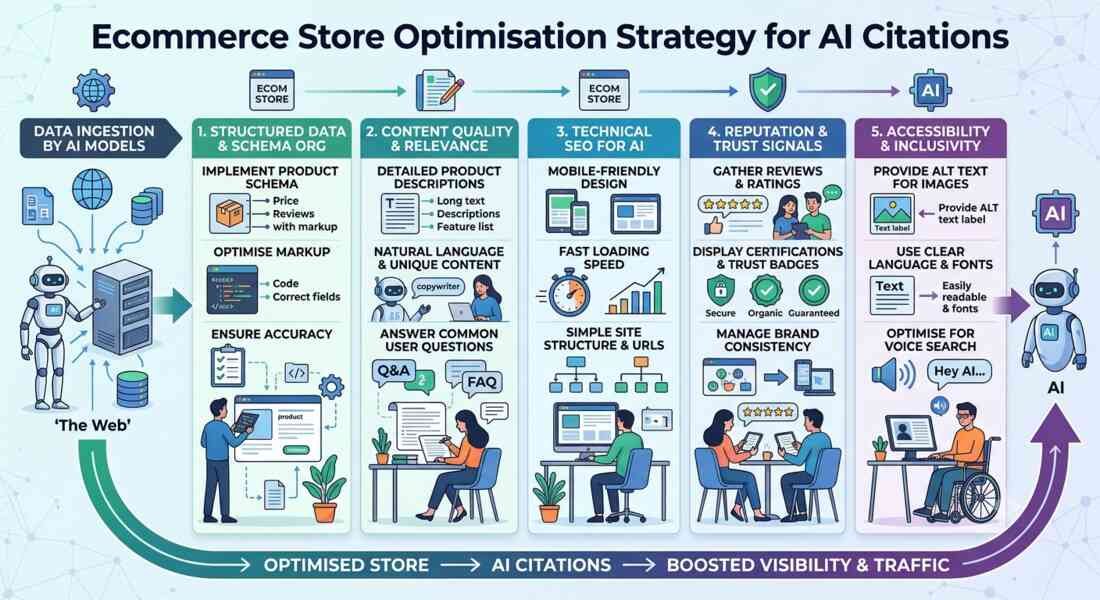
Ecommerce store optimisation for AI citations is the process of improving an online store’s technical accessibility, product information, content quality, credibility, and structured data so AI-powered search systems can more effectively discover and understand its pages.
The goal is not just to rank in traditional search results. It is also to make the store a useful, reliable source when AI systems answer product-related questions. Consider an online store selling ergonomic office chairs. A conventional SEO strategy might target keywords such as:
Buy ergonomic office chairs online
Best office chairs for back support
Affordable computer chairs
Ergonomic chair price in India
An AI citation strategy also considers conversational questions such as:
Which office chair is suitable for working eight hours a day?
What features should I look for in an ergonomic chair?
Is a mesh chair better than a cushioned chair in a hot climate?
Which ergonomic chairs offer adjustable lumbar support?
The store can address these questions through detailed product pages, comparison guides, buying advice, transparent specifications, and helpful FAQs. The central principle is simple: create content that answers genuine shopping questions accurately and make sure search engines and AI systems can access the information.
AI citations are not guaranteed by any particular optimisation technique. Different platforms use different retrieval and ranking systems, and some AI-generated answers may not include citations at all.
Why AI Citations Matter for Ecommerce Businesses
AI citations can introduce a store to shoppers who are still researching a product and have not yet decided which brand to buy. Instead of competing only for a traditional search result, your business can become a source that helps answer the shopper’s question. For ecommerce businesses, this may create opportunities across three stages of the buying journey.
1. Product discovery
Your content can help shoppers discover products that match their needs, budgets, and preferences.
2. Product consideration
Detailed comparisons, specifications, buying guides, and genuine reviews can help customers evaluate their options.
3. Purchase decisions
Clear pricing, stock status, shipping details, warranty information, and return policies help shoppers decide whether to buy.
Key Benefits of Optimising for AI Citations
More discovery opportunities: Your brand may be referenced when shoppers ask AI tools questions relevant to your products.
Stronger product understanding: Complete product information makes it easier to interpret what you sell and whom it serves.
Better-informed customers: Buying guides and comparisons help customers make decisions with less confusion.
Improved trust signals: Verifiable specifications, transparent policies, and authentic customer feedback support credibility.
Additional referral traffic: When an AI platform links to your store, interested users may visit the page to explore the product.
Stronger overall SEO foundations: Many improvements, including crawlability, useful content, and structured product data, also support traditional search visibility.
These are potential benefits, not guaranteed outcomes. An increase in AI citations does not automatically mean an increase in revenue, so businesses should measure both visibility and commercial performance.
1. Understand How AI Search Discovers Ecommerce Content
Before optimising your store, understand the basic process behind AI-powered search. Depending on the platform, an AI search system may discover information through web crawling, existing search indexes, product feeds, or other retrieval systems.
It may then select relevant sources, interpret the available information, and generate an answer with or without citations. A simplified process looks like this:
Customer asks a product question
Example: Which waterproof walking shoes are suitable for monsoon weather?
Content discovery and retrieval
Relevant webpages, indexed information, and available product data
Relevance and information assessment
Product suitability, factual clarity, context, and source relevance
AI-generated response
May include product recommendations, explanations, and source links
The exact process varies by platform. There is no universally published checklist that guarantees an ecommerce page will be selected as an AI citation.
For example, OpenAI’s documentation explains that website owners should allow OAI-SearchBot to crawl their content if they want to support inclusion in ChatGPT search results. Blocking the crawler prevents a site from appearing in ChatGPT search answers through that route. This makes technical accessibility an important starting point.
2. Make Your Ecommerce Store Accessible to AI Crawlers
A useful product page cannot be cited through normal crawling and retrieval if the relevant systems cannot access it. Technical SEO should therefore be the first stage of your ecommerce AI citation strategy.
Check your robots.txt file
Your robots.txt file provides instructions to compliant crawlers about which parts of your website they may access. Review whether your rules unintentionally block relevant product pages, category pages, buying guides, images, or other important content. For example, a simplified configuration intended to allow OpenAI’s search crawler could look like this:
User-agent: OAI-SearchBot
Allow: /
This is only an illustrative rule. Integrate it carefully with your existing robots.txt configuration rather than replacing all current rules. Other directives, authentication requirements, firewall rules, and server restrictions can still affect accessibility.
Important distinction: OAI-SearchBot supports search discovery, while GPTBot relates to potential model training. OpenAI documents these controls separately, so a business can make its own choices about search access and training access.
Technical SEO Checklist for AI Citations
| Technical element | What to check | Why it matters |
|---|---|---|
| Robots.txt | Important pages are not unintentionally blocked | Supports crawler access |
| XML sitemap | Canonical product and category URLs are included | Helps search systems discover pages |
| HTTP status codes | Important pages return successful responses | Avoids broken-page issues |
| Canonical tags | Preferred product URLs are identified correctly | Helps consolidate duplicate URL signals |
| JavaScript rendering | Product details appear in accessible page content | Reduces reliance on unsupported rendering |
| Mobile usability | Content and purchasing information work on mobile | Improves usability across devices |
| Internal links | Products connect to relevant categories and guides | Helps discovery and site navigation |
| CDN and firewall rules | Legitimate crawlers are not mistakenly blocked | Prevents avoidable access failures |
Keep Product Content Accessible in HTML
Some ecommerce stores load most product information through client-side JavaScript. This may work for shoppers using a modern browser but can complicate content discovery for some crawlers and retrieval systems. Where practical, make important information available in the initial HTML or through reliable server-side rendering. Prioritise:
Product name and description
Price and currency
Availability
Product attributes and variants
Shipping and return information
Customer-facing FAQs
Relevant internal links
Do not assume that every AI crawler processes JavaScript in the same way. Test the actual rendered output and crawler access instead of relying on assumptions.
3. Optimise Product Pages for Clear, Verifiable Answers
Product pages are among the most important assets for an ecommerce AI citation strategy because they contain the details shoppers need before buying. A weak product page may contain only a product name, a short description, a price, and a photograph.
A stronger page explains what the product does, who it is suitable for, its limitations, and the specifications that distinguish it from alternatives.
Essential Features of an AI-friendly Product Page
Specific product identification
Use a clear product name, brand, model, category, SKU or GTIN where applicable, and accurate variant information.
Detailed specifications
Explain materials, dimensions, weight, capacity, compatibility, performance ratings, and other relevant attributes.
Target audience and use cases
Describe who benefits most from the product and which situations it is designed for.
Advantages and limitations
Explain practical benefits without exaggerating performance or making unsupported claims.
Purchase information
Display current pricing, stock status, delivery estimates, warranty conditions, and return policies.
Example: Before and after product page optimisation
Imagine an ecommerce store selling an office chair.
| Element | Basic product page | Optimised product page |
|---|---|---|
| Product title | Office Chair | ErgoFlex Mesh Office Chair with Adjustable Lumbar Support |
| Description | Comfortable chair for office use | Explains suitable users, adjustments, materials, and intended use |
| Specifications | Limited details | Dimensions, maximum supported load, materials, and adjustment range |
| Benefits | Comfortable design | Explains how adjustability supports different desk setups |
| Limitations | Not mentioned | States assembly requirements and any relevant fit limitations |
| Buying information | Price only | Price, availability, delivery, warranty, and returns |
| Customer questions | None | Answers common questions about assembly, fit, and maintenance |
The improved page provides more specific information that can help both shoppers and information-retrieval systems understand the product.
Write descriptions that answer real shopping questions
Avoid relying entirely on generic manufacturer descriptions repeated across dozens of websites. Instead of writing:
“Premium-quality running shoes designed for comfort and performance.”
Write something more informative:
“These running shoes feature a breathable mesh upper, a cushioned midsole, and a rubber outsole. They are designed for everyday road running and walking. Check the available size chart before ordering, particularly if you usually wear a different size across brands.”
The second description contains identifiable features, intended uses, and practical advice. It is also less likely to sound like interchangeable promotional copy.
Do not invent technical specifications to make descriptions appear more detailed. Use manufacturer documentation, product testing, or verified internal product records.
4. Implement Structured Data for Ecommerce Products
Structured data is machine-readable information that helps search engines interpret the contents of a webpage. It is not an AI citation guarantee, but it can strengthen the consistency and clarity of product information across your store.
Google documents ecommerce-related structured data types such as Product, Offer, BreadcrumbList, and business information markup. Product markup can make pages eligible for certain enhanced search appearances, depending on the page and Google’s requirements.
Recommended Schema Types
| Schema type | Typical use |
|---|---|
Product | Product name, brand, image, description, and identifiers |
Offer | Current price, currency, and availability |
AggregateRating | Genuine aggregate rating information |
Review | A specific, authentic customer or editorial review |
BreadcrumbList | Navigation hierarchy |
Organization | Business identity and relevant organisational details |
Article | Editorial buying guides and educational articles |
Use only the properties that accurately describe the visible content. Schema should not contain fictional ratings, misleading prices, or availability information that contradicts the page.
Example Product schema
The following simplified JSON-LD example demonstrates how a store might describe a product. The product name, price, currency, and availability are illustrative and should be replaced with accurate live data.
<script type="application/ld+json">
{
  "@context": "https://schema.org",
  "@type": "Product",
  "name": "ErgoFlex Mesh Office Chair",
  "description": "Mesh office chair with adjustable lumbar support.",
  "brand": {
    "@type": "Brand",
    "name": "Example Brand"
  },
  "sku": "EF-100",
  "offers": {
    "@type": "Offer",
    "price": "6499.00",
    "priceCurrency": "INR",
    "availability": "https://schema.org/InStock",
    "url": "https://example.com/products/ergoflex-chair"
  }
}
</script>
The URL and product details above are placeholders. The price should reflect the actual offer, and InStock should be used only when the product is available. For a real implementation, Google requires specific properties depending on the rich-result type. Review the official Product structured data documentation and test the implementation before deployment.
Keep schema, page content, and product feeds consistent
Suppose your product page displays a price of ₹6,499, but the structured data says ₹5,999 and the product feed says the item is out of stock. These discrepancies create conflicting information. Maintain a single reliable source for product data wherever possible. Synchronise the following:
Product page content
Structured data
Ecommerce inventory system
Merchant Center feed
Variant and size information
Promotional pricing
Shipping and return policies
Google recommends combining appropriate product structured data with Merchant Center product feeds to help its systems understand and verify product information.
This approach supports accurate product discovery across shopping and search experiences, even though it does not guarantee AI citations.
5. Create Helpful Buying Guides and Comparison Content
Product pages answer questions about individual items. Buying guides and comparison articles answer broader questions that shoppers often ask before choosing a product. These pages can help an ecommerce store demonstrate product knowledge while creating additional entry points for relevant search queries. For example, a footwear store could publish:
Best walking shoes for everyday use
Walking shoes vs. running shoes: What is the difference?
How to choose shoes for monsoon weather
How to measure your feet before buying shoes online
What to look for in shoes for standing all day
A consumer electronics store could develop guides such as:
How to choose an inverter for a small home
Pure sine wave vs. modified sine wave inverters
How much inverter capacity does a home need?
Inverter battery capacity explained
Common mistakes to avoid when buying an inverter
These topics help connect product information with real customer needs.
How to structure an AI-friendly buying guide
Use a clear format that allows readers to find specific answers without reading the entire article.
Example buying guide structure
Direct answer: Start with a concise answer to the main question.
Selection criteria: Explain the features customers should evaluate.
Product comparison: Compare relevant models using consistent criteria.
Use-case recommendations: Explain which product suits different customer needs.
Limitations: Describe trade-offs, compatibility concerns, or situations where a product may not be suitable.
Evidence: Reference manufacturer specifications, testing methodology, or trustworthy sources.
Next step: Link to relevant products and related guides.
Use comparison tables to simplify decisions
Comparison tables make product differences easier to understand. For example:
| Feature | Product A | Product B |
|---|---|---|
| Intended use | Daily walking | Road running |
| Upper material | Breathable mesh | Engineered mesh |
| Cushioning | Moderate | Higher cushioning |
| Outsole | Everyday rubber | Running-focused rubber |
| Best suited for | Casual everyday use | Regular running sessions |
This is an illustrative comparison, not a claim about specific products. Actual recommendations should reflect verified product specifications and testing.
Best practice: Do not publish a comparison table just to include more keywords. Explain what the differences mean for customers. If one product is lighter but less supportive, describe which shoppers may prefer that trade-off.
Build topic clusters around product categories
A topic cluster connects a central category page with supporting buying guides and individual product pages. For an online shoe store, the structure might look like this:
Walking Shoes Category
Main commercial page
Buying Guide
How to choose walking shoes
Comparison
Walking vs. running shoes
Sizing Guide
Measure feet accurately
Product Pages
Models, sizes and features
Link these pages naturally. The buying guide should point to suitable categories or products, while product pages should link back to useful sizing, maintenance, or comparison resources. This creates a coherent information structure rather than a collection of disconnected blog posts.
6. Optimise Product Categories for Search Intent
Category pages are often overlooked in AI citation strategies because ecommerce teams focus mainly on individual product pages. However, category pages can be useful when shoppers want to understand a group of products, compare available options, or narrow their choices. A category page for air purifiers, for example, could explain:
Which room sizes the available products support
What CADR means and why it matters
The differences between HEPA filtration and other filtration technologies
Which filters need regular replacement
How noise levels and maintenance costs differ
Which models suit different budgets
The category should still prioritise shopping usability. Avoid placing an excessively long article above the product listings if it makes the page difficult to navigate.
Recommended Category Page Elements
| Element | Optimisation approach |
|---|---|
| Category introduction | Explain the product range and its main uses |
| Filtering options | Allow users to filter by relevant attributes |
| Product cards | Show clear names, prices, images, and availability |
| Buying advice | Help customers understand key selection criteria |
| FAQs | Answer genuine questions about the category |
| Internal links | Connect to relevant guides, subcategories, and products |
| Category schema | Use appropriate markup only when supported by the page |
For large stores, create category-specific content rather than using the same generic introduction on every page. For example, “air purifiers for bedrooms” should discuss noise, room size, and nighttime use, whereas “air purifiers for large living rooms” should focus on coverage and air-cleaning capacity. This approach aligns the page with the user’s actual needs.
7. Use Original Data, Product Testing, and First-Hand Experience
One of the strongest ways to make an ecommerce store more useful is to publish information that customers cannot easily find by reading generic product descriptions. AI search systems may retrieve information from multiple sources.
Original, well-documented evidence can give your pages a distinct contribution to the discussion, although no particular evidence type guarantees a citation.
Types of original content worth creating
Product testing
Test products against consistent criteria, such as durability, comfort, ease of assembly, battery performance, or maintenance requirements.
Verified specifications
Publish accurate measurements, compatibility details, materials, weight, dimensions, and other useful product attributes.
Customer research
Summarise genuine customer survey findings, recurring questions, common purchase concerns, or product feedback.
Compare products using transparent criteria and explain how the testing was performed.
Example: An ecommerce footwear store
Suppose a footwear retailer wants to publish a guide titled “Are Lightweight Walking Shoes Better for Everyday Use?” A generic article might repeat the usual advantages of lightweight shoes. A stronger article could compare five models and record:
Weight per shoe in a specified size
Upper and outsole materials
Cushioning characteristics
Flexibility under a consistent testing method
Available sizes and price
Feedback from a clearly described group of testers
If 12 testers evaluate five products, the article could report the number of testers who preferred each model, provided the results were genuinely collected and the methodology is disclosed.
That is much more useful than claiming that “95% of customers prefer lightweight shoes” without evidence. Important: Small samples should be labelled as small samples. Do not present a limited product test as representative of all shoppers or invent percentages to make content appear authoritative.
8. Improve Customer Reviews and Trust Signals
Customer reviews can help shoppers understand how products perform outside the manufacturer’s description. They can also provide practical details about sizing, assembly, comfort, durability, and everyday use.
For example, a verified review might explain that a pair of shoes fits well for narrow feet but feels tight for customers with wider feet. Another might describe how long a battery-powered device lasts under a specific usage pattern. These details may help readers make more informed decisions.
How to optimise review content
Collect genuine feedback after purchases.
Display review dates where useful.
Distinguish verified-purchase reviews when your platform supports verification.
Respond professionally to recurring complaints.
Encourage customers to describe their actual experience.
Avoid suppressing legitimate negative feedback simply because it is unfavourable.
Do not fabricate reviews or use misleading ratings.
Separate customer opinions from independently verified product specifications.
Add trust information across the store
Your website should clearly explain who operates the business and what customers can expect after ordering. Include:
An informative About Us page
Contact details and customer support options
Transparent shipping and delivery policies
Clear return and refund conditions
Warranty terms
Secure checkout information
Product sourcing or testing details where relevant
These elements improve the overall customer experience and help make claims easier to verify. They should be truthful, accessible, and consistent across the website.
9. Optimise Product Images and Visual Information
Ecommerce discovery is not limited to text. Product images help customers evaluate appearance, design, colour, fit, dimensions, and practical use. Although image handling varies across search platforms, clear visual assets and descriptive accompanying information are important parts of a well-optimised store.
Image optimisation checklist
| Image element | Recommended practice |
|---|---|
| Image quality | Use sharp, appropriately sized product images |
| File names | Use descriptive names instead of generic camera filenames |
| Alt text | Describe the actual product or relevant visual detail |
| Image formats | Use suitable modern formats, such as WebP or AVIF, where supported |
| Loading performance | Compress images and avoid unnecessarily large files |
| Product angles | Show useful views, close-ups, and important features |
| Contextual images | Include genuine usage images where they help explain the product |
| Image accessibility | Ensure important information is not communicated only through images |
For example, ergoflex-mesh-chair-adjustable-lumbar-support.webp is more descriptive than IMG_0048.webp. A suitable alt attribute might be:
<img
  src="ergoflex-mesh-chair.webp"
  alt="Mesh office chair with adjustable lumbar support"
>
Alt text should describe what is actually visible. Do not stuff it with a long list of keywords. Where relevant, show a product’s scale, construction, controls, packaging, or installation process. For technical products, a labelled diagram can be more useful than several nearly identical promotional photographs.
10. Optimise Product Feeds and Inventory Accuracy
Product feeds are structured data files that provide shopping platforms with information about products, including names, prices, images, availability, identifiers, and other attributes.
For eligible merchants, maintaining an accurate feed can support product discovery in shopping experiences. Google also recommends combining appropriate product structured data with Merchant Center feeds.
Essential product feed attributes
Product ID
Title and description
Product URL
Main image URL
Brand
GTIN or MPN, where applicable
Price and currency
Availability
Condition
Product category
Relevant variants, such as colour and size
Example of product feed optimisation
A weak feed title might be:
“Chair 100”
A more descriptive title might be:
“ErgoFlex Mesh Office Chair with Adjustable Lumbar Support – Black”
The improved title identifies the product type, key feature, and colour without becoming unnecessarily long. Keep titles readable and accurate. Do not add unrelated search phrases, promotional claims, or attributes the product does not possess.
Prevent data inconsistencies
Set up a regular process to compare the information in your ecommerce platform, product feed, and product pages. For example, if an item sells out, update its stock status promptly.
If a sale ends, ensure the old promotional price does not remain in the feed or structured data. For large stores, automated feed validation can help flag missing identifiers, invalid prices, broken image URLs, and inconsistent availability.
11. Build an Ecommerce FAQ Strategy Around Real Questions
Frequently asked questions can help resolve purchase objections and clarify information that is otherwise scattered across your store. They are most valuable when they answer specific questions rather than repeating generic marketing statements.
Example: Office chair store FAQs
Q1. Which office chair is suitable for long working hours?
Look for a chair with adjustable seat height, suitable lumbar support, a comfortable seat, and dimensions that fit your body and desk. The best choice depends on your needs, workspace, and preferred sitting position.
Q2. Is a mesh office chair better than a cushioned chair?
Mesh chairs may offer more airflow, while cushioned chairs vary in padding and upholstery. Comfort depends on the chair’s design, adjustability, materials, and the user’s preferences.
Q3. What should I check before buying an office chair online?
Review the dimensions, adjustment features, maximum supported load, assembly requirements, warranty, shipping costs, and return policy.
Q4. How do I know whether an office chair will fit my desk?
Compare the chair’s seat-height range and armrest dimensions with your desk height and available space. Check the product measurements rather than relying only on general labels such as standard or ergonomic.
Notice that these answers are direct but not absolute. They help shoppers evaluate their options without claiming that one product suits everyone.
Where should FAQs appear?
Place questions on the pages where they are most relevant:
Product-specific questions on product pages
General selection questions on category pages
Comparison questions in buying guides
Delivery and return questions in policy and help sections
Troubleshooting questions in support documentation
Use FAQ schema only when it accurately represents visible page content and complies with the relevant search platform’s requirements. Do not assume FAQ markup will generate a rich result or an AI citation.
12. Improve Website Speed, Mobile Experience, and Conversion Rates
AI citation optimisation should not come at the expense of the shopping experience. If a customer clicks a source link but finds a slow, confusing, or difficult-to-use product page, the business may lose the opportunity to convert that visit into a sale. A technically sound store should combine discoverability with usability.
Key Performance Areas to Monitor
| Metric | What it measures | Recommended action |
|---|---|---|
| Largest Contentful Paint (LCP) | Loading performance | Aim for 2.5 seconds or less |
| Interaction to Next Paint (INP) | Responsiveness | Aim for 200 milliseconds or less |
| Cumulative Layout Shift (CLS) | Visual stability | Aim for 0.1 or less |
| Mobile conversion rate | Mobile purchase efficiency | Identify friction in the shopping journey |
| Cart abandonment rate | Customers who leave without completing checkout | Investigate unexpected costs and checkout problems |
| Product page conversion rate | Purchases relative to product page visits | Test product information, pricing, and calls to action |
The first three targets are Google’s published Core Web Vitals thresholds for a good user experience, assessed at the 75th percentile of page visits. They are useful performance targets, not direct guarantees of AI citation eligibility.
Practical ways to improve performance
Compress oversized product images and use responsive image sizes.
Reduce unnecessary JavaScript and third-party scripts.
Use caching and a suitable content delivery network.
Reserve image and banner dimensions to prevent layout shifts.
Simplify mobile navigation and product filters.
Make product variants, stock status, and delivery information easy to access.
Test the complete checkout journey on mobile devices.
For example, a mobile shopper comparing two products should not have to open multiple menus just to discover whether a particular size is available. Better information architecture can improve both the shopping experience and the accessibility of product information.
13. Measure AI Citation Performance With the Right KPIs
One of the biggest challenges in AI search optimisation is measurement. Traditional SEO reports focus on rankings, impressions, clicks, and organic traffic. AI citation strategies need to add source mentions, referral traffic, and assisted conversions. No single metric captures the entire impact.
Important AI citation KPIs
AI Citation Frequency
Track how often your store is cited in a defined set of relevant prompts, using consistent testing conditions.
AI Share of Voice
Compare your brand’s share of tracked mentions against selected competitors across the same prompt set.
AI Referral Sessions
Measure visits from identifiable AI platforms using analytics and available referral information.
Conversions and Revenue
Measure purchases, revenue, average order value, and assisted conversions associated with AI-referred visits where attribution is available.
How to calculate AI citation rate
Suppose your team tests 100 relevant prompts across a defined set of AI search experiences. Your store appears as a source in 18 of those responses. The citation rate for that test is:
This means your store was cited in 18% of the tested responses. It does not mean your brand has an 18% share of all AI search citations across the internet. For a meaningful comparison, keep the prompt set, platforms, locations, testing dates, and counting rules consistent. Also distinguish a brand mention from an actual clickable citation.
How to Calculate AI Share of Voice
Suppose your store and three competitors collectively receive 80 tracked brand mentions across a consistent prompt set. Your store receives 20.
Your store’s share is 25% of the tracked mentions. Use the same measurement method for competitors. A brand mentioned in an answer without a source link should not automatically count as a citation.
Track AI Referral Traffic in Analytics
OpenAI states that referral URLs from ChatGPT search include the UTM parameter utm_source=chatgpt.com, which can help businesses identify visits in analytics platforms. Create a reporting segment for identifiable AI referrals and monitor:
Sessions and engaged sessions
Landing pages
Add-to-cart events
Checkout starts
Completed purchases
Revenue
Conversion rate
Remember that not every AI-influenced purchase will produce an identifiable referral. A shopper may discover a brand in an AI answer and later visit it directly, for example.
14. A Practical 90-Day Ecommerce AI Citation Optimisation Plan
You do not need to overhaul every page on your store at once. Start with the pages that matter most commercially, establish a baseline, and expand based on results. The following is an example implementation plan, not a guarantee that citations will appear within 90 days.
Days 1–30: Audit and establish the foundation
Audit crawling, indexing, canonical URLs, sitemaps, and rendering.
Check access for relevant AI search crawlers.
Select 20–50 priority product and category pages.
Review product descriptions, structured data, pricing, and inventory accuracy.
Record baseline organic traffic, AI citations, referral sessions, and conversions.
Days 31–60: Improve content and product data
Rewrite priority product pages with complete specifications.
Correct schema and product feed inconsistencies.
Publish 3–5 high-quality buying guides or comparisons.
Add relevant FAQs and contextual internal links.
Improve product imagery and mobile usability.
Days 61–90: Test, measure, and expand
Retest the same AI prompt set and citation sources.
Compare results against the initial baseline.
Analyse AI referral landing pages and conversion behaviour.
Improve pages that receive relevant traffic but convert poorly.
Expand the strategy to additional categories based on evidence.
Example 90-day measurement dashboard
The following figures are hypothetical and demonstrate how a business could set up a reporting dashboard. They are not industry benchmarks or predicted outcomes.
| KPI | Baseline | Day 90 example target |
|---|---|---|
| Priority product pages audited | 0 | 50 |
| Priority pages with validated product schema | 10 | 45 |
| Buying guides published or substantially improved | 0 | 5 |
| AI citation rate across a fixed prompt set | 5% | 10% |
| Monthly identifiable AI referral sessions | 100 | 200 |
The targets should be adjusted to the store’s size, technical condition, category, competition, and baseline performance. If AI referral traffic is currently negligible, a more useful early goal may be to fix crawlability and establish reliable measurement rather than promise a specific traffic increase.
15. Common Mistakes to Avoid in AI Citation Optimisation
Some ecommerce SEO practices create extra work without making the store meaningfully more useful.
| Common mistake | Better approach |
|---|---|
| Publishing hundreds of thin AI-generated articles | Produce fewer, more useful pages with verified information |
| Repeating keywords in every heading | Use natural language based on real shopping questions |
| Blocking all automated crawlers unintentionally | Review crawler rules and make an informed access decision |
| Adding inaccurate product schema | Keep structured data consistent with visible product information |
| Inventing customer reviews or statistics | Use genuine feedback and documented evidence |
| Creating multiple near-identical category pages | Build distinct pages around real product and customer differences |
| Publishing outdated pricing and availability | Synchronise inventory, feeds, and product pages |
| Focusing only on citations | Measure qualified traffic, conversion rate, and revenue too |
| Expecting instant results | Test consistently and evaluate performance over time |
| Treating one AI platform as representative of all platforms | Track multiple relevant AI search experiences separately |
A particularly important mistake is assuming that structured data, FAQ sections, or a particular word count automatically makes a page citation-worthy. These elements are useful only when they support accurate, accessible, relevant information.
16. How to Prioritise Your Ecommerce AI Citation Strategy
If resources are limited, focus on changes that improve product understanding and business performance at the same time. A simple prioritisation framework is to score each task on three factors:
Business impact: How important is the page to sales or customer acquisition?
Content or technical gap: How much useful information or functionality is missing?
Implementation effort: How much time and development work will the fix require?
Here is an illustrative priority matrix.
| Task | Expected usefulness | Effort | Priority |
|---|---|---|---|
| Fix blocked priority product pages | High | Low to medium | Very high |
| Correct price and stock inconsistencies | High | Medium | Very high |
| Improve top-selling product descriptions | High | Medium | Very high |
| Add or validate product schema | High | Low to medium | High |
| Create original product comparisons | High | Medium to high | High |
| Improve internal linking | Medium to high | Low to medium | High |
| Publish large volumes of generic articles | Uncertain | High | Low |
| Add unnecessary schema types to every page | Low or uncertain | Medium | Low |
The best starting point is usually the combination of technical accessibility, accurate product data, and improved content on commercially important pages. These foundational improvements are valuable even if AI citation growth takes longer than expected.
Frequently Asked Questions (FAQs)
1. What is ecommerce store optimisation for AI citations?
Ecommerce store optimisation for AI citations involves improving product pages, category pages, structured data, technical accessibility, and supporting content so AI-powered search systems can discover, understand, and potentially cite a store when answering shopping-related questions.
2. How can an ecommerce website get cited by AI search engines?
Start by ensuring important pages are accessible to relevant crawlers. Publish accurate product specifications, useful buying guides, original comparisons, transparent business policies, and relevant structured data. Track citations across a consistent set of shopping-related prompts. No technique guarantees inclusion in AI-generated answers.
3. Does product schema help with AI citations?
Product schema helps describe product information in a machine-readable format. It can support search engines’ understanding of product details and eligibility for certain search enhancements. However, there is no guarantee that adding schema will cause an AI system to cite a page.
4. How often should ecommerce stores update content for AI search?
Update product information whenever important details change, particularly prices, availability, specifications, and policies. Review buying guides periodically and whenever product ranges or relevant facts change. Focus on accuracy and usefulness rather than making unnecessary edits simply to display a recent publication date.
5. Are customer reviews important for AI citations?
Genuine customer reviews can provide useful information about product experiences, limitations, sizing, durability, and ease of use. They can strengthen the usefulness of product pages, but reviews alone do not guarantee citations. Avoid fabricated feedback or unsupported claims about customer satisfaction.
6. How long does it take to see results from AI citation optimisation?
There is no fixed timeline. Technical corrections may improve crawl accessibility relatively quickly, but citation patterns and referral traffic depend on discovery, relevance, platform behaviour, competition, and the quality of the available content. A 90-day programme can establish a useful testing and measurement process, but results may take longer.
7. What is the difference between traditional SEO and AI citation optimisation?
Traditional SEO focuses on improving visibility in search results through relevance, technical accessibility, content quality, and other ranking signals. AI citation optimisation places additional emphasis on making information useful and retrievable for AI-generated answers. The strategies overlap substantially, so businesses should generally improve both rather than abandon traditional SEO.
8. Which ecommerce pages should be optimised first?
Start with your highest-value product pages, important category pages, best-performing buying guides, and pages with strong search demand but incomplete information. Prioritise products with reliable inventory, competitive offers, and clear customer use cases.
9. Can small ecommerce businesses benefit from AI citation optimisation?
Yes. Small businesses can start with a limited number of priority products, accurate specifications, useful buying guides, clear policies, and consistent product data. A focused strategy can be more practical than trying to optimise every URL at once.
10. How do you measure the ROI of AI citation optimisation?
Track identifiable AI referral sessions, engagement, add-to-cart events, purchases, revenue, and assisted conversions where available. Compare these results with implementation costs and a consistent baseline. Citation frequency and share of voice can help measure visibility, but they should not be treated as direct evidence of revenue growth.
Conclusion
An effective ecommerce store optimisation strategy for AI citations starts with a simple principle: make your store easy to access, your product information easy to understand, and your content genuinely useful to shoppers.
Technical SEO establishes the foundation. Detailed product pages, accurate structured data, reliable product feeds, original comparisons, genuine reviews, and helpful buying guides make the store more informative. Clear pricing, availability, delivery details, and return policies help customers evaluate their options with confidence.
The next step is measurement. Track AI citations across consistent prompts, monitor identifiable referral traffic, and evaluate whether those visits contribute to purchases. Use the results to refine your content and prioritise the pages that matter most to your business.
AI search is an evolving discovery channel, and no ecommerce optimisation strategy can guarantee that a particular platform will cite your website. Nevertheless, building a store around accurate information, strong technical foundations, and genuine customer needs is a practical way to prepare for changing search behaviour while strengthening your overall ecommerce SEO strategy.