
Google Ads is becoming more AI-driven, changing how businesses reach potential customers through paid search. One of the most important developments is AI Max for Search campaigns, a set of AI-powered features designed to help advertisers discover new search opportunities, create more relevant ad messages, and direct users to suitable landing pages.
For businesses, this creates an interesting opportunity. AI Max can help uncover customer searches that traditional keyword targeting may miss, reduce some manual campaign work, and improve the relevance of advertisements. However, it also introduces challenges involving budget control, lead quality, messaging accuracy, and landing-page selection.
According to Google, its AI Max for Search campaigns can deliver an average 14% increase in conversions or conversion value at a similar cost per acquisition (CPA) or return on ad spend (ROAS) under the conditions described in Google’s performance reporting. This is an average based on Google’s internal data, not a guarantee for every advertiser.
So, should your business enable AI Max? The answer depends on your advertising goals, conversion tracking, website quality, and how much control you need over your campaigns. This guide explains how Google Ads AI Max works, its key features, pros and cons, practical examples, and best practices for using it effectively.
What Is Google Ads AI Max?
Google Ads AI Max is a collection of AI-powered targeting and creative optimization features that can be enabled within existing Google Search campaigns. It is not a separate campaign type. Instead, it adds automation to parts of your search advertising strategy, including query matching, ad copy customization, and landing-page selection.
Traditional Search campaigns rely heavily on keyword selection, manually written advertisements, and predefined landing-page URLs. AI Max gives Google’s systems more flexibility to interpret search intent and adjust these elements based on the available campaign and website information. For example, imagine a company offering commercial cleaning services. Its keyword list might include:
Commercial cleaning services
Office cleaning company
Industrial cleaning services
Commercial cleaners near me
However, potential customers may search for phrases such as “professional cleaning for a large warehouse” or “hire a team to clean our corporate office.” AI Max can help identify relevant searches beyond the advertiser’s original keyword list, tailor ad messaging, and potentially direct users to a more relevant service page. The goal is not simply to generate more clicks. It is to help businesses connect with people whose search intent aligns with their products or services.
Key Features of Google Ads AI Max
Google Ads AI Max combines several features that work together to improve campaign reach and relevance.
1. AI-powered search term matching
AI Max can use broad-match and keywordless technology, along with signals from keywords, ads, and website content, to identify additional relevant searches. This can help advertisers discover demand that their existing keyword lists do not fully cover.
2. AI-generated text customization
Google can generate additional headlines and descriptions using existing ad assets, landing-page content, keywords, and other relevant information. The aim is to make ad messaging more closely match the user’s search.
3. Final URL expansion
When enabled, Google may send a visitor to a different relevant page on your website instead of the original final URL. This can help users reach a specific product, service, or solution without having to navigate from the homepage.
4. Improved reporting and controls
AI Max provides reporting insights related to search terms, ad assets, and landing-page URLs. Advertisers can also use available brand controls, URL exclusions, and campaign settings to guide automation.
How these features work together
Consider an online store selling ergonomic office chairs. A customer searches for “comfortable chair for working eight hours at home.” AI Max may identify the search as relevant to the store’s products, customize the ad message to emphasize comfort and home-office use, and direct the visitor to a suitable ergonomic chair category or product page.
The advertiser still needs to ensure that the products, claims, pricing, tracking, and landing pages are accurate. Automation supports the campaign; it does not replace sound marketing decisions.
Benefits of Google Ads AI Max for Businesses
AI Max can be useful for businesses that want to expand their reach without manually building a keyword list for every possible customer search. However, its value depends on how well the campaign is configured and measured.
1. Discover more relevant search opportunities
Customers do not always use the exact words businesses expect. They may search using conversational phrases, specific problems, product attributes, or alternative descriptions of a service. AI Max can help identify these search opportunities using the context available in your campaign.
Example: A digital marketing agency may target “Google Ads management services,” but potential clients could also search for “help reducing wasted PPC spending” or “agency to improve paid search conversions.”
AI Max may identify these related searches when the system determines that their intent matches the advertised service. Business benefit: More opportunities to reach potential customers without manually adding every relevant search phrase.
2. Improve ad relevance through customized messaging
A single advertisement may not communicate the same value to every searcher. Someone looking for affordable services may respond to pricing information, while another customer may care more about expertise or speed. AI Max can generate customized headlines and descriptions to better align the message with search intent.
For example, an accounting software company might have messaging related to invoicing, expense management, and tax reporting. Depending on the search and available assets, AI-generated copy may emphasize the most relevant benefit.
The important point is that more relevant messaging should be evaluated through actual conversion performance, not simply the number of ad variations generated.
3. Direct visitors to more suitable landing pages
Landing-page relevance can make a significant difference to the customer experience. Imagine a company offering three services:
Residential solar installation
Commercial solar installation
Solar battery installation
If every advertisement sends visitors to the homepage, customers may need to take additional steps to find the information they want.
With Final URL expansion enabled, AI Max can select a more relevant page when appropriate. Someone searching for commercial solar panels may be directed to the commercial installation page rather than the general homepage.
This can reduce unnecessary navigation and create a more direct path toward conversion. However, the destination page must contain accurate information, a clear call to action, and a straightforward conversion process.
4. Reduce some manual campaign management
Traditional search advertising often involves extensive keyword research, ad copywriting, testing, search-term analysis, and landing-page adjustments. AI Max automates parts of this work.
Advertisers can spend less time manually anticipating every search variation and more time reviewing campaign performance, improving website content, and identifying profitable opportunities. It does not eliminate campaign management. Search-term reviews, negative keyword management, conversion tracking, and budget decisions remain important.
5. Support campaign growth
Businesses with established Search campaigns may have already captured many of the obvious keyword opportunities in their markets. AI Max can help explore additional demand beyond the existing keyword strategy.
Google reports an average 14% increase in conversions or conversion value at a similar CPA or ROAS in its AI Max performance reporting. This is an important benchmark to consider, but it should not be interpreted as a guaranteed uplift for a particular company.
For example, if a campaign currently generates 100 conversions in a comparable reporting period, a hypothetical 14% increase would mean 114 conversions. That is an illustration of the percentage, not a forecast of what AI Max will deliver. Actual results depend on the campaign’s baseline performance, market competition, website, budget, and conversion measurement.
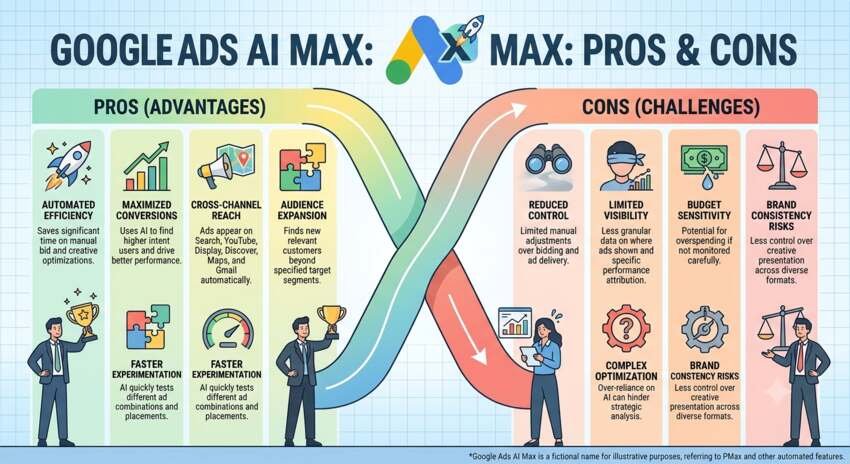
Google Ads AI Max: Pros and Cons at a Glance
The following comparison summarizes the main advantages and limitations businesses should consider before enabling AI Max.
| Area | Pros | Cons |
|---|---|---|
| Search targeting | Finds additional relevant search opportunities | May reach queries that are not commercially valuable |
| Ad copy | Customizes messaging based on search intent | Generated text may need review and correction |
| Landing pages | Can direct visitors to more relevant website pages | May choose a page that does not suit the campaign’s business objective |
| Efficiency | Automates parts of targeting and creative optimization | Still requires active management |
| Growth | Can uncover demand outside the existing keyword list | Additional reach does not guarantee more qualified leads |
| Reporting | Offers insights into search terms, assets, and URLs | Advertisers must interpret reports and act on them |
| Brand management | Provides available brand and URL controls | Some traditional controls may behave differently under automation |
| Conversion performance | May improve conversions or conversion value at a similar CPA or ROAS | Performance varies, and the learning process may affect short-term results |
The main trade-off is straightforward: AI Max gives Google more flexibility to optimize your Search campaign, while the advertiser remains responsible for business strategy, measurement, and quality control.
What Are the Cons and Risks of Google Ads AI Max?
Although automation can create new opportunities, it also introduces risks that should be considered before activating it across an entire account.
1. Less predictable keyword targeting
With traditional keyword targeting, advertisers can build campaigns around carefully researched search terms and match types. AI Max can expand beyond those manually selected keywords. This may uncover valuable searches, but it can also introduce queries that are only loosely connected to the business.
For example, a company selling new commercial machinery might want to avoid traffic from people searching for second-hand equipment, free machinery, or equipment repair services. If the system reaches these searches, the campaign may spend money on visitors who are unlikely to become customers. How to manage the risk:
Review the Search Terms report regularly.
Add negative keywords for clearly irrelevant searches.
Monitor the quality of leads generated from expanded targeting.
Use available campaign and ad group controls to guide search-term matching.
Evaluate conversions and qualified leads, not clicks alone.
2. AI-generated ad copy may need human review
AI-generated headlines and descriptions can help make advertisements more relevant. However, generated copy may not always reflect your brand’s exact tone, offer conditions, or service limitations.
For example, a healthcare provider might offer consultations for a specific treatment. An automatically generated headline could unintentionally imply a broader treatment offering than the clinic actually provides.
A similar problem can arise with finance, legal services, insurance, and other industries where wording and claims require particular care. How to manage the risk:
Review the assets that AI Max generates. Check factual accuracy, brand voice, pricing, guarantees, promotional terms, and applicable advertising policies. Where precise wording is essential, use the available controls and consider disabling text customization if it does not meet your requirements.
3. Final URL expansion may send users to the wrong page
Final URL expansion can improve relevance, but it is not appropriate for every website or campaign. Suppose a B2B software company runs a campaign specifically for enterprise CRM implementation. Its website also includes blog posts, support documentation, free tools, and small-business product pages.
If the wrong destination is selected, visitors may land on an informational article or a page intended for a different customer segment rather than the enterprise sales page. This can create a mismatch between the advertisement, the user’s expectations, and the desired conversion. How to manage the risk:
Keep service and product pages clearly organized.
Exclude irrelevant URLs, such as support pages or careers pages, where appropriate.
Use URL inclusions or other available controls when only selected destinations should be eligible.
Check the actual landing pages receiving paid traffic.
Disable Final URL expansion when strict destination control is more important than automated page selection.
Google documents URL exclusions and other destination controls for managing Final URL expansion. It also notes that pinned responsive search ad assets may not be respected when expansion selects a different URL.
4. More traffic does not necessarily mean more sales
One of the most common mistakes in paid advertising is treating increased traffic as proof of campaign success. A campaign might receive 25% more clicks after enabling broader targeting, but if most additional visitors are not potential buyers, the business may see little improvement in revenue. Consider this hypothetical example:
| Metric | Before AI Max | After AI Max |
|---|---|---|
| Clicks | 1,000 | 1,250 |
| Conversions | 50 | 55 |
| Conversion rate | 5% | 4.4% |
| Advertising spend | ₹50,000 | ₹62,500 |
| Cost per conversion | ₹1,000 | ₹1,136.36 |
In this example, clicks increase by 25%, but conversions rise by only 10%. Spending increases by 25%, and cost per conversion rises by approximately 13.6%. The campaign generates more conversions, but at a higher acquisition cost.
Whether that is acceptable depends on the value and profitability of each conversion. This is why AI Max should be judged against business outcomes rather than traffic growth alone.
5. Poor conversion tracking can undermine optimization
AI-powered campaign optimization depends on the quality of the signals it receives. If conversion tracking is inaccurate, incomplete, or focused on the wrong actions, the campaign may optimize toward misleading outcomes.
For example, a B2B company might track form submissions as conversions. However, some submissions may come from job seekers, vendors, students, or people outside its target market. If all submissions are treated as equally valuable, the campaign may prioritize inexpensive but low-quality leads. How to manage the risk:
Audit Google Ads conversion actions before activating AI Max.
Check Google Analytics 4 and Google Tag Manager implementations where applicable.
Avoid counting duplicate form submissions or repeated events as separate valuable conversions.
Import qualified lead or offline sales data when your setup supports it.
Measure cost per qualified lead, sales opportunities, and revenue alongside basic conversion counts.
Accurate measurement helps advertisers distinguish between activity and actual business value.
Google Ads AI Max Best Practices for Better Results
To get value from AI Max, businesses should treat it as a campaign optimization tool rather than a replacement for advertising strategy. The following practices can help you maintain control while testing its potential.
1. Start with a campaign that already has a clear objective
AI Max is generally easier to evaluate when you have a defined conversion goal and a reliable baseline. Before testing it, establish what success means for your business. That could be online purchases, qualified leads, booked appointments, phone calls, or revenue. Avoid enabling additional automation simply because it is available. Start with a business objective that can be measured.
2. Fix conversion tracking before enabling automation
Check whether your Google Ads conversion actions accurately represent meaningful customer activity. For an e-commerce store, purchases and purchase value may be appropriate primary conversion signals.
For a service business, a qualified enquiry or booked consultation may be more valuable than a generic page visit. Where practical, connect CRM or offline conversion data to help measure lead quality and sales outcomes.
3. Improve your website and landing pages
AI Max uses available information from your keywords, advertisements, and website to help determine which searches to target, what messages to show, and which URLs to select. A well-structured website gives the system clearer information about your business. For example, a digital marketing agency could create separate landing pages for:
Google Ads management
SEO services
Meta Ads management
Conversion rate optimization
E-commerce marketing
Each page should explain the service, identify the intended customer, describe the benefits, and provide a clear conversion action. A useful landing page should also have accurate pricing information where applicable, relevant proof points, fast loading times, and a mobile-friendly design.
4. Review search terms and negative keywords
AI Max can identify additional search opportunities, but those opportunities still need human evaluation. Create a regular search-term review process. Look for queries that are irrelevant, too broad, informational when you need transactional intent, or connected to services you do not provide.
For example, a paid agency campaign targeting businesses looking for Google Ads management might exclude searches related to jobs, internships, free courses, or tutorials if those searches do not align with its goals. Negative keywords should be selected carefully. Overly broad exclusions can block valuable searches as well as irrelevant ones.
5. Test AI-generated ad copy
Review the headlines and descriptions produced through text customization. Check that the messaging:
Accurately describes the product or service.
Matches the landing page.
Uses the correct brand name and terminology.
Does not introduce unsupported claims or misleading offers.
Complies with applicable advertising policies.
Pay particular attention to regulated industries, promotional claims, and offers with specific eligibility conditions.
6. Control landing-page selection
Decide whether your campaign should allow Google to select alternative landing pages. If your website contains several relevant service pages, Final URL expansion may help improve the visitor journey.
If your campaign is designed around a single offer, a specific sales funnel, or a tightly controlled landing page, keeping expansion disabled may be more suitable. Check URL exclusions and available URL controls before launching the test.
7. Use an appropriate bidding strategy
Google’s setup documentation states that AI Max features such as search-term matching, Final URL expansion, and text customization require conversion-based Smart Bidding strategies to function effectively. The appropriate bidding strategy depends on your objective and the quality of your conversion data. For example:
Maximize Conversions: May suit lead-generation campaigns focused on generating conversions within a budget.
Target CPA: May suit campaigns with a meaningful conversion history and a defined acquisition-cost goal.
Maximize Conversion Value: May suit e-commerce or other campaigns where conversion values differ.
Target ROAS: May suit advertisers seeking a defined return relative to advertising spend, provided conversion-value tracking is reliable.
These strategies are not interchangeable. Choose based on your business model, conversion signals, and financial targets.
8. Compare results using consistent reporting periods
Do not judge AI Max only by the first few days of activity. Changes in traffic, auction competition, conversion delays, and campaign adjustments can affect short-term results.
Compare the test with a suitable baseline and account for seasonality, budget changes, and other campaign modifications. Review:
Total conversions and conversion value
Cost per conversion
Qualified lead rate
Revenue and ROAS
Search-term relevance
Landing-page performance
Impression and click growth
Lead-to-sale conversion rate
Where possible, avoid changing several major campaign settings simultaneously. This makes it easier to understand which changes may have contributed to the results.
Practical Example: How AI Max Could Work for a Digital Marketing Agency
Imagine a digital marketing agency in Ahmedabad that manages Google Ads campaigns for local and national businesses. The agency currently targets keywords such as “Google Ads agency Ahmedabad,” “PPC management services,” and “Google Ads consultant.” It wants to attract additional clients without increasing spending on irrelevant traffic.
Example AI Max campaign evaluation
Illustrative scenario — not actual campaign performance.
Monthly advertising budget
₹60,000
Baseline conversions
40
Baseline cost per conversion
₹1,500
Test conversions
48
Test cost per conversion
₹1,250
Illustrative outcome: 20% more conversions and 16.7% lower cost per conversion at the same spend.
Here is how the agency could approach the test.
Step 1: Define the target audience. Focus on businesses that need paid advertising services, not people looking for employment or free training.
Step 2: Prepare relevant landing pages. Create dedicated pages for Google Ads management, e-commerce PPC, and lead generation.
Step 3: Enable AI Max selectively. Use the available controls to test expanded search matching and asset optimization, while maintaining appropriate negative keywords and URL exclusions.
Step 4: Evaluate lead quality. Review whether the additional enquiries come from businesses that match the agency’s budget, location, and service requirements.
Step 5: Compare results. Assess cost per qualified lead, consultations booked, new clients acquired, and the revenue generated from those clients.
If AI Max produces more enquiries but fewer qualified prospects, the agency should refine targeting and conversion measurement rather than assuming the campaign has succeeded. The objective is profitable growth, not simply a higher volume of traffic.
Who Should Use Google Ads AI Max?
AI Max is not equally suitable for every business. Your campaign structure, conversion data, website quality, and need for control should influence the decision.
| Business type | Potential suitability | What to consider |
|---|---|---|
| E-commerce stores | High when product and purchase data are reliable | Check product-page relevance and revenue tracking |
| B2B lead generation | Moderate to high | Measure qualified leads and actual sales opportunities |
| Local service businesses | Moderate to high | Monitor geographic relevance and lead quality |
| Large websites with multiple service pages | High when URLs are well organized | Exclude irrelevant pages and review landing-page selection |
| New advertisers without conversion history | Use cautiously | Establish accurate tracking and a clear baseline |
| Highly regulated businesses | Depends on controls and compliance needs | Review generated copy and destination pages carefully |
| Businesses requiring exact keyword and URL control | Potentially limited | Consider disabling individual automation features |
| Businesses with poorly structured websites | Improve the website first | Create clear service pages and accurate content |
These are practical guidelines, not official Google eligibility ratings. The best decision depends on each advertiser’s circumstances.
How to Enable AI Max in Google Ads
According to Google’s setup documentation, AI Max can be activated in a new or existing Search campaign. Google also documents AI Max as enabled by default in its new Search campaign creation flow, so advertisers should review the selected settings rather than assume every campaign is configured identically. For an existing Search campaign, the general process is:
Open your Google Ads account and navigate to the relevant Search campaign.
Open the campaign’s settings and select the AI Max section.
Enable AI Max and review the available search-term matching and asset optimization settings.
Review text customization and Final URL expansion. Remember that Final URL expansion requires text customization to be enabled.
Configure URL exclusions, brand controls, and other available targeting controls where needed.
Confirm conversion tracking, bidding, negative keywords, and landing-page quality before evaluating performance.
Monitor search terms, ad assets, URLs, conversion costs, and lead or sales quality after activation.
The exact settings and options available may vary by campaign and account. Consult Google’s current AI Max setup guide before making changes.
Google Ads AI Max vs. Traditional Search Campaigns vs. Performance Max
It is important to understand that AI Max and Performance Max are not the same thing. AI Max enhances Search campaigns, while Performance Max is a separate campaign type designed to reach customers across Google’s advertising channels.
| Feature | Traditional Search setup | Search with AI Max | Performance Max |
|---|---|---|---|
| Campaign type | Search | Search with AI-powered enhancements | Separate campaign type |
| Core reach | Keyword-based targeting and selected match types | Expanded search matching and intent signals | Multiple Google advertising channels |
| Ad customization | Advertiser-created assets | Advertiser assets plus AI text customization | AI-assisted asset combinations and optimization |
| Landing pages | Usually predefined final URLs | Can use Final URL expansion | Uses campaign-specific URL and asset settings |
| Primary advantage | Familiar targeting and control | More flexibility within Search | Broader cross-channel reach |
| Main consideration | Manual research and optimization workload | Requires oversight of expanded targeting and messaging | Requires cross-channel measurement and asset management |
Which should you choose?
If your business wants to improve an existing Search campaign, AI Max is worth evaluating. If your strategy requires broader reach across Google’s advertising inventory, Performance Max may be relevant.
Traditional Search settings can still be appropriate when precise control over keywords, messages, and landing pages is a priority. These options should be compared against your actual business objectives, not treated as a universal ranking of campaign performance.
Frequently Asked Questions About Google Ads AI Max
1. What is Google Ads AI Max?
Google Ads AI Max is a collection of AI-powered features for Search campaigns. It helps advertisers expand search-term matching, customize ad text, and select potentially more relevant landing pages. It is an optimization layer, not a separate campaign type.
2. Does AI Max improve Google Ads performance?
It can improve performance, but results vary. Google has reported an average 14% increase in conversions or conversion value at a similar CPA or ROAS in its AI Max performance reporting. Individual results depend on campaign setup, conversion tracking, budget, website quality, and market conditions.
3. Is AI Max suitable for small businesses?
Yes, small businesses can consider AI Max if they have a clear advertising objective, accurate conversion tracking, relevant landing pages, and the capacity to monitor results. Smaller budgets make it especially important to control irrelevant traffic and measure qualified leads rather than clicks alone.
4. Does AI Max replace keyword research?
No. AI Max can identify relevant searches beyond your existing keyword list, but keyword research remains important for understanding customer intent, selecting profitable services, identifying negative keywords, and planning landing pages.
5. Can Google AI Max change my ad headlines?
Yes. Text customization can generate additional headlines and descriptions using information from existing ads, website pages, and other campaign inputs. Advertisers should review generated messaging for accuracy, brand consistency, and compliance.
6. Can AI Max send visitors to different landing pages?
Yes. When Final URL expansion is enabled, Google may direct visitors to a different relevant page on your website. Advertisers can use URL exclusions and other available controls to restrict destinations. Final URL expansion can also be disabled.
7. Does AI Max increase advertising costs?
Not automatically. Actual spending depends on your budget settings, bidding strategy, auction competition, and campaign delivery. However, expanded targeting can lead to higher costs if additional traffic does not convert efficiently. Monitor CPA, conversion value, and qualified lead costs.
8. How long should a business test AI Max?
There is no universal testing period that guarantees a reliable conclusion. Allow enough time to collect meaningful conversion data and account for sales cycles, conversion delays, and normal fluctuations. Low-volume campaigns may need longer observation periods than high-volume campaigns.
9. Is AI Max better than Performance Max?
Neither is universally better. AI Max enhances Search campaigns, while Performance Max is designed to reach customers across multiple Google advertising channels. The right choice depends on your objectives, desired reach, conversion data, and need for control.
10. Should every business enable AI Max?
No. Businesses should evaluate whether the additional automation fits their goals and operational requirements. Companies with reliable conversion tracking, relevant website pages, and a willingness to monitor search-term quality may be better positioned to benefit than advertisers who need strict control over every targeting and messaging decision.
Final Thoughts: Is Google Ads AI Max Worth Trying?
Google Ads AI Max represents a shift toward more flexible, AI-driven Search advertising. It can help businesses discover new customer searches, adapt ad messaging, and send visitors to relevant website pages without requiring advertisers to manage every variation manually.
However, automation does not guarantee profitability. Expanded reach can introduce irrelevant searches, automatically generated text needs oversight, and landing-page selection must align with the intended customer journey.
The best approach is to test AI Max against clearly defined business goals, maintain accurate conversion tracking, and evaluate performance using qualified leads, sales, CPA, and ROAS. For businesses with a strong website and a well-managed Google Ads account, AI Max may uncover valuable opportunities.
For businesses that rely on strict keyword control or operate in highly regulated markets, a more selective approach may be appropriate. Ultimately, AI Max should support your marketing strategy, not replace it.


