The way people search for products, services, and businesses online is changing rapidly. Earlier, customers mostly relied on Google search results, clicked on websites, compared different businesses, and then made purchasing decisions. Today, many users are asking questions directly to AI-powered platforms such as ChatGPT, Google AI Overviews, Google AI Mode, Gemini, and Perplexity.
Instead of searching for “best digital marketing agency in Ahmedabad”, a potential customer might ask, “Which digital marketing agency in Ahmedabad is suitable for a small business with a limited marketing budget?”
AI-powered search tools can provide direct answers, summarize information, compare service providers, and recommend relevant businesses. This shift creates a new opportunity for small businesses in India to reach customers through Answer Engine Optimization (AEO) and Generative Engine Optimization (GEO).
For Indian small businesses, including local retailers, healthcare clinics, professional service providers, manufacturers, educational institutions, and digital agencies, appearing in AI-generated answers can improve online visibility and build brand credibility.
However, getting mentioned by AI platforms is not simply about adding AI-related keywords to website content. Businesses need useful information, trustworthy sources, clear website structure, relevant local signals, and consistent brand information across the internet.
This guide explains the best practices for AEO and GEO, their features, benefits, differences, practical implementation strategies, and examples that small businesses in India can use to improve their visibility in AI-powered search experiences.
1. Understanding AEO and GEO in Digital Marketing
Before implementing an optimization strategy, small businesses should understand what AEO and GEO mean and how they influence online visibility.
What is Answer Engine Optimization (AEO)?
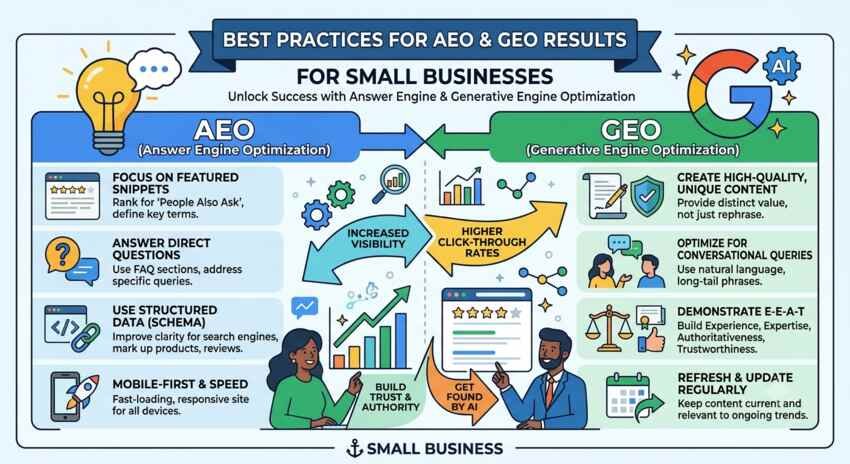
Answer Engine Optimization (AEO) is the process of improving website content so that search engines and AI-powered platforms can easily understand, extract, and present it as a direct answer to users’ questions. AEO focuses on answering specific questions clearly and accurately. It helps businesses improve their chances of appearing in:
Google’s Featured Snippets.
Google’s People Also Ask results.
Google AI Overviews and AI Mode.
Voice search answers.
AI-powered search experiences.
Direct answers on conversational search platforms.
Example: A dental clinic in Ahmedabad can create a page answering “How much does teeth whitening cost in Ahmedabad?” The page should explain the treatment, approximate pricing factors, procedure, benefits, and consultation process. If the information is relevant, trustworthy, and accessible, search systems may use it when answering related queries.
What is Generative Engine Optimization (GEO)?
Generative Engine Optimization (GEO) focuses on improving a brand’s visibility in AI-generated responses across platforms such as ChatGPT, Gemini, Perplexity, and other generative AI tools.
Unlike traditional search engines that primarily display a list of web pages, generative engines synthesize information from different sources and produce conversational answers. GEO helps businesses increase their chances of being:
Mentioned in AI-generated answers.
Cited as an information source.
Recommended when users compare products or services.
Included in industry-related discussions.
Recognized as a credible brand within a particular market.
Example: A user asks ChatGPT, “Which digital marketing agencies in Ahmedabad help small businesses generate leads through Google Ads?”
An agency with relevant service pages, useful case studies, credible reviews, consistent business information, and strong industry mentions may have a better opportunity to be considered in relevant AI-generated responses. However, no GEO strategy can guarantee that an AI platform will mention or recommend a particular business.
Why Are AEO and GEO Important for Indian Small Businesses?
India’s digital market is expanding, and customers increasingly use online platforms to research businesses before purchasing products or services. According to DataReportal’s Digital 2025 report, India had approximately 806 million internet users at the beginning of 2025, representing 55.3% of the population. This creates a substantial online audience for businesses across urban and regional markets.
Google also reported in August 2026 that AI Overviews had more than 2.5 billion monthly active users globally, while AI Mode had surpassed one billion monthly users. These figures demonstrate the growing importance of AI-powered search experiences. For small businesses, this shift creates several opportunities:
More discovery opportunities: Businesses can become visible when customers ask detailed questions rather than searching only for generic keywords.
Improved brand credibility: Being cited by an AI platform can introduce a business as a potential source of useful information.
Better-qualified enquiries: Specific answers can attract customers who already understand their requirements.
Local market visibility: Businesses can target city-specific and service-specific questions.
Long-term digital presence: High-quality content can support organic search, AI discovery, and customer education simultaneously.
2. AEO vs GEO vs Traditional SEO: Understanding the Differences
SEO, AEO, and GEO are closely connected, but each has a different primary focus. Small businesses should understand these differences before allocating their digital marketing budgets.
| Comparison factor | Traditional SEO | AEO | GEO |
|---|---|---|---|
| Full form | Search Engine Optimization | Answer Engine Optimization | Generative Engine Optimization |
| Primary objective | Improve search rankings | Provide direct answers | Improve visibility in AI-generated responses |
| Main platforms | Google, Bing | Featured Snippets, AI Overviews, voice search | ChatGPT, Gemini, Perplexity, AI-powered search |
| Content approach | Keyword-focused and informative | Question-based and answer-focused | Contextual, comprehensive, and evidence-based |
| Important signals | Relevance, links, technical SEO | Answer clarity, relevance, structured content | Brand credibility, useful information, source references |
| Main outcome | Organic rankings and website traffic | Answer visibility | Brand mentions and AI citations |
| Measurement | Rankings, clicks, impressions | Answer appearances and relevant search visibility | AI mentions, citations, referral visits |
Which strategy should small businesses prioritize?
The best approach is not to choose one strategy over another. Instead, businesses should build a combined SEO, AEO, and GEO strategy.
Traditional SEO helps search engines discover and index website content. AEO makes information easier to understand and use as an answer. GEO expands the focus to brand visibility and citations across generative AI platforms.
Google’s guidance also confirms that traditional SEO fundamentals remain important for its generative AI search experiences. It does not require a separate set of AI-specific ranking tricks or special schema markup to appear in AI Overviews or AI Mode.
3. Best Practices for AEO & GEO Results for Small Businesses in India
Implementing AEO and GEO does not require a huge marketing budget. Small businesses can start with their existing websites, improve content quality, strengthen local visibility, and build a consistent online reputation. Here are the most important practices to follow.
1. Understand Customer Questions and Search Intent
The first step is understanding what potential customers actually ask before purchasing a product or service. Traditional keyword research often focuses on short phrases such as:
Digital marketing agency Ahmedabad.
Best dentist in Surat.
Accounting services in Mumbai.
Website development company in Pune.
However, conversational AI searches are often more detailed. For example:
Which digital marketing agency in Ahmedabad is suitable for a small business?
How much does SEO cost for a local business in India?
What should I check before hiring a website development company?
Which accounting services does a startup need?
How can a local clinic attract more patients through Google?
Small businesses should identify questions across different stages of the customer journey.
| Customer journey | Example search questions | Content opportunity |
|---|---|---|
| Awareness | What is local SEO and how does it work? | Educational blogs |
| Consideration | Which SEO services does a small business need? | Service guides and comparisons |
| Evaluation | How much do SEO services cost in Ahmedabad? | Pricing guides |
| Decision | Which SEO agency provides monthly reporting? | Service pages and case studies |
| Post-purchase | How can I measure SEO performance? | Tutorials and support content |
How to implement this practice:
Use Google Search Console to identify queries bringing visitors to your website.
Review Google’s People Also Ask questions.
Explore autocomplete suggestions.
Check customer enquiries, WhatsApp messages, and sales conversations.
Use keyword research tools to identify long-tail and question-based searches.
Study relevant questions on Quora, Reddit, and industry forums.
Review the questions customers ask your competitors.
Practical example:
A small solar installation company in Gujarat might identify these questions:
How much does a 5 kW solar system cost in Gujarat?
What government subsidies are available for residential solar?
How many units does a 5 kW solar system generate?
How long does solar panel installation take?
Is rooftop solar worth installing for a small home?
Instead of publishing one generic solar installation page, the company can create useful content addressing each question. This approach helps cover different customer needs while building topical relevance.
2. Create Answer-First, Question-Based Content
One of the most effective AEO practices is answering the user’s main question immediately. Many business websites begin with lengthy introductions, promotional statements, and generic descriptions.
This makes it difficult for visitors to find the information they need. For AEO, provide a direct answer before explaining the topic in detail.
Example:
Question: How much does local SEO cost for a small business in India?
Weak answer:
Local SEO is an important digital marketing activity that helps businesses improve their online presence. It includes different techniques that improve visibility and help companies connect with potential customers.
Better answer:
Local SEO costs for small businesses in India vary depending on the target city, competition, website condition, number of locations, and services required. A basic campaign may focus on Google Business Profile optimization, local keyword targeting, reviews, and location pages, while a competitive campaign may also include technical SEO, content development, and link building.
Businesses should request a customized proposal based on their goals rather than relying on a fixed industry-wide price. The second answer provides useful context immediately. Best practices for answer-first content:
Answer the main question within the opening 40–60 words where practical.
Use descriptive H2 and H3 headings.
Keep paragraphs focused on one topic.
Use bullet points for processes and benefits.
Add tables when comparing multiple options.
Include examples relevant to Indian customers.
Explain technical terms in simple language.
Support factual claims with reliable references.
These practices make content easier for both visitors and search systems to understand.
3. Build Topical Authority Around Your Business
Topical authority means demonstrating consistent knowledge and expertise across a particular subject area. For small businesses, publishing unrelated blogs simply to increase website content is not an effective long-term strategy. Instead, develop content clusters around your main products and services.
Example: A digital marketing agency in Ahmedabad
The agency can create a central service page about SEO services and support it with related content.
| Main topic | Supporting content ideas |
|---|---|
| SEO services | What is SEO and how does it work? |
| Local SEO | Local SEO checklist for Ahmedabad businesses |
| Technical SEO | Technical SEO issues affecting website rankings |
| Ecommerce SEO | Ecommerce SEO strategies for online stores |
| AEO | How small businesses can appear in AI-generated answers |
| GEO | GEO strategies for improving AI brand visibility |
| SEO pricing | How much do SEO services cost in India? |
| SEO results | How long does SEO take to generate leads? |
Connect these articles through relevant internal links. For example, an article about local SEO should link to the agency’s local SEO service page. A pricing guide can link to relevant service pages and case studies. Benefits of topical authority:
Improves website information architecture.
Helps search engines understand business expertise.
Provides additional entry points for organic traffic.
Creates stronger internal linking opportunities.
Helps AI systems discover related information.
Supports customer education throughout the buying journey.
The goal is to become a genuinely useful source within your industry rather than publishing hundreds of similar articles.
4. Optimize Your Google Business Profile for Local AEO and GEO
For Indian businesses that serve customers in specific cities, local visibility is essential. A Google Business Profile helps businesses provide important information such as:
Business name and address.
Contact number.
Website URL.
Business categories.
Working hours.
Products and services.
Customer reviews.
Photographs and updates.
Location and service areas, where applicable.
Example:
Suppose a dental clinic operates in Vastrapur, Ahmedabad. Its Google Business Profile should accurately communicate:
Dental clinic as its primary business category, if appropriate.
Available treatments such as dental implants, teeth cleaning, and orthodontics.
Accurate address and contact details.
Appointment information.
Genuine patient reviews.
Recent photographs of the clinic.
Updated business hours.
A business should also maintain consistent information on its website and other relevant business directories. Local AEO content ideas:
Best dental treatments available in Ahmedabad.
Dental implant treatment process and cost factors.
How to choose a dentist in Vastrapur.
When should you visit a dentist for tooth pain?
What should you expect during a dental consultation?
Important: Never create fake reviews, misleading locations, or inaccurate service information. Business information should reflect actual operations.
5. Develop Detailed and Helpful Service Pages
A service page should do more than describe what your business offers. It should help potential customers understand the service, its value, pricing factors, process, and expected outcomes. Many small business websites have service pages containing only 200–300 words of generic promotional information. Such pages often fail to address important customer questions. A useful service page should cover:
What the service includes.
Who needs the service.
Problems it solves.
Main features and benefits.
Working process.
Pricing factors.
Expected timelines.
Frequently asked questions.
Relevant case studies or examples.
Contact and enquiry options.
Example: Website development company in Surat
Instead of publishing a page that simply says “We provide professional website development services,” explain:
What types of websites do you develop?
Do you build WordPress and ecommerce websites?
How much does website development cost in Surat?
How long does a typical website project take?
Is website maintenance included?
Do you provide mobile-responsive designs?
Can you integrate payment gateways and CRM systems?
This creates a more useful resource for potential customers.
6. Use Structured Data and Schema Markup Correctly
Structured data helps search engines understand specific information about a webpage or business. It uses a standardized format to describe entities such as organizations, local businesses, products, services, articles, and other content. For small businesses, relevant schema types may include:
| Schema type | Purpose | Suitable business |
|---|---|---|
| Organization | Describes the business entity | Agencies and companies |
| LocalBusiness | Describes a local business | Clinics, retailers, restaurants |
| Service | Describes a service offering | Marketing and professional services |
| Product | Provides product information | Ecommerce businesses |
| Article | Identifies an article or blog post | Business blogs |
| BreadcrumbList | Describes page navigation | Multi-page websites |
| FAQPage | Describes eligible FAQ content | Where applicable under Google’s current policies |
Example:
A local accounting firm can use relevant Organization or LocalBusiness structured data to describe its business name, website, address, and contact details. A service page can also use appropriate Service markup to describe its offering. Best practices:
Use relevant schema types.
Ensure structured data matches visible webpage content.
Avoid adding false ratings or reviews.
Validate markup using Google’s Rich Results Test and Schema Markup Validator.
Keep business information updated.
Avoid adding unnecessary schema just for AI visibility.
One important clarification: Schema markup can help describe content, but it does not guarantee rankings, featured snippets, or AI citations. Google explicitly states that there is no special schema markup required to appear in its generative AI search experiences.
7. Improve E-E-A-T Signals and Brand Credibility
E-E-A-T stands for Experience, Expertise, Authoritativeness, and Trustworthiness. These concepts are particularly important for businesses operating in industries where customers need accurate information before making decisions.
For example, healthcare clinics, financial service providers, legal professionals, and educational institutions should demonstrate genuine expertise and provide reliable information. Ways to strengthen E-E-A-T signals:
Publish detailed About Us information.
Add author names and relevant professional qualifications.
Include real business experience.
Publish original case studies.
Display genuine customer testimonials.
Reference credible research and industry sources.
Keep contact information visible.
Explain the business’s working process.
Update outdated information.
Provide transparent service and pricing details.
Example:
A small accounting firm in Pune can publish an article about GST registration for startups. Instead of providing generic information, the firm can include:
Practical registration steps.
Required documents.
Common application mistakes.
Relevant official government references.
Examples of business situations.
The author’s professional background.
This gives readers more reasons to trust the content.
8. Earn Quality Brand Mentions and Relevant Backlinks
GEO is not limited to website optimization. Your business’s presence across the wider internet can also contribute to its discoverability and credibility. When a business is mentioned by relevant industry websites, publications, business directories, and other trusted sources, it creates additional opportunities for customers and search systems to discover the brand. Practical strategies for small businesses:
Get listed in relevant Indian business directories.
Contribute expert articles to industry publications.
Participate in local business associations.
Collaborate with complementary businesses.
Publish original research or customer case studies.
Share useful insights with local media.
Participate in relevant industry discussions.
Build relationships with suppliers and business partners.
Example:
A digital marketing agency in Ahmedabad could publish an original report about digital marketing challenges faced by local retailers. The agency can share the findings with business communities, local publications, and industry websites.
If the research offers useful information, other publishers may reference the report and mention the agency. This creates genuine brand exposure instead of relying on artificial link-building techniques.
Remember: The quality and relevance of brand mentions matter more than simply increasing the number of mentions. Do not purchase fake citations or create misleading brand recommendations.
9. Publish Original Data, Statistics, and Real Business Examples
AI-generated answers often need information that helps explain a topic, compare options, or support a recommendation. Original research and first-hand business experience can make your website more useful than content that simply repeats information already available online.
Small businesses do not need large research budgets to create original insights. They can use their existing business data, customer feedback, project results, and operational experience. Examples of original content:
| Business type | Original information to publish |
|---|---|
| Digital marketing agency | Lead generation results from an advertising campaign |
| Dental clinic | Patient education about different dental procedures |
| Solar company | Energy generation data from completed installations |
| Accounting firm | Common GST filing mistakes among small businesses |
| Ecommerce store | Product comparison based on actual customer feedback |
| Manufacturer | Product specifications and quality testing information |
| Travel company | Destination comparisons and seasonal travel insights |
For example, a solar installation company in Gujarat could publish a case study showing how a residential 5 kW solar installation performs over a particular period. The case study might include:
Installation location.
System capacity.
Number of panels.
Monthly electricity generation.
Customer electricity consumption.
Actual bill comparisons.
Maintenance requirements.
Use verified project data and clearly explain the measurement period. Original information gives customers a practical reason to visit your website and gives other publishers something valuable to reference.
10. Optimize Content for Conversational and Voice Search
People often interact with AI assistants using natural language instead of typing short keywords. For example:
Traditional search: “Best SEO agency Ahmedabad”
Conversational search: “Can you recommend an SEO agency in Ahmedabad that works with small businesses and provides transparent monthly reporting?” Small businesses should create content that addresses these natural-language queries. Recommended practices:
Use natural question-based headings.
Write answers in conversational English.
Include location-specific information.
Explain complex topics in simple language.
Add practical examples.
Cover follow-up questions.
Provide clear contact and service information.
Indian businesses should also consider regional language requirements. For example, a healthcare clinic in Gujarat may benefit from providing essential patient information in English and Gujarati, depending on its audience.
Similarly, businesses serving customers across India can consider Hindi and other regional languages where there is genuine demand. Avoid translating content word for word without checking local terminology and accuracy.
11. Strengthen Your Website’s Technical SEO Foundation
Even excellent content cannot perform effectively if search engines cannot discover, crawl, or index the website. Technical SEO remains an important foundation for AEO and GEO. Technical optimization checklist:
| Technical factor | Recommended practice |
|---|---|
| Website indexing | Ensure important pages are indexable |
| Robots.txt | Avoid blocking essential content |
| XML sitemap | Submit an updated sitemap |
| Mobile responsiveness | Provide a smooth mobile experience |
| Website speed | Optimize images, scripts, and server response |
| HTTPS | Secure the website with SSL |
| Internal linking | Connect related pages logically |
| Canonical tags | Manage duplicate or similar URLs |
| JavaScript rendering | Ensure important content is accessible |
| Page structure | Use descriptive headings and semantic HTML |
| Image optimization | Add descriptive alt text |
| Broken links | Regularly identify and fix errors |
Small businesses should use Google Search Console to monitor indexing, search performance, and technical issues. Google’s official guidance also recommends ensuring that important content is available in textual form, maintaining internal links, providing a good page experience, and making sure structured data matches visible content.
12. Keep Website Content Accurate and Updated
Outdated information can damage customer trust and reduce the usefulness of a business website. This is particularly important for Indian businesses that publish information about pricing, taxes, government schemes, regulations, products, and services.
For example, a solar company publishing information about government subsidies should regularly verify the latest eligibility conditions and official guidelines. Similarly, an accounting firm should review articles covering GST, income tax, and other regulatory matters. Content maintenance checklist:
Review important service pages every 3–6 months.
Update outdated statistics and references.
Check pricing and service availability.
Replace broken external links.
Refresh business contact information.
Review old FAQs.
Add new examples and customer insights.
Correct inaccurate or misleading information.
Not every page needs a complete rewrite. Sometimes updating a few outdated sections is enough to improve its usefulness.
4. Important Features of a Strong AEO & GEO Strategy
A successful AEO and GEO campaign combines content quality, technical accessibility, business credibility, and consistent brand communication. The following features should be included in a practical strategy.
| Feature | What it involves | Business benefit |
|---|---|---|
| Question-based keyword research | Identifying customer questions | Better search intent coverage |
| Answer-focused content | Providing direct and useful responses | Improved answer visibility opportunities |
| Topical authority | Publishing connected industry content | Stronger subject relevance |
| Local SEO integration | Optimizing location and business information | Better local discovery |
| Schema implementation | Adding relevant structured data | Clearer content understanding |
| E-E-A-T development | Demonstrating real experience and expertise | Greater customer confidence |
| Brand mention building | Earning relevant online references | Wider brand discovery |
| Original research | Sharing verified data and case studies | More distinctive content |
| Technical SEO | Improving crawlability and indexing | Better content accessibility |
| Content updates | Maintaining accurate information | Long-term content usefulness |
| AI visibility monitoring | Tracking mentions and citations | Better strategy evaluation |
5. Benefits of AEO & GEO for Small Businesses in India
AEO and GEO can support business growth in several ways when implemented alongside a strong digital marketing strategy.
1. Increased Online Brand Visibility
Traditional SEO focuses heavily on website rankings, while AEO and GEO expand the opportunity to appear within direct answers and AI-generated recommendations. For example, a user researching website development services in Vadodara may discover a local company through an AI-generated answer even before visiting its website.
2. Better Quality Leads
Answer-focused content helps customers understand services before contacting a business. For example, a website development company can explain its pricing factors, development process, technology options, and delivery timelines. Customers who understand these details may submit more relevant enquiries.
3. Improved Brand Trust
When a business consistently publishes useful information, original examples, and accurate service details, it can strengthen its reputation. Relevant third-party mentions, genuine reviews, and professional credentials further support brand credibility.
4. Greater Local Market Reach
Small businesses often depend on customers from a particular city or geographical area. Combining local SEO with AEO and GEO helps businesses target searches such as:
Best physiotherapist in Ahmedabad.
Affordable interior designer in Surat.
CA for startup registration in Pune.
Solar panel installation company in Rajkot.
This can help businesses communicate their services to more relevant local audiences.
5. Better Customer Education
AEO and GEO encourage businesses to answer questions before customers make purchasing decisions. An ecommerce company, for example, can publish product comparisons, buying guides, usage instructions, and maintenance information. This reduces uncertainty and helps customers make informed decisions.
6. Multiple Digital Discovery Opportunities
Businesses can use the same high-quality information across different digital channels. A well-researched article can support:
Organic Google search visibility.
AI-powered search discovery.
Social media distribution.
Email newsletters.
Customer education.
Sales conversations.
This makes content marketing more valuable over time.
7. Long-Term Digital Marketing Value
Paid advertising generally stops generating new paid impressions when campaigns are paused. Useful organic content can continue attracting visitors as long as it remains relevant, accessible, and discoverable.
However, AEO and GEO are not free or guaranteed traffic channels. They require consistent research, content development, technical maintenance, and performance monitoring.
6. Industry-Specific AEO & GEO Strategies for Indian Small Businesses
Different industries attract different types of customers. Therefore, small businesses should customize their AEO and GEO strategies according to their products, services, locations, and customer requirements.
A. Healthcare Clinics and Doctors
Healthcare customers often search for symptoms, treatments, consultation costs, and specialist information. Content ideas:
When should you consult a dermatologist?
What happens during a dental implant procedure?
How much does IVF treatment cost in Ahmedabad?
What are the benefits of regular health checkups?
How do you choose the right physiotherapist?
Recommended practices:
Publish medically reviewed information.
Display genuine doctor qualifications.
Provide accurate clinic details.
Use appropriate healthcare-related structured data.
Include appointment information.
Reference reliable medical sources.
Avoid unsupported treatment or recovery claims.
Healthcare content should be reviewed by qualified professionals and should never replace personalized medical advice.
B. Ecommerce and Retail Businesses
Ecommerce customers frequently compare products before purchasing. Content ideas:
Which product is suitable for beginners?
What is the difference between two product models?
How do you choose the right product size?
Which features should you check before buying?
How should you maintain a particular product?
Recommended practices:
Create detailed product descriptions.
Include accurate specifications.
Publish comparison guides.
Add genuine customer reviews.
Use appropriate Product structured data.
Maintain consistent product information.
Keep prices and availability updated.
C. Accounting and Financial Service Providers
Accounting firms can build visibility by publishing helpful educational content for individuals, startups, and businesses. Content ideas:
How does GST registration work in India?
What documents are required for company registration?
When should a small business hire an accountant?
What is the difference between bookkeeping and accounting?
How can startups maintain proper financial records?
Recommended practices:
Publish professionally reviewed tax information.
Include relevant government references.
Explain processes step by step.
Provide location-specific service pages.
Display professional qualifications.
Update content whenever regulations change.
D. Digital Marketing Agencies
Digital marketing agencies can use AEO and GEO to demonstrate expertise and attract potential clients. Content ideas:
How much does SEO cost for small businesses in India?
What is the difference between SEO and GEO?
How can local businesses generate leads through Google Ads?
What is the role of AI Overviews in digital marketing?
How can businesses improve their AI search visibility?
Recommended practices:
Publish detailed service pages.
Share genuine campaign case studies.
Include verified performance metrics.
Explain marketing processes.
Publish original industry research.
Build relevant industry citations.
Create location-specific content.
E. Manufacturing and B2B Companies
B2B customers usually need detailed product and technical information before contacting suppliers. Content ideas:
How do you select the right industrial equipment?
What specifications should buyers check?
What is the difference between two manufacturing processes?
How do you evaluate a reliable industrial supplier?
What factors affect bulk product pricing?
Recommended practices:
Publish detailed product specifications.
Include technical documentation.
Add manufacturing capabilities.
Share quality certifications where valid.
Publish industry-specific case studies.
Provide clear enquiry and quotation options.
7. AEO & GEO Content Strategy: Practical Examples
To understand how these strategies work together, consider a small business offering digital marketing services in Ahmedabad. Suppose the company wants to attract startup founders, local retailers, healthcare businesses, and ecommerce companies. Instead of publishing generic articles, it can create content around specific customer questions.
| Customer question | Recommended content format | Primary objective |
|---|---|---|
| What is AEO? | Educational blog | Awareness |
| How does GEO work? | Detailed guide | Education |
| How much does SEO cost in India? | Pricing article | Consideration |
| Which agency provides local SEO in Ahmedabad? | Local service page | Local discovery |
| How can Google Ads generate leads? | Service guide and case study | Lead generation |
| What is the difference between SEO and AEO? | Comparison article | Evaluation |
| How do I measure AI search visibility? | Practical tutorial | Education |
Example: Turning One Question into an AEO-Optimized Article
Target question: How can small businesses improve visibility in Google AI Overviews? Recommended content structure:
Direct answer in the introduction.
Explanation of Google AI Overviews.
Importance of SEO fundamentals.
Content optimization practices.
Technical SEO checklist.
Examples for Indian businesses.
Common mistakes.
Frequently asked questions.
This structure covers the main question while answering related queries.
Example: Building GEO Visibility Through Original Content
Suppose an Ahmedabad-based digital marketing agency publishes a report titled “Digital Marketing Challenges Faced by Small Businesses in Gujarat.” The report includes:
Survey responses from 100 local business owners.
Common advertising challenges.
Website and SEO adoption trends.
Lead generation difficulties.
Marketing budget considerations.
Practical recommendations.
The agency can then distribute the report through its website, social media channels, relevant industry communities, and business publications. If the report provides original and useful findings, other websites may reference it. This approach can help establish the agency as a recognizable source within its industry.
8. Common AEO & GEO Mistakes Small Businesses Should Avoid
Many businesses start optimizing for AI search without understanding how search engines and generative platforms evaluate information. Avoid the following mistakes.
| Common mistake | Why it is problematic | Better approach |
|---|---|---|
| Publishing AI-generated articles without editing | Content may contain errors and generic information | Add expert review and original insights |
| Keyword stuffing | Reduces readability and content quality | Use natural language and relevant terms |
| Creating unnecessary FAQs | Adds repetitive and low-value content | Answer genuine customer questions |
| Adding irrelevant schema | Creates misleading structured data | Use only applicable schema types |
| Buying AI citations | Artificial mentions may damage credibility | Earn genuine industry references |
| Ignoring local SEO | Weakens local business discovery | Maintain accurate business profiles |
| Publishing duplicate city pages | Creates repetitive content | Add unique local information |
| Making unsupported claims | Reduces customer trust | Include reliable evidence |
| Ignoring technical SEO | Prevents effective crawling and indexing | Maintain a technically accessible website |
| Focusing only on AI mentions | Ignores leads, sales, and customer value | Measure business outcomes |
A common misconception: Some SEO providers claim that adding a special AI file, using a fixed number of words per paragraph, or inserting a particular schema type guarantees AI citations.
These claims should be treated carefully. Google’s 2026 generative AI guidance specifically advises businesses to prioritize unique, helpful content and established SEO practices rather than relying on unnecessary AI-specific optimization tricks.
9. How to Measure AEO & GEO Performance
AEO and GEO campaigns need consistent monitoring. However, businesses should not measure success only by the number of AI-generated mentions. The real objective is to improve brand discovery, attract relevant visitors, generate enquiries, and contribute to revenue.
Important AEO Metrics
| Metric | What it measures |
|---|---|
| Featured Snippet visibility | Whether important pages appear in featured answers |
| Search impressions | How often pages appear in Google Search |
| Search clicks | Visits generated through search results |
| Question-based queries | Performance for question-oriented keywords |
| Organic CTR | Percentage of impressions resulting in clicks |
| AI-related search visibility | Visibility in supported AI search reporting |
Important GEO Metrics
| Metric | What it measures |
|---|---|
| AI brand mentions | How frequently your brand appears in AI answers |
| AI citation frequency | How often your website is referenced as a source |
| Citation share | Your citations compared with a defined competitor set |
| Brand recommendation rate | How often your brand appears in relevant recommendation queries |
| AI referral traffic | Visitors arriving from identifiable AI platforms |
| AI-generated leads | Enquiries attributed to AI referral sources |
| Assisted conversions | Conversions influenced by AI discovery |
How to Calculate AI Share of Voice
AI Share of Voice measures your brand’s share of total tracked brand mentions across a defined set of AI responses and competitors. Formula:
AI Share of Voice = (Your Brand Mentions ÷ Total Tracked Brand Mentions) × 100
Example:
Suppose a digital marketing agency tracks 100 relevant AI-generated brand mentions across selected queries.
Agency A: 35 mentions.
Agency B: 30 mentions.
Agency C: 20 mentions.
Agency D: 15 mentions.
Agency A’s AI Share of Voice is:
(35 ÷ 100) × 100 = 35%
This is an illustrative example, not an industry benchmark.
Businesses should use consistent query sets, platforms, locations, and reporting periods when calculating this metric. Mention share does not automatically translate into traffic, leads, or sales.
Recommended Tools for Monitoring AEO and GEO
| Tool | Main use |
|---|---|
| Google Search Console | Search impressions, clicks, and indexing |
| Google Analytics 4 | Website traffic and conversions |
| Google Business Profile | Local visibility and customer interactions |
| Google Rich Results Test | Structured data validation |
| Schema Markup Validator | Schema testing |
| Semrush | Keyword research and competitor analysis |
| Ahrefs | Backlink and organic search analysis |
| Brand24 | Brand mention monitoring |
| Manual AI prompt testing | Checking brand mentions and citations |
| AI visibility platforms | Tracking AI citations and brand presence |
Small businesses can begin with Google Search Console, GA4, Business Profile insights, and a simple spreadsheet for manual AI visibility tracking. Not every AI platform provides complete referral or citation data. Therefore, combine available analytics with repeatable manual testing.
10. A 90-Day AEO & GEO Implementation Plan for Small Businesses
Small businesses do not need to optimize every page or publish dozens of articles immediately. A structured 90-day implementation plan can help them build a strong foundation and gradually improve AI search visibility.
Phase 1: Days 1–30 – Research and Website Optimization
Primary objective: Build the foundation for AEO and GEO. Activities:
Conduct a complete website SEO audit.
Identify important products and services.
Research 30–50 customer questions.
Analyze competitor websites and AI visibility.
Optimize important service pages.
Update Google Business Profile.
Fix technical SEO issues.
Review website indexing and crawlability.
Implement relevant structured data.
Expected deliverables:
Website audit report.
Customer question and keyword list.
Competitor analysis.
Optimized business information.
Technical SEO improvement plan.
Phase 2: Days 31–60 – Content Development and Brand Authority
Primary objective: Publish useful information and establish subject expertise. Activities:
Publish 4–6 detailed educational articles.
Optimize 3–5 important service pages.
Create question-based FAQ sections.
Develop relevant comparison guides.
Add original business examples.
Publish one detailed case study.
Build relevant industry citations.
Strengthen internal linking.
Update author and business information.
Expected deliverables:
New AEO-focused content.
Improved service pages.
Original case study.
Updated internal linking structure.
Relevant third-party brand mentions.
Phase 3: Days 61–90 – GEO Monitoring and Performance Improvement
Primary objective: Evaluate results and identify opportunities for improvement. Activities:
Track selected AI search queries.
Test brand visibility across AI platforms.
Monitor website impressions and clicks.
Analyze AI referral traffic.
Review competitor brand mentions.
Update underperforming content.
Improve pages based on customer questions.
Identify additional content opportunities.
Evaluate enquiries and conversions.
Expected deliverables:
AEO and GEO performance report.
AI visibility comparison.
Updated content calendar.
Lead generation analysis.
Next-quarter optimization roadmap.
90-Day AEO & GEO Activity Comparison
| Activity | First 30 days | Days 31–60 | Days 61–90 |
|---|---|---|---|
| Technical SEO | High priority | Review | Monitor |
| Question research | High priority | Expand | Refine |
| Service page optimization | Start | Complete priority pages | Improve |
| Blog publishing | Plan | Publish | Update |
| Case studies | Identify | Publish | Expand |
| Brand mentions | Research | Build | Monitor |
| AI visibility tracking | Establish baseline | Test | Evaluate |
| Performance reporting | Baseline | Interim | Full review |
Important: This is an implementation schedule, not a guaranteed results timeline. AI citations, search rankings, and leads depend on competition, content quality, indexing, platform behaviour, and other factors.
11. How Much Does AEO & GEO Cost for Small Businesses in India?
The cost of AEO and GEO services depends on website size, industry competition, the number of locations, content requirements, and the amount of ongoing optimization. A small local business may need only a few optimized service pages and educational articles, while an ecommerce company or national service provider may require a much larger content and technical SEO strategy.
The following is an illustrative planning budget, not a verified industry-wide pricing benchmark.
| Service category | Indicative monthly budget |
|---|---|
| Basic AEO content optimization | ₹8,000–₹15,000 |
| Local SEO and AEO | ₹12,000–₹25,000 |
| GEO and brand visibility activities | ₹15,000–₹30,000 |
| Combined SEO, AEO and GEO | ₹20,000–₹50,000 |
| Advanced multi-location or ecommerce strategy | ₹50,000+ |
Factors That Influence AEO & GEO Costs
Website size: Larger websites require more content auditing and technical optimization.
Industry competition: Competitive sectors require stronger content and brand authority.
Content requirements: Expert-reviewed content and original research require additional resources.
Location targeting: Businesses targeting multiple Indian cities need more extensive local optimization.
Technical requirements: Website development, schema implementation, and technical improvements can increase costs.
Reporting and monitoring: Regular AI visibility testing and performance analysis require ongoing effort.
For small businesses, starting with a focused strategy is generally more practical than investing in every available optimization activity.
12. Future of AEO and GEO for Small Businesses in India
AI-powered search is changing how customers discover brands, research products, and evaluate service providers. In the coming years, businesses may need to optimize not only for traditional search queries but also for conversational recommendations, AI-generated comparisons, voice-based discovery, and agent-assisted purchasing experiences. Several developments are worth watching.
1. Growth of Conversational Search
Customers are increasingly able to ask detailed questions instead of entering multiple short search queries. Businesses should create content that answers complete questions and related follow-ups.
2. Greater Importance of Brand Reputation
AI search experiences can draw on information from multiple sources. Therefore, a business should maintain a consistent identity across its website, business profiles, industry directories, and other relevant platforms.
3. Increased Demand for Original Information
Generic content is easy to reproduce. Original case studies, practical experience, product comparisons, expert opinions, and verified data can help businesses differentiate themselves.
4. More Opportunities for Local Businesses
Local companies can create useful city-specific content addressing customer requirements, service availability, pricing factors, and local industry conditions. A small business does not necessarily need a national marketing budget to become a useful source of information within its local market.
5. Integration of SEO, AEO, and GEO
The future of search optimization is likely to involve an integrated strategy rather than three completely separate marketing activities. Businesses should focus on:
Technical SEO.
Helpful and original content.
Local search optimization.
Brand authority.
Customer experience.
AI visibility monitoring.
Conversion optimization.
Companies that build these foundations can adapt more effectively as search experiences evolve.
13. Frequently Asked Questions About AEO & GEO for Small Businesses
1. What is the difference between AEO and GEO?
AEO (Answer Engine Optimization) focuses on making website content suitable for direct answers in search engines and answer-based platforms. GEO (Generative Engine Optimization) focuses on improving brand visibility, mentions, and citations in AI-generated responses from platforms such as ChatGPT, Gemini, and Perplexity. Both strategies rely on useful content, website accessibility, and brand credibility.
2. Why are AEO and GEO important for small businesses in India?
AEO and GEO help small businesses improve their opportunities to appear in AI-powered search experiences. They can support brand discovery, customer education, local visibility, and lead generation. These strategies are particularly useful for businesses targeting specific cities, industries, and customer groups.
3. How can a small business appear in Google AI Overviews?
Start by following established SEO practices. Create helpful, original content, answer relevant customer questions, maintain technical accessibility, build relevant internal links, and ensure important pages are indexed. Google does not guarantee AI Overview appearances, and there is no special schema markup required specifically for inclusion.
4. Does GEO replace traditional SEO?
No. GEO does not replace traditional SEO. Search engine optimization remains an important foundation for website discovery, indexing, and online visibility. AEO and GEO extend the strategy by focusing on direct answers, AI-generated recommendations, brand mentions, and citations.
5. How long does it take to see AEO and GEO results?
There is no fixed timeline for AEO and GEO results. Technical improvements and content updates may be completed within a few weeks, but improvements in search visibility, AI citations, and brand recognition can take several months or longer. Results depend on competition, website authority, content quality, and platform behaviour.
6. Which AI platforms should small businesses target for GEO?
Small businesses can monitor ChatGPT, Google AI Overviews, Google AI Mode, Gemini, and Perplexity. However, they should prioritize platforms relevant to their customers rather than attempting to optimize for every AI platform simultaneously.
7. Does FAQ content help with AEO?
Yes, well-written FAQ content can support AEO by addressing genuine customer questions in a clear and organized format. Businesses should provide accurate, concise answers and expand on topics where additional explanation is useful. However, FAQ content does not guarantee featured snippets or AI citations.
8. Is schema markup necessary for GEO?
Schema markup is useful for describing business entities, products, services, and webpage content. However, it is not a mandatory requirement for appearing in generative AI search results. Google confirms that there is no special schema markup required for AI Overviews or AI Mode.
9. Can local businesses benefit from GEO?
Yes. Local businesses can create useful location-specific content, maintain accurate business information, collect genuine reviews, publish detailed service pages, and earn relevant industry mentions. These activities can improve their overall online discoverability and create opportunities for AI-generated recommendations.
10. How can businesses measure GEO performance?
Businesses can measure GEO performance through AI brand mentions, website citations, citation share, AI referral traffic, relevant recommendation appearances, and leads generated through AI discovery. They can combine manual prompt testing with website analytics and available AI visibility tools.
11. Is AI-generated content good for AEO and GEO?
AI can help with research, content outlines, question identification, and drafting. However, publishing large volumes of unedited AI-generated content is not a sustainable optimization strategy. Businesses should add original insights, verify facts, include practical examples, and ensure expert review where necessary.
12. What is the best AEO and GEO strategy for a small business with a limited budget?
Start with the most important service pages, customer questions, Google Business Profile, technical SEO, and a few high-quality educational articles. Build relevant industry mentions and monitor AI visibility regularly. Focus on improvements that can generate qualified enquiries rather than publishing large volumes of content without a clear purpose.
Conclusion
AEO and GEO are becoming important considerations for small businesses that want to improve their online visibility in India’s changing digital environment. As customers increasingly use conversational search and AI-powered platforms to discover products and services, businesses need to make their information more useful, accessible, and trustworthy.
The most effective strategy is not to chase AI search shortcuts. Instead, build a strong SEO foundation, answer real customer questions, publish original content, strengthen local visibility, demonstrate industry expertise, and maintain consistent business information across the internet.
Small businesses in India can begin with simple improvements: optimize existing service pages, publish helpful FAQs, update Google Business Profile, develop relevant case studies, and track AI-generated brand mentions.
Most importantly, measure success through meaningful business outcomes such as qualified enquiries, customer trust, website engagement, and revenue contribution. The long-term opportunity is clear: businesses that consistently provide reliable information and genuine value can create stronger visibility across both traditional search engines and emerging AI-powered discovery platforms.