Meta Ads can help B2B businesses connect with potential clients, introduce their solutions to the right audience, and generate enquiries that lead to real business opportunities. While Facebook and Instagram are often associated with consumer marketing, both platforms can play a useful role in a well-planned B2B marketing strategy.
The key is knowing who you want to reach and what would make them interested in your business. Start by identifying your ideal customers based on their industry, professional roles, business requirements, and common challenges.
Your advertisements should communicate how your product or service can solve a specific problem. Instead of relying on promotional messages alone, use product demonstrations, customer stories, industry insights, and practical resources to give potential buyers a reason to engage with your brand.
It is equally important to experiment with different ad formats, including videos, carousels, image ads, and lead generation campaigns. Track how people respond, test different headlines and calls to action, and use retargeting to reconnect with visitors who have already shown interest.
Most importantly, don’t measure success by the number of clicks or form submissions alone. Look at how many enquiries turn into qualified leads, sales conversations, and actual business opportunities. With the right strategy, consistent optimisation, and proper performance tracking, Meta Ads can become a valuable channel for long-term B2B growth.
Imagine your Meta Ads campaign generates 100 enquiries in a month. At first, the results look promising because the cost per lead is relatively low. But when your sales team starts contacting those prospects, the picture changes. Some are outside your service area, others are looking for employment, and only a few have genuine business requirements.
This is a common challenge for B2B advertisers. Generating an enquiry is relatively straightforward. Finding people who have a genuine requirement, fit your ideal customer profile, and are ready to discuss a purchase is what really matters.
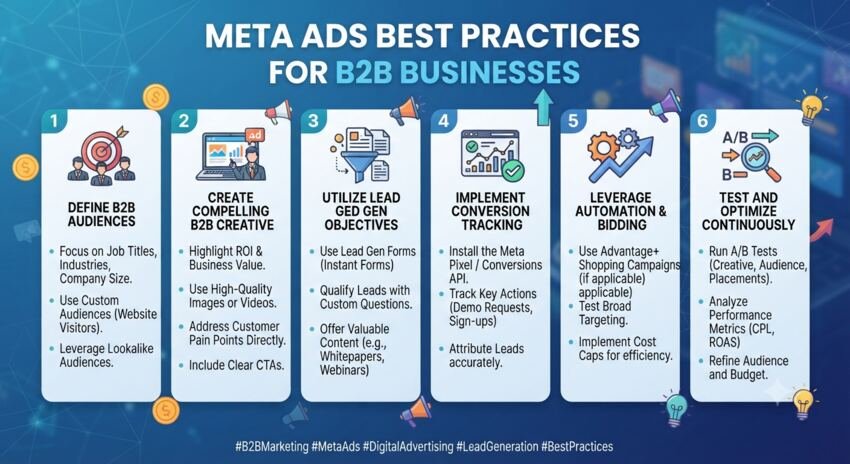
The most effective Meta Ads best practices for B2B businesses come down to three important things: understanding your target audience, giving potential buyers something relevant to engage with, and tracking what happens after they submit an enquiry.
In this guide, we’ll explore how businesses can use Facebook and Instagram advertising more effectively, with practical examples for SaaS companies, manufacturers, and professional service providers.
Why Meta Ads Can Work for B2B Businesses in India
B2B buyers don’t necessarily spend all their time researching products on Google or LinkedIn. They also use Facebook and Instagram to follow industry updates, explore business content, and discover solutions to everyday challenges.
For example, consider a factory manager who comes across an Instagram video explaining how a manufacturing facility reduced recurring compressor downtime. They might not need the service immediately, but the information could become useful during their next maintenance discussion.
When the requirement eventually arises, the manager may remember the company, revisit its website, or share the resource with a colleague. This is where Meta Ads can support the B2B buying journey. They help businesses introduce their solutions before prospects are actively looking for a supplier.
A 2025 study of nearly 4,000 B2B buyers globally, referenced in the original source, reported that buyers first contacted sellers around 61% of the way through their buying journey. The eventual winning supplier was already on the buyer’s initial shortlist in 95% of purchases studied.
These findings highlight why businesses should not wait until someone is ready to request a quotation. Product demonstrations, educational videos, case studies, and practical buying guides can help build familiarity much earlier.
What Do Facebook Lead Ads Cost?
Advertising costs depend on your industry, target audience, competition, campaign objective, and the offer you’re promoting. According to the WordStream 2026 benchmark report, which analysed 452 US-based Facebook lead campaigns running between April 2025 and June 2026, the median cost per lead varied across industries.
| Facebook lead campaign category | Median cost per lead |
|---|---|
| All industries in the sample | $27.39 |
| Industrial & Commercial | $35.87 |
| Education & Instruction | $26.31 |
Source: WordStream Facebook Ads Benchmarks 2026. All figures are in US dollars.
These figures provide a useful reference point, but they shouldn’t be treated as expected costs for Indian B2B campaigns. The sample covers US advertisers with different budgets, audiences, and lead definitions.
For Indian businesses, it’s better to establish advertising targets through initial testing. Monitor how much you’re spending to generate a qualified lead and whether those enquiries eventually turn into sales opportunities.
12 Meta Ads Best Practices for B2B Businesses
Facebook and Instagram advertising can support different stages of the B2B sales journey, from introducing your brand to generating enquiries and staying connected with interested prospects. However, simply launching advertisements isn’t enough. Your campaigns need to reflect your customers’ actual business requirements. Here are 12 practical ways to improve your B2B Meta Ads strategy.
1. Define Your Target Audience Before Launching Campaigns
One of the biggest mistakes businesses make is trying to reach everyone who might be interested in their products or services. A better approach is to understand what your ideal customer looks like before spending money on advertising.
For example, a company selling industrial automation equipment may want to reach manufacturing businesses, plant managers, operations heads, and procurement professionals rather than a general audience interested in technology. Start by identifying the industries you serve, the type of companies you want to work with, and the people involved in purchasing decisions.
Things to consider when defining your audience:
- Build an ideal customer profile (ICP) based on your best existing customers.
- Identify relevant industries, business categories, and professional interests.
- Understand the problems that encourage potential customers to look for your solution.
- Create custom audiences using eligible website visitors and existing customer data.
- Test different audience segments to identify which ones generate relevant enquiries.
The more clearly you understand your potential customers, the easier it becomes to create advertisements that speak to their requirements.
2. Create Ads Around Real Business Problems
B2B buyers are generally looking for practical solutions. They want to reduce operating costs, improve productivity, save time, manage resources more efficiently, or increase revenue. Your advertisements should reflect these priorities instead of relying on broad promotional statements.
For example, a warehouse software company could create an advertisement explaining how its platform helps businesses track inventory across multiple locations. This communicates a specific benefit and gives the right audience a reason to learn more.
Here are a few ways to make your advertisements more relevant:
- Identify common problems your customers experience.
- Explain how your product or service addresses those challenges.
- Use practical examples instead of complicated marketing language.
- Include genuine customer feedback and success stories.
- Write headlines that communicate the value of your solution clearly.
A good B2B advertisement doesn’t need to explain everything about your business. It should make the right person recognise a problem and understand why your solution deserves attention.
3. Select Meta Ad Formats That Match Your Campaign Goals
Not every advertisement needs to look the same. Some formats work better for introducing your business, while others are more suitable for demonstrating products or collecting enquiries. The best approach is to select formats according to your campaign objective and the type of information your audience needs.
Ad formats worth testing include:
- Video ads: Demonstrate how your product works, explain a service, or introduce a business solution.
- Carousel ads: Present multiple products, features, services, or stages of a process.
- Lead generation ads: Collect prospect information through Meta’s lead forms.
- Image ads: Communicate a specific offer or business benefit quickly.
- Reels ads: Use short-form vertical videos to increase visibility and introduce your brand to new audiences.
For instance, an industrial equipment supplier could use a video to demonstrate machinery, followed by a carousel highlighting its different models and applications. Testing multiple formats helps you understand how your audience prefers to engage with your business.
4. Share Useful Content Instead of Only Promoting Your Services
B2B customers rarely make purchasing decisions after seeing a single advertisement. They often spend time researching solutions, comparing suppliers, discussing requirements internally, and evaluating whether a product is worth the investment. This makes educational content an important part of your Meta Ads strategy. Rather than asking every visitor to book a sales call, give them something useful that helps them understand their problem or evaluate available options.
Content ideas for B2B advertising include:
- Industry guides, downloadable ebooks, and practical checklists.
- Case studies explaining how you helped an existing customer.
- Free consultations and product demonstrations.
- Short educational videos explaining technical services.
- Customer reviews, testimonials, and project highlights.
For example, a digital marketing agency could promote a free website performance checklist to business owners. Someone who downloads it may not be ready to hire an agency immediately, but the interaction creates an opportunity to build a relationship. Useful content helps your business remain relevant while potential customers move through their buying journey.
5. Use Retargeting to Reconnect With Interested Prospects
Not every visitor who clicks your advertisement will enquire immediately. Some may explore your website, watch a product video, visit your Facebook page, or compare your services with other providers.
Retargeting gives you an opportunity to reach eligible audiences who have already interacted with your business. For example, someone who visits your industrial equipment page could later see an advertisement featuring a product demonstration or a relevant customer case study.
Some practical retargeting opportunities include:
- Reach people who visited important product or service pages.
- Reconnect with eligible audiences who watched your videos.
- Show relevant content to people who engaged with your social media posts.
- Promote case studies and customer experiences to interested visitors.
- Exclude existing customers and recently converted leads from unsuitable acquisition campaigns.
Keep your retargeting messages connected to the visitor’s previous interaction. Someone who has only watched a short video may need more information, while someone who has visited your pricing page may be closer to requesting a quotation.
6. Build Landing Pages That Encourage Meaningful Enquiries
A successful Meta Ads campaign doesn’t end when someone clicks your advertisement. The landing page plays an equally important role in converting that visitor into an enquiry. If the page is slow, confusing, or unrelated to the advertisement, potential customers may leave without taking action. Your landing page should continue the same conversation that started with the ad.
Improve landing page performance by following these practices:
- Use a clean layout that makes information easy to find.
- Match the headline and offer with the advertisement.
- Explain your product or service benefits clearly.
- Add relevant calls to action such as “Request a Quote” or “Book a Consultation.”
- Make sure the page works properly on mobile devices.
- Include customer testimonials, reviews, certifications, or other relevant trust signals.
For example, an advertisement promoting accounting services should lead visitors to a page explaining those services, the types of businesses supported, and how to request a consultation. Avoid sending every advertisement to your homepage. A focused landing page usually provides a more relevant experience.
7. Set an Advertising Budget You Can Manage
You don’t need to commit a large amount of money before understanding whether Meta Ads can work for your business. Start with a controlled testing budget and use the initial campaign data to identify promising audiences, advertisements, and offers. The amount you invest should depend on your industry, average customer value, sales cycle, and the cost of acquiring a customer.
Budget management tips:
- Decide on a monthly or campaign-level spending limit.
- Begin with a manageable budget to test different creatives and audiences.
- Monitor both cost per lead and cost per qualified lead.
- Increase spending on campaigns that generate genuine sales opportunities.
- Reduce or pause campaigns that repeatedly attract unsuitable enquiries.
For B2B businesses, a campaign generating 20 relevant enquiries can be more valuable than another campaign generating 100 enquiries that rarely convert.
8. Monitor the Metrics That Actually Matter
Regular campaign analysis helps you understand whether your advertising investment is contributing to business growth. While impressions, clicks, and engagement provide useful information, they don’t tell the complete story. You should also understand what happens after someone visits your website or submits a lead form.
Important metrics to monitor include:
- Click-through rate (CTR): Shows how frequently people click after seeing your advertisement.
- Cost per click (CPC): Helps you understand the average cost of generating an ad click.
- Cost per lead (CPL): Measures how much you’re spending to generate an enquiry.
- Landing page conversion rate: Shows how effectively your landing page turns visitors into leads.
- Cost per qualified lead: Measures the cost of acquiring enquiries that meet your business criteria.
- Booked meetings: Helps you understand how many prospects are willing to discuss their requirements.
- Sales opportunities: Shows whether your advertising is contributing to the sales pipeline.
Use Meta Pixel and Conversions API where appropriate to measure website activity and supported conversion events. Connecting your campaign data with your CRM can provide a clearer picture of how advertising enquiries progress through your sales process.
9. Test Different Creatives, Headlines, and Offers
Even a well-designed advertisement may not perform equally well across different audiences. What attracts a SaaS buyer may not interest a manufacturing business owner. Similarly, a product demonstration might generate more meaningful enquiries than a general promotional image. Testing helps you identify these differences.
Consider experimenting with:
- Different headlines and advertising messages.
- Static images compared with short videos.
- Multiple calls to action.
- Product demonstrations versus customer testimonials.
- Educational content versus direct promotional offers.
- Different versions of landing pages and lead forms.
Make sure each test has a clear purpose. Changing too many elements simultaneously can make it difficult to identify what influenced the results. Review performance over a meaningful period and refresh your advertisements when engagement or conversion quality begins to decline.
10. Prioritise Lead Quality Over the Number of Enquiries
For most B2B businesses, generating more leads doesn’t automatically mean generating more revenue. Imagine receiving 150 enquiries, but only 15 match your target customer profile. Another campaign generates 75 enquiries, of which 30 are genuinely relevant. The second campaign may offer better commercial value despite having a higher cost per lead.
Ways to improve lead quality:
- Add relevant qualifying questions to your lead forms.
- Ask about company requirements, business type, and project needs where appropriate.
- Make your service area and ideal customer profile clear in the advertisement.
- Follow up with new enquiries promptly.
- Track how many leads progress to meetings and sales opportunities.
- Review lead quality regularly with your sales team.
- Monitor cost per qualified lead rather than relying only on overall CPL.
Your marketing and sales teams should agree on what makes an enquiry worth pursuing. This ensures both teams are working towards the same business objectives.
11. Choose the Right Advertising Platform for Your Business
Meta Ads can help B2B businesses build awareness, share educational content, and generate enquiries. However, Facebook and Instagram aren’t necessarily the best channels for every campaign. Your platform selection should depend on your audience and the way your customers make purchasing decisions.
Here’s how different platforms can support your marketing strategy:
- Facebook: Useful for promoting business services, industry content, customer stories, and lead generation offers.
- Instagram: Suitable for visual demonstrations, short videos, reels, and brand-building activities.
- LinkedIn: Worth considering when your campaign requires more specific professional or account-based targeting.
- Google Search Ads: Useful for reaching potential customers who are actively searching for particular products or services.
For example, an industrial software company could use Google Ads to reach people searching for inventory management software while using Meta Ads to promote product demonstrations and customer case studies.
Instead of choosing a platform based on popularity, compare channels using qualified enquiries, sales opportunities, and customer acquisition costs.
12. Create a Follow-Up Process for Every Lead
Generating an enquiry is only the beginning of the B2B sales process. Depending on the product or service, potential customers may need several discussions, technical explanations, product demonstrations, or internal approvals before making a decision. Without a proper follow-up process, even relevant enquiries can go unnoticed.
A consistent lead management process should include:
- Contact new enquiries as soon as reasonably possible.
- Understand the prospect’s requirements before recommending a solution.
- Share relevant product details, pricing information, or case studies.
- Schedule consultations and product demonstrations when appropriate.
- Use email marketing to nurture prospects who have given the necessary consent.
- Record lead interactions and progress in your CRM.
- Continue engaging with suitable prospects who aren’t ready to purchase immediately.
A structured follow-up process helps your sales team maintain communication and gives potential customers the information they need to make an informed decision.
Additional Meta Ads Strategies to Improve Your B2B Campaign Performance
Following general advertising best practices is a good starting point. However, B2B campaigns often need a more thoughtful approach because purchasing decisions can involve multiple stakeholders, longer sales cycles, and detailed evaluation. The following strategies can help you improve campaign quality and connect advertising activity more closely with business outcomes.
1. Define What a Qualified Lead Looks Like Before Launching
Before creating advertisements, speak with your sales team about the types of enquiries they actually want to receive. Review five enquiries that resulted in useful sales conversations and compare them with five that weren’t worth pursuing. Look for common differences, including company size, location, industry, application, budget, and expected purchase timeline. For example, an Ahmedabad-based manufacturer selling packaging machinery might consider an enquiry qualified when:
- The prospect operates a manufacturing facility within its service region.
- The business needs machinery that matches the company’s product range.
- The project has a realistic budget.
- The prospect expects to purchase or upgrade within the next six months.
A SaaS company may use different criteria, such as employee count, existing software, the business process the prospect wants to improve, and the expected implementation date. It’s also important to distinguish between a qualified lead and a sales-ready lead.
A business that fits your ideal customer profile but plans to purchase next year may still be valuable. It simply needs a longer nurturing process. On the other hand, an enquiry from outside your service area may not be worth pursuing at all. Record these differences in your CRM so your marketing and sales teams can identify where campaigns need improvement.
2. Give Potential Buyers a Relevant Reason to Respond
Asking everyone to “Book a Demo” or “Contact Us Today” may not be the best approach. A person who has just discovered your brand may not be ready to speak with your sales team. They might first want to understand their options, compare solutions, or learn more about a particular problem. Your advertising offer should match the buyer’s stage in the decision-making process.
| Buyer stage | Offer to test | B2B example | What to measure |
|---|---|---|---|
| Recognising a problem | Checklist, short video, or calculator | Compressor downtime checklist for plant managers | Relevant visits and subsequent engagement |
| Comparing solutions | Buyer’s guide, case study, or webinar | Guide to choosing a barcode system for a multi-location warehouse | Qualified leads and subsequent meetings |
| Ready to discuss | Product demo, technical consultation, or quotation | Site assessment for a packaging-line upgrade | Meetings held, opportunities, and cost per opportunity |
The offer should be specific enough to address a real business requirement.
For example, “Warehouse Manager’s Checklist for Replacing Manual Stock Counts” gives a potential buyer a clearer reason to respond than a generic message such as “Discover Our Innovative Inventory Solutions.”
3. Select the Lead Generation Format That Fits Your Offer
Meta provides different ways for businesses to collect enquiries through its advertising ecosystem. The right format depends on how much information potential customers need before they’re comfortable sharing their details. Here are three options worth considering:
| Format | Features and benefits | Best suited for | Possible limitation |
|---|---|---|---|
| Instant Forms | Forms open within Facebook or Instagram, with some fields prefilled | Webinars, checklists, and straightforward consultation requests | Quick submissions may include people who haven’t fully considered the offer |
| Website Forms | Dedicated landing pages with room for detailed information, product specifications, and scheduling | Technical quotations, enterprise demos, and complex services | Page speed and mobile experience can affect completion rates |
| Click-to-Message Ads | Allow prospects to start conversations and share basic requirements | Pricing questions, service availability, and product compatibility enquiries | Requires someone to manage messages and respond promptly |
Meta has published a case study in which ecommerce software provider ikas reported 3.3 times as many leads and a 39% lower cost per lead using in-app Instant Forms compared with its usual website-directed advertisements.
However, more leads don’t necessarily mean more business opportunities. Your own results will depend on the audience, offer, product, and sales process.
A useful way to compare the formats is to promote the same offer through an Instant Form and a website landing page. Keep the audience and creative as consistent as possible, then compare qualified leads and meetings rather than just submission costs.
4. Combine Audience Targeting With Relevant Ad Creatives
Audience targeting and advertising content should work together. Even if your campaign reaches the right people, a generic advertisement may not give them a reason to respond. Start by identifying the locations and markets your business can serve.
For example, a commercial equipment supplier operating across Gujarat and Maharashtra should make its service footprint clear before expanding its campaigns to other regions. You can then test suitable audience segments, including eligible first-party audiences and lookalike audiences created from qualified leads or customers where available.
Your advertisement should also help the right prospect recognise themselves. Consider this example:
“Barcode Inventory Software for Distributors Managing Stock Across Multiple Warehouses.”
This headline communicates the product, intended customer, and business application in a single message. You can also use retargeting to continue the conversation with people who have already interacted with your business. For example:
- Product page visitors can see a detailed product demonstration.
- Website visitors can receive a relevant customer case study.
- People who have already requested a demo can be excluded from further demo acquisition campaigns where supported.
- Existing customers can be excluded from campaigns focused on acquiring new customers.
Meta’s Advantage+ placements can distribute advertisements across eligible placements within its ecosystem. Prepare creative assets that work in both feed and vertical formats, then evaluate the results using reliable lead and conversion data. Don’t assume that the placement producing the lowest CPL is automatically the best one. The quality of the enquiries matters just as much.
5. Write Advertisements Using the Language Your Customers Actually Use
B2B advertising becomes much more effective when it reflects the questions customers ask during real sales conversations. Think about the concerns your sales team hears repeatedly. For example, a manufacturing company might regularly receive questions about installation downtime, maintenance costs, machine compatibility, and production capacity.
These questions can become useful starting points for advertising creatives. Here are three creative approaches to test:
| Creative angle | What to show | Example advertising hook |
|---|---|---|
| Problem and solution | A familiar business challenge followed by your solution | “Still reconciling inventory across three different spreadsheets?” |
| Product demonstration | A screen recording, equipment walkthrough, or improved workflow | “See how a warehouse supervisor investigates a stock mismatch.” |
| Customer proof | A genuine customer experience with relevant context | “How a regional distributor introduced barcode scanning across three depots.” |
For video advertisements, introduce the product or business problem early. Add captions so viewers can understand the message even when watching without sound.
Carousel advertisements are useful when you need to explain multiple features, compare product options, or show different stages of a service process. If you mention customer results, use verified figures and explain what was measured. Specific and credible information builds more trust than exaggerated marketing claims.
6. Ask the Right Questions to Improve Lead Quality
A shorter form may encourage more people to submit their details, but it doesn’t always provide enough information for your sales team. On the other hand, asking too many questions can discourage genuinely interested prospects. The goal is to collect only the information that helps you qualify, route, or prepare for the enquiry. For example, a packaging machinery supplier might ask:
- Name and business email.
- Company name.
- Type of packaging application.
- Machinery requirement.
- Expected purchase timeline.
A prospect requesting an industrial equipment quotation may need to provide more information than someone registering for a free webinar. You can also improve lead quality by answering common questions before the form is submitted.
If buyers frequently ask about minimum order quantities, service locations, installation timelines, or product compatibility, include that information in your advertisement or landing page. This helps potential customers understand what they’re enquiring about. Finally, assign an owner to every lead, connect submissions to your CRM, and test the entire process before launching the campaign.
7. Connect Meta Ads With Your CRM and Track Sales Outcomes
Your advertising platform can tell you how many leads were generated, but your CRM can show what happened after those enquiries reached your sales team. Connecting these systems helps you understand which campaigns are producing commercially useful leads.
Meta’s lead retrieval integrations can transfer eligible Instant Form submissions into your CRM. Conversions API for CRM can also send supported downstream events, such as qualified lead outcomes, back to Meta.
For supported Instant Form setups, Meta documents the Maximise number of conversion leads performance goal for campaigns using Conversions API for CRM. A practical implementation process looks like this:
- Capture the lead source: Use UTM parameters for website advertisements and retain available Meta lead and campaign identifiers for Instant Form submissions.
- Create consistent CRM stages: Use stages such as New Lead, Qualified Lead, Meeting Held, Opportunity Created, and Closed Won.
- Record disqualification reasons: Identify whether a lead was outside your service area, unsuitable for your product, duplicated, or unreachable.
- Test the complete integration: Submit a test enquiry and confirm that the correct information reaches your CRM.
- Choose meaningful conversion events: Select a CRM stage that generates sufficient and consistent feedback. For businesses with long sales cycles, qualified leads may provide more frequent signals than closed sales.
For website campaigns, configure Meta Pixel and Conversions API where appropriate. If both systems send the same event, check that event deduplication is working correctly. Keep Meta-attributed conversions and CRM-reported sales pipeline data identifiable in your reports. Different attribution systems may assign credit differently, so looking at both provides a more balanced view.
8. Compare Cost Per Qualified Lead Instead of Looking Only at CPL
A low cost per lead can make a campaign appear successful, even when most enquiries are unsuitable. To understand the actual business value of your advertising, compare cost per qualified lead and cost per sales opportunity. Consider an illustrative example of an Indian B2B software company running two campaigns with an advertising budget of ₹60,000 each.
| Metric | Campaign A | Campaign B |
|---|---|---|
| Advertising spend | ₹60,000 | ₹60,000 |
| Total leads | 150 | 75 |
| Cost per lead | ₹400 | ₹800 |
| Qualified leads | 15 | 30 |
| Lead qualification rate | 10% | 40% |
| Cost per qualified lead | ₹4,000 | ₹2,000 |
| Sales opportunities | 3 | 9 |
| Cost per opportunity | ₹20,000 | ₹6,667 |
Campaign A generates twice as many enquiries, and its CPL is lower. However, Campaign B produces twice as many qualified leads and three times as many sales opportunities. Its cost per opportunity is also approximately 67% lower.
This makes Campaign B the stronger candidate for additional investment, assuming both campaigns generate opportunities with comparable deal values and closing potential. For businesses with longer sales cycles, compare leads acquired during similar periods and allow enough time for follow-up.
A recently launched campaign may appear less successful simply because its leads haven’t progressed through the sales pipeline yet. Track closed revenue once deals mature, while keeping open pipeline value separate.
9. Plan Your Advertising Budget Around Customer Acquisition Economics
Your advertising budget should be connected to what your business can realistically afford to spend to acquire a customer. Instead of choosing a daily budget without considering profitability, work backwards from your target customer acquisition cost.
For example, suppose your business can spend ₹40,000 in advertising costs to acquire one new customer. If 10% of qualified leads eventually become customers, you can work out your target cost per qualified lead. If 25% of all enquiries meet your qualification criteria, you can also estimate the maximum raw CPL that fits your target.
| Planning input | Illustrative figure |
|---|---|
| Target media cost per customer | ₹40,000 |
| Qualified lead-to-customer conversion rate | 10% |
| Target cost per qualified lead | ₹4,000 |
| Raw lead qualification rate | 25% |
| Implied target cost per raw lead | ₹1,000 |
These figures are illustrative. Use your own sales history and actual conversion rates wherever possible. Also remember that advertising spend is only one part of total customer acquisition cost. Include relevant sales, agency, software, and creative expenses when calculating the complete CAC.
If you’re working with a limited budget, begin with one priority audience, one relevant offer, and a few clearly different creatives. Once the first campaign produces enough data, introduce additional tests based on what you’ve learned.
10. Identify Where Potential Customers Drop Out of the Sales Funnel
When a campaign isn’t producing the expected results, changing the audience or increasing the budget isn’t always the right solution. Sometimes the problem is the landing page. In other cases, enquiries are relevant, but the sales team isn’t following up quickly enough. Review campaign performance alongside your sales team to identify where prospects are dropping out.
| What you’re noticing | What to investigate | What you can test |
|---|---|---|
| People click advertisements but rarely submit the form | Mobile loading speed, form errors, and consistency between the ad and landing page | Simplify the landing page or test an Instant Form |
| Many leads arrive but few are qualified | Target geography, audience relevance, offer, and disqualification reasons | Make your ideal customer clear and add a qualifying question |
| Qualified leads don’t book meetings | Follow-up speed, contact accuracy, and lead ownership | Assign enquiries immediately and provide a clear booking option |
| Meetings take place but few become opportunities | Project requirements, buying authority, and purchase timeline | Make the demo more relevant to a specific business application |
| Opportunities increase but sales remain flat | Deal age, pricing, proposal feedback, and attribution | Review mature opportunities with the sales team before changing budgets |
A regular review helps you make decisions based on actual customer behaviour rather than assumptions.
FAQs on Meta Ads Best Practices for B2B Businesses
1. Are Meta Ads effective for B2B businesses?
Yes, Meta Ads can be effective for B2B businesses when campaigns are planned around the right audience and business objectives. Platforms like Facebook and Instagram help businesses reach decision-makers, business owners, professionals, and industry-specific audiences. They are particularly useful for generating leads, building brand awareness, promoting webinars, and nurturing potential clients.
2. Which Meta Ads objectives work best for B2B companies?
Lead generation, website traffic, engagement, and conversion campaigns are among the most useful objectives for B2B companies. Lead generation campaigns can collect prospect details through instant forms, while conversion campaigns encourage visitors to request a consultation, book a demo, or submit an enquiry through your website. The right objective depends on your sales process and marketing goals.
3. How should B2B businesses target the right audience with Meta Ads?
B2B businesses should focus on reaching people who influence or make purchasing decisions. You can build audiences using relevant interests, job-related signals, business demographics, website visitors, customer lists, and custom or lookalike audiences where available. Combining audience research with regular campaign testing helps identify prospects who are more likely to become paying customers.
4. What type of ad creatives work best for B2B Meta Ads campaigns?
B2B audiences generally respond well to informative and problem-solving content rather than overly promotional advertisements. Consider using short explainer videos, customer testimonials, case studies, product demonstrations, industry insights, infographics, and carousel ads. Highlighting how your product or service solves a specific business challenge can make your advertisements more relevant and encourage qualified enquiries.
5. How much budget should a B2B business allocate to Meta Ads?
There is no fixed advertising budget for every B2B business. A company can start with a controlled testing budget of ₹500–₹1,500 per day, depending on its industry, audience size, competition, and campaign objectives. Once you identify which audiences and creatives generate quality leads, gradually increase the budget based on cost per qualified lead, conversion rates, and customer acquisition costs.
6. How can B2B companies generate high-quality leads through Meta Ads?
Generating quality B2B leads requires more than collecting a large number of form submissions. Use detailed lead forms with relevant qualifying questions about company size, business requirements, budget, and purchase timelines. Create specific landing pages, communicate a clear value proposition, and follow up quickly with interested prospects. Integrating your CRM with lead campaigns can also help your sales team track and manage enquiries efficiently.
7. How often should B2B businesses optimise their Meta Ads campaigns?
Meta Ads campaigns should be monitored regularly, with a more detailed performance review at least once a week. Track important metrics such as click-through rate (CTR), cost per lead (CPL), conversion rate, lead quality, and return on ad spend (ROAS), where applicable. Test different creatives, audience segments, ad formats, and messaging. Avoid making frequent changes without sufficient performance data, as this can make it difficult to understand what is actually working.
8. How long does it take to see results from B2B Meta Ads campaigns?
B2B Meta Ads campaigns may start generating clicks and enquiries within the first few days, but identifying consistently profitable campaigns usually takes longer. Allow approximately 2–4 weeks for initial testing and optimisation, depending on your budget, audience, and conversion volume. Since B2B purchasing decisions often involve multiple discussions and approvals, evaluate campaign performance alongside lead quality and sales pipeline progress rather than judging success only by immediate conversions.
Final thoughts
Begin with a clearly defined target customer, understand the business challenge they are trying to solve, and create an offer that gives them a genuine reason to get in touch. Once your campaign starts generating enquiries, review them with your sales team. Are these prospects the right fit? Do they have genuine requirements? Are they moving forward with discussions? If the leads are turning into meaningful sales opportunities, you can consider increasing your advertising budget. However, if you’re repeatedly attracting unsuitable prospects, take a closer look at your ad messaging, audience targeting, offer, and lead form before investing more.
Meta Ads can help B2B businesses connect with potential clients, reach relevant decision-makers, and generate valuable business enquiries. But getting good results isn’t simply about increasing your advertising spend. It requires a clear understanding of your audience, engaging ad creatives, relevant offers, continuous testing, and proper performance tracking.
The key is to focus on the quality of enquiries rather than the number of leads alone. Start with a well-defined campaign strategy, monitor how prospects move through your sales funnel, and make improvements based on actual results. With consistent testing and thoughtful optimisation, Meta Ads can become a valuable channel for building business relationships and generating long-term growth.