
What is White Label Digital Marketing?
White label digital marketing involves hiring an external service provider to carry out marketing tasks, which are then presented under your own brand. In straightforward terms, companies offer services such as social media marketing, SEO, content marketing, or paid advertising without executing the tasks themselves.
This framework enables businesses to concentrate on strategy and client connections while specialists manage execution discreetly.
How It Works in a Global Business Environment?
In the current global landscape, well-known international brands function across various markets and time zones. Overseeing marketing campaigns on this scale can be daunting.
That’s where digital marketing under a white label comes into play. A brand collaborates with expert agencies that implement campaigns, generate reports, and refine strategies, all while staying unseen by the final customer.
Why Reputed International Brands Opt for White Label Solutions?
Rising Demand for Scalable Marketing Solutions
The need for digital marketing services has surged dramatically. Brands must provide reliable performance on platforms such as Google, social networks, and email. White label solutions offer immediate scalability.
Rather than recruiting extensive internal teams, businesses can broaden their services swiftly and effectively. Industry data shows that agencies utilizing white label services experience growth 2.3 times quicker than those that do not.
Globalization and Digital Expansion
As companies grow globally, they encounter various markets, languages, and consumer behaviours. Handling this complexity necessitates proficiency across various fields.
White label partners provide regional expertise and international experience, assisting brands in adjusting strategies for various areas without the need to establish distinct teams.
Key Benefits of White Label Digital Marketing for International Companies
White labelling is essentially the “secret sauce” for global firms looking to scale without the overhead of building massive, localized departments from scratch. Here are the key benefits:
- Rapid Market Entry: It allows international companies to offer specialized services like SEO or PPC, in new territories instantly, without the months-long process of recruiting and training local talent.
- Cost Efficiency: By outsourcing execution to a white-label partner, firms convert fixed labour costs into variable expenses, significantly reducing the overhead associated with maintaining a full-service in-house team.
- Localized Expertise: Global brands can leverage the partner’s specific knowledge of regional digital trends, languages, and platform nuances, ensuring campaigns resonate culturally without the brand losing its “global” identity.
- Scalability on Demand: Companies can handle sudden influxes of work or take on massive international projects by simply tapping into the partner’s resources, keeping the brand agile and responsive to market shifts.
Cost Efficiency and Reduced Overheads
One of the biggest reasons reputed international brands opt for white label digital marketing services is cost savings and fast delivery with accuracy. Hiring an in-house team involves salaries, training, tools, and infrastructure.
White label services eliminate these costs by offering pay-as-you-go solutions. Studies show that outsourcing significantly reduces operational expenses while improving profitability.
Access to Specialized Expertise
White label agencies employ experts in SEO, PPC, content marketing, and analytics. This allows brands to deliver high-quality services without investing in continuous training. These specialists stay updated with algorithm changes and industry trends, ensuring better campaign performance.
Faster Time-to-Market
Speed matters in digital marketing. Launching campaigns quickly can make a big difference in competitive industries. White label providers have streamlined processes that enable faster execution and delivery, helping brands stay ahead of competitors.
Improved Client Retention
Offering a full suite of services under one brand enhances customer satisfaction. Research shows that businesses using white label solutions experience up to 42% higher client retention rates.
White Label Services in Different Marketing Channels
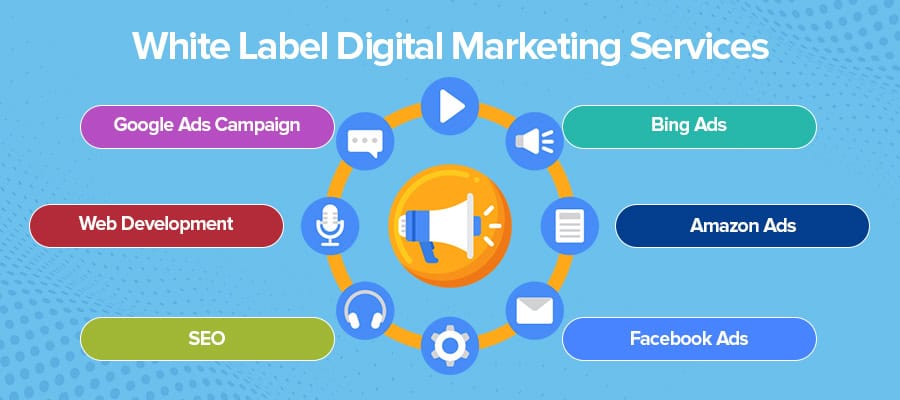
White label services allow agencies to expand their repertoire without the overhead of hiring niche specialists for every single platform. By outsourcing the “heavy lifting” to a specialized partner, companies can offer a cohesive, full-service experience under their own brand.
Key Marketing Channels for White Labelling
- Search Engine Optimization (SEO): Partners handle the technical audits, backlink building, and keyword research, allowing the primary agency to focus on high-level strategy and client reporting.
- Pay-Per-Click (PPC) & Paid Social: Specialized white-label teams manage complex bidding strategies and creative rotations across Google Ads, Meta, and LinkedIn, ensuring high ROI without internal burnout.
- Content Marketing: Professional writing pods produce blog posts, whitepapers, and newsletters tailored to a specific brand voice, providing the scale needed for aggressive organic growth.
- Social Media Management: White-label providers can manage daily posting schedules, community engagement, and reputation management across multiple time zones and platforms.
- Email Marketing: This often includes the technical setup of automation workflows, list segmentation, and template design to drive lead nurturing at scale.
SEO and Content Marketing
Search engine optimization and content creation are time-intensive processes. White label providers handle keyword research, content writing, and link building. This ensures consistent quality and improved search rankings.
PPC and Paid Advertising
Paid campaigns require constant monitoring and optimization. Many brands outsource PPC to achieve better ROI without overburdening internal teams. In fact, over 60% of agencies outsource PPC campaigns to specialists.
Social Media Marketing
Managing multiple social platforms requires creativity and strategy. White label teams create engaging content, manage campaigns, and analyze performance metrics.
Email Marketing Automation
From newsletters to drip campaigns, white label services handle email marketing end-to-end, improving lead nurturing and conversion rates.
Role of White Label Services in Brand Reputation
White label services act as a silent engine for brand reputation, allowing companies to deliver high-quality, specialized results that they might not have the in-house infrastructure to produce.
By leveraging the expertise of a white label partner, a brand can maintain a consistent standard of excellence across multiple service lines, which builds deep client trust and perceived authority.
How White Labelling Impacts Brand Perception?
- Consistency and Quality Control: Access to proven systems and veteran specialists ensures that deliverables remain high-quality, preventing the “trial and error” phase that often damages a brand’s reputation when launching new services.
- Faster Turnaround Times: Efficient, outsourced workflows allow brands to meet tight deadlines and respond to market shifts rapidly, positioning them as agile and reliable partners in the eyes of their clients.
- Breadth of Authority: Offering a “one-stop-shop” experience under a single brand identity creates the image of a robust, full-service powerhouse, even if the execution is handled by a network of specialized partners.
- Risk Mitigation: White label partners often stay ahead of platform updates and compliance standards (like GDPR or algorithm shifts), protecting the primary brand from technical failures or outdated strategies that could lead to public errors.
Maintaining Brand Identity
Even though the work is outsourced, it’s delivered under the brand’s identity. This ensures consistency in communication and customer experience.
Enhancing Credibility
By delivering high-quality services consistently, brands build trust and credibility in the market. White label partnerships allow businesses to maintain a strong reputation without compromising on quality.
How White Label Digital Marketing Supports Business Scalability?
Flexible Resource Allocation
White label services allow brands to scale up or down based on demand. This flexibility is crucial in dynamic markets.
Handling Large Client Portfolios
International brands often manage hundreds of clients. White label partners help handle this workload efficiently, ensuring timely delivery and consistent quality.
Market Trends and Statistics of White Label Digital Marketing
The white label digital marketing landscape has shifted from a “behind-the-scenes” convenience to a primary strategic engine for agency growth. In 2026, the market is characterized by a move toward outcome-based results rather than just task execution.
Key Market Statistics (2025–2026)
-
Market Valuation: The global white label industry is projected to reach approximately $99.19 billion by the end of 2026.
-
Adoption Rates: Roughly 73% of marketing agencies now utilize white label services to expand their offerings without the overhead of full-time hiring.
-
Growth Potential: Agencies that outsource 40% to 60% of their fulfillment are growing 2.3 times faster than those relying solely on in-house teams, often seeing profit margins increase by 18–22%.
-
Client Retention: Agencies using specialized white label partners report a 42% higher client retention rate due to the consistent quality and access to high-tier expertise.
Dominant Trends for 2026
-
Agentic AI Fulfillment: White label providers are moving beyond basic AI tools to “Agentic AI,” where autonomous agents manage creative variations, predictive analytics, and real-time campaign optimization.
-
Fractional Expertise: There is a surge in demand for “fractional experts” (specialized SEO or PPC strategists) who can be embedded into an agency’s workflow on-demand to solve the persistent talent shortage.
-
Omnichannel Integration: Clients now expect unified strategies rather than siloed services. Top providers are offering integrated ecosystems that link Search, Social, and Retail Media Networks (RMNs) into a single reporting dashboard.
-
Privacy-Native Strategies: With the full deprecation of third-party cookies, white label partners are focusing heavily on first-party data strategies and privacy-compliant tracking to maintain ROI for their agency partners.
Growth of White Label Industry
The white label digital marketing industry is booming, with projections reaching nearly $99 billion by 2026. Additionally, around 73% of agencies already use white label services, highlighting its widespread adoption.
Adoption by International Brands
Large brands are increasingly adopting this model to stay competitive, reduce costs, and deliver better results.
Challenges and Considerations in White Label Digital Marketing
While white label digital marketing offers rapid scalability, it introduces a unique set of operational and ethical risks. In 2026, the complexity has increased due to AI-driven fulfillment and stricter global data regulations.
1. Quality Control and Brand Integrity
The most significant risk is the “dilution of quality.” Since the work is performed by a third party but delivered under your brand, any sub-par output directly damages your reputation.
-
Inconsistency: Differences in “tone of voice” or design standards between your internal team and the partner can confuse clients.
-
The “Black Box” Problem: Agencies often struggle to provide deep technical insights to clients because they aren’t performing the work themselves, leading to a perceived lack of transparency.
2. Data Privacy and Compliance Risks
In 2026, data privacy is no longer just a legal checkbox; it’s a brand requirement.
-
Patchwork Regulations: Partners must navigate a complex landscape including the EU AI Act, GDPR, and various US state laws (like CCPA/CPRA).
-
Chain of Custody: You are ultimately responsible for how your white label partner handles client data. If they use non-compliant tracking or insecure file-sharing, your agency faces the legal and financial fallout.
-
First-Party Data Transitions: As third-party cookies vanish, ensuring your partner can execute advanced first-party data strategies (like “Data Clean Rooms”) is a major hurdle.
3. Communication and Technical Bottlenecks
The “silent partner” model creates inherent lag in communication.
-
Feedback Loops: Relaying client feedback to a white label team and back again can lead to “telephone-game” errors and delayed turnaround times.
-
API and Tool Conflicts: Standardizing data across different platforms (e.g., Google Ads vs. Meta) is difficult. If your partner’s reporting schema doesn’t match yours, you’ll spend hours manually “cleaning” data before the client sees it.
4. Strategic Considerations Before Partnering
Before committing to a white label provider in 2026, consider the following:
-
The “Hiring vs. Outsourcing” Math: While outsourcing saves on payroll taxes (often 1.25–1.4x base salary), it can lead to higher costs if high-volume projects require frequent, expensive revisions.
-
Vetting for “Agentic AI”: Ensure the partner isn’t just using basic AI to churn out generic content. In 2026, search engines prioritize E-E-A-T (Experience, Expertise, Authoritativeness, Trustworthiness), and “robotic” content can lead to site de-indexing.
-
Scalability Limits: Some providers “red-line” at a certain volume. Ensure they have the infrastructure to handle your growth without a drop in performance.
Pro-Tip: Always start with a “trial project” rather than a full retainer. This allows you to test their communication speed and quality control processes before moving your entire client base.
Choosing the Right Partner
Selecting a reliable white label provider is critical. Brands must evaluate expertise, communication, and track record before partnering.
Maintaining Quality Control
Even with outsourcing, maintaining quality standards is essential. Regular monitoring and clear communication help ensure consistency.
Future of White Label Digital Marketing Services
In 2026, the future of white-label digital marketing is being redefined by the transition from simple task execution to strategic AI-driven orchestration. As standard digital tasks become commoditized, the value of white-label partnerships is shifting toward high-level expertise and proprietary technology stacks that internal teams can’t replicate.
Key Trends Shaping the Future (2026 & Beyond)
- AI as the “Invisible Copilot”: White-label providers are moving beyond human-only fulfilment. By 2026, 91% of marketers are using AI, and white-label partners are leading this by offering “AI-as-a-Service”, rebranded AI agents for lead qualification, predictive SEO, and hyper-personalized content pipelines that integrate directly into a client’s brand voice.
- Outcome-Oriented Deliverables: The industry is moving away from “activity metrics” (like number of posts) toward performance-based outcomes. Future partnerships will focus on measurable business impact such as revenue growth and lead quality, tracked through real-time, automated dashboards.
- Generative Engine Optimization (GEO): With the rise of AI-first search (like ChatGPT and Perplexity), white-label SEO is evolving. Partners now specialize in GEO, ensuring brands aren’t just ranking on Google but are being cited as trusted sources by AI assistants.
- The “Fractional Expert” Model: To combat global talent shortages, white-label services are evolving into on-demand fractional departments. Instead of just buying a service, agencies are “renting” entire specialized units (e.g., a “Retail Media Network” team) that function as a native part of their company.
- Hyper-Personalization at Scale: Automation is moving from “rules-based” to “intent-based.” Future white-label solutions use predictive analytics to adapt website content, email triggers, and ad creatives in real-time based on individual user behaviour, making global campaigns feel deeply local and personal.
AI and Automation Integration
The future of white label digital marketing lies in automation and AI-driven strategies. These technologies will enhance efficiency and campaign performance.
Increasing Global Demand
As digital transformation accelerates, more brands will adopt white label solutions to stay agile and competitive.
FAQs on White Label Digital Marketing Solutions
-
Why do reputed international brands opt for white label digital marketing services?
They do so to reduce costs, access expertise, and scale operations efficiently without expanding internal teams.
-
Is white label digital marketing cost-effective?
Yes, it eliminates expenses related to hiring, training, and infrastructure, making it highly cost-efficient.
-
Can white label services maintain brand identity?
Absolutely. All services are delivered under the brand’s name, ensuring consistency and trust.
-
What services can be outsourced through white label marketing?
SEO, PPC, content marketing, social media management, and email marketing are commonly outsourced.
-
Is white label marketing suitable for small businesses?
Yes, it helps small businesses compete with larger brands by providing access to expert services.
-
What are the risks of white label digital marketing?
The main risks include choosing the wrong partner and lack of quality control, which can be managed with proper oversight.
Conclusion
The decision by reputed international brands to opt for white label digital marketing services is not just a trend, it’s a strategic move. With benefits like cost savings, scalability, and access to expertise, this model empowers businesses to grow faster and stay competitive in a rapidly evolving digital landscape. As the industry continues to expand, white label digital marketing will play an even more critical role in shaping the future of global marketing strategies.