

Search engine optimization (SEO) is one of the most effective digital marketing strategies for generating consistent organic traffic, qualified leads, and long-term business growth. However, many businesses invest in SEO without defining clear objectives. They publish content, optimize pages, and build backlinks but struggle to measure whether their efforts are actually producing meaningful results.
The solution lies in setting SMART SEO goals.
Rather than chasing vanity metrics such as rankings for a handful of keywords, SMART SEO goals help businesses focus on measurable outcomes that align with overall business objectives. Whether you’re a startup, local business, eCommerce store, or enterprise brand, having well-defined SEO goals creates a roadmap for sustainable success.
In this guide, you’ll learn what SMART SEO goals are, why they matter, how to create them, examples for different businesses, common mistakes to avoid, and the benefits of using a structured SEO strategy.
What Are SMART SEO Goals?
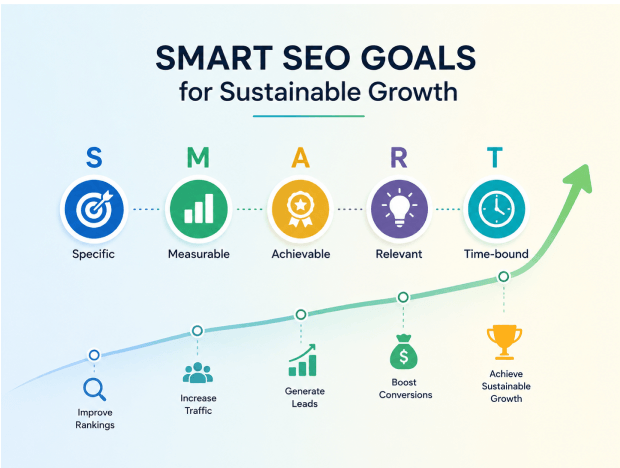
SMART SEO goals are clear, structured objectives that help you improve your website’s search engine performance in a practical and measurable way. Instead of aiming for a vague goal like “get more traffic,” SMART goals focus on outcomes that are Specific, Measurable, Achievable, Relevant, and Time-bound.
For example, rather than saying “I want to rank higher on Google,” a SMART SEO goal would be: “Increase organic traffic by 25% and rank in the top 5 Google results for five target keywords within the next six months.”
By setting SMART SEO goals, businesses can stay focused, track progress with real data, make informed decisions, and achieve sustainable long-term growth through effective SEO strategies.
SMART is a proven goal-setting framework that helps businesses create realistic and measurable objectives. SMART stands for:
- Specific
- Measurable
- Achievable
- Relevant
- Time-Bound
Instead of saying:
“We want better SEO.”
A SMART SEO goal would be:
“Increase organic website traffic by 35% within the next six months through content optimization, technical SEO improvements, and high-quality backlink acquisition.”
Notice the difference?
The second goal clearly explains:
- What needs to improve
- How success will be measured
- Whether it’s realistic
- Why it matters
- When it should be achieved
This level of clarity makes SEO campaigns far more effective.
Why Setting SMART SEO Goals Is Important
Setting SMART SEO goals gives your SEO strategy a clear direction and purpose. Instead of chasing rankings without a plan, you focus on measurable outcomes that support your overall business objectives. Whether your aim is to increase website traffic, generate more qualified leads, or boost online sales, SMART goals help you stay on track and measure what truly matters.
They also make it easier to monitor progress, identify what’s working, and adjust your strategy when needed. With specific timelines and realistic targets, you can use your time, budget, and resources more effectively while avoiding guesswork.
Most importantly, SMART SEO goals encourage consistent, long-term growth by helping you build sustainable search visibility rather than relying on short-term tactics. SEO is a long-term investment rather than a quick marketing tactic. Without clear goals, businesses often lose direction and end up measuring the wrong metrics.
SMART SEO goals help you:
- Prioritize high-impact SEO activities
- Measure campaign performance accurately
- Improve accountability across marketing teams
- Allocate budgets more effectively
- Track ROI from organic search
- Identify areas needing improvement
- Maintain consistent long-term growth
Most importantly, SMART goals connect SEO performance directly with business growth instead of focusing solely on keyword rankings.
Breaking Down the SMART Framework for SEO
The SMART framework helps turn broad SEO ambitions into practical, achievable goals. Each part of the framework ensures your SEO strategy stays focused, measurable, and aligned with your business objectives.
- Specific: Define exactly what you want to achieve. For example, instead of saying “increase website traffic,” aim to “rank on the first page of Google for five high-intent keywords related to digital marketing services.”
- Measurable: Use key SEO metrics to track your progress, such as organic traffic, keyword rankings, click-through rate (CTR), conversions, backlinks, or leads generated from organic search.
- Achievable: Set realistic goals based on your website’s current performance, competition, available resources, and timeline. Challenging yet attainable goals keep your team motivated.
- Relevant: Make sure your SEO goals support your overall business objectives. Whether your focus is increasing sales, generating leads, or building brand awareness, every SEO effort should contribute to those priorities.
- Time-bound: Set a clear deadline to achieve your goal. For example, “Increase organic traffic by 30% within six months” creates accountability and helps you regularly review and optimize your SEO strategy.
By following the SMART framework, businesses can create a structured SEO plan that delivers measurable, sustainable growth instead of relying on guesswork or unrealistic expectations.
Specific Goals
Your SEO objectives should clearly define what you want to accomplish.
Instead of saying:
Increase website visibility.
Say:
- Increase organic traffic to service pages.
- Improve rankings for local search terms.
- Generate more organic leads.
- Increase blog traffic.
- Improve product page visibility.
The more specific your objective, the easier it becomes to develop an effective SEO strategy.
Measurable Goals
Every SEO goal should include measurable metrics. Common SEO KPIs include:
- Organic traffic
- Keyword rankings
- Click-through rate (CTR)
- Organic conversions
- Lead generation
- Bounce rate
- Average session duration
- Backlinks earned
- Domain authority improvements
- Indexed pages
- Revenue from organic search
Using measurable data allows you to evaluate progress instead of relying on assumptions.
Achievable Goals
SEO takes time. Expecting to rank #1 for highly competitive keywords within a month is usually unrealistic. Instead, focus on goals that align with:
- Website authority
- Current rankings
- Available budget
- Team resources
- Industry competition
- Existing content quality
Realistic goals encourage consistent progress without creating unnecessary pressure.
Relevant Goals
Every SEO objective should support broader business goals. For example: A law firm should prioritize:
- Local SEO
- Practice area rankings
- Qualified lead generation
An eCommerce business may focus on:
- Product page traffic
- Category page optimization
- Organic sales
A SaaS company might prioritize:
- Educational content
- Product-related keywords
- Free trial sign-ups
Relevant goals ensure your SEO efforts contribute directly to business success.
Time-Bound Goals
SEO requires patience, but deadlines create accountability. Examples include:
- Increase organic traffic by 25% within six months.
- Publish 40 optimized blogs in nine months.
- Improve Core Web Vitals within three months.
- Earn 60 quality backlinks during the next year.
- Increase organic conversions by 20% before year-end.
Having timelines helps evaluate campaign performance and maintain momentum.
Examples of SMART SEO Goals
SMART SEO goals help transform general marketing objectives into clear, actionable targets. Here are a few practical examples:
- Increase Organic Traffic: Grow organic website traffic by 30% within the next six months through content optimization, technical SEO improvements, and quality backlink building.
- Improve Keyword Rankings: Rank in the top 5 Google search results for 10 high-intent target keywords within five months.
- Boost Lead Generation: Increase organic leads by 20% over the next quarter by optimizing landing pages, improving calls-to-action, and targeting transactional keywords.
- Enhance Click-Through Rate (CTR): Improve the average organic CTR from 3% to 5% within three months by optimizing title tags and meta descriptions.
- Increase Conversions: Raise the website’s organic conversion rate by 15% in six months through better user experience, faster page speed, and conversion-focused content.
- Strengthen Backlink Profile: Earn 50 high-quality backlinks from authoritative websites within six months to improve domain authority and search visibility.
- Improve Local SEO Performance: Increase Google Business Profile views and local search inquiries by 25% within four months through local SEO optimization and customer reviews.
These SMART SEO goals provide clear direction, make progress easy to measure, and help businesses achieve sustainable growth through focused and data-driven SEO strategies. Here are several practical examples businesses can adapt.
Traffic Goal
Increase organic website traffic by 40% within 12 months by publishing two optimized blog articles every week and improving technical SEO.
Keyword Ranking Goal
Rank on the first page for 20 high-intent keywords within eight months through content optimization and strategic link building.
Local SEO Goal
Increase Google Business Profile visibility and generate 50% more local enquiries within six months.
Lead Generation Goal
Increase organic lead submissions from service pages by 30% during the next two quarters.
Content Marketing Goal
Publish 100 high-quality SEO articles within one year targeting informational and commercial search intent.
Technical SEO Goal
Reduce page load time below two seconds and achieve passing Core Web Vitals scores within three months.
How to Set SMART SEO Goals Step by Step
Setting SMART SEO goals is easier when you follow a structured process. These steps help you create realistic objectives that align with your business goals and deliver measurable results.
1. Define Your Business Objective
Start by identifying what you want your business to achieve. Your SEO goals should support broader objectives, such as increasing website traffic, generating more leads, boosting online sales, or improving brand awareness.
2. Analyze Your Current SEO Performance
Review your existing SEO metrics, including organic traffic, keyword rankings, click-through rate (CTR), conversion rate, backlinks, and page performance. Knowing your starting point helps you set realistic targets.
3. Choose the Right SEO KPIs
Select the key performance indicators (KPIs) that best reflect your goals. Common SEO KPIs include organic traffic, keyword rankings, impressions, conversions, bounce rate, page speed, and backlink growth.
4. Apply the SMART Framework
Make sure each goal is Specific, Measurable, Achievable, Relevant, and Time-bound. For example: Increase organic traffic by 25% within six months by publishing high-quality content and optimizing existing pages.
5. Create an Action Plan
Break your goal into smaller tasks such as conducting keyword research, improving on-page SEO, fixing technical issues, publishing valuable content, optimizing internal links, and building quality backlinks.
6. Monitor Progress Regularly
Track your SEO performance using tools like Google Analytics and Google Search Console. Review your KPIs regularly to understand what’s working and identify areas that need improvement.
7. Adjust and Improve Your Strategy
SEO is an ongoing process. Use performance data to refine your strategy, update content, optimize underperforming pages, and adapt to search engine algorithm changes to stay on track. By following these steps, you can create SMART SEO goals that are practical, measurable, and focused on driving consistent, long-term organic growth.
1. Understand Your Current SEO Performance
Begin with an SEO audit. Evaluate:
- Organic traffic
- Indexed pages
- Keyword rankings
- Backlinks
- Technical issues
- Conversion rates
- Mobile usability
- Website speed
Knowing your starting point makes goal setting far more accurate.
2. Define Business Objectives
SEO should support business growth rather than operate independently. Ask yourself:
- Do you need more leads?
- More sales?
- Better brand awareness?
- Increased local visibility?
- Higher customer retention?
Once business priorities are clear, create SEO goals that directly contribute to them.
3. Research Your Competitors
Study competitors to understand:
- Which keywords they rank for
- Their backlink profile
- Content strategy
- User experience
- Technical SEO strengths
Competitive analysis helps identify realistic opportunities without blindly copying others.
4. Prioritize High-Value Keywords
Focus on keywords that match user intent. These generally fall into three categories:
Informational Keywords
Users seeking answers.
Example:
- SEO checklist
- Technical SEO guide
Commercial Keywords
Users comparing services.
Example:
- Best SEO agency
- SEO pricing
Transactional Keywords
Users ready to purchase.
Example:
- Hire SEO company
- Buy SEO audit
Balancing all three creates a healthy organic traffic funnel.
5. Create an SEO Roadmap
Your roadmap should include:
- Technical SEO fixes
- Content creation schedule
- Internal linking improvements
- Backlink acquisition
- Local SEO optimization
- Performance monitoring
Breaking large goals into monthly milestones keeps the project manageable.
6. Measure Progress Regularly
Track performance every month rather than waiting until the campaign ends.
Review:
- Organic sessions
- Keyword improvements
- Conversion growth
- Content performance
- Technical health
- User engagement
Continuous monitoring allows for timely adjustments and better long-term results.
Features of SMART SEO Goal Planning
SMART SEO goal planning provides a structured approach to achieving long-term search engine success. Here are its key features:
- Clear and Specific Objectives: Defines exactly what you want to achieve, eliminating confusion and keeping your SEO strategy focused.
- Measurable Performance Metrics: Uses KPIs such as organic traffic, keyword rankings, conversions, and click-through rates to track progress accurately.
- Realistic and Achievable Targets: Sets practical goals based on your website’s current performance, competition, and available resources.
- Business-Focused Strategy: Aligns SEO goals with your overall business objectives, ensuring every optimization effort contributes to growth.
- Time-Bound Milestones: Establishes clear deadlines that encourage accountability and help measure success over a specific period.
- Data-Driven Decision Making: Relies on analytics and performance data to guide SEO improvements rather than assumptions.
- Action-Oriented Planning: Breaks larger SEO goals into manageable tasks, making implementation more organized and efficient.
- Continuous Performance Monitoring: Encourages regular tracking and reporting to identify opportunities and resolve issues quickly.
- Flexible and Adaptable: Allows goals to evolve based on algorithm updates, market trends, and business priorities.
- Supports Sustainable Growth: Focuses on consistent, long-term improvements in search visibility, traffic, leads, and conversions instead of short-term wins.
By incorporating these features, SMART SEO goal planning helps businesses stay organized, measure meaningful progress, and build a strong foundation for lasting SEO success. Businesses that implement SMART SEO planning gain several operational advantages.
Clear Strategic Direction
Every SEO activity supports a measurable business objective.
Better Team Alignment
Content writers, developers, SEO specialists, and marketers all work toward shared goals.
Improved Resource Allocation
Budgets are spent on activities that generate measurable impact instead of random optimization tasks.
Easier Performance Tracking
Defined KPIs make it simple to evaluate campaign success and identify areas for improvement.
Continuous Optimization
Regular measurement encourages ongoing improvements rather than one-time SEO efforts.
Better ROI Measurement
Businesses can accurately determine how SEO contributes to leads, sales, and revenue.
Benefits of Setting SMART SEO Goals
Setting SMART SEO goals helps businesses create a focused, measurable, and results-driven SEO strategy. Instead of relying on guesswork, you can make informed decisions that support long-term growth and improve your return on investment.
- Provides Clear Direction: SMART goals give your SEO efforts a defined purpose, helping your team focus on the tasks that matter most.
- Makes Progress Measurable: By tracking key metrics like organic traffic, keyword rankings, and conversions, you can easily evaluate your SEO performance.
- Improves Decision-Making: Data-driven goals help you identify successful strategies and optimize areas that need improvement.
- Aligns SEO with Business Goals: Every SEO activity contributes to broader objectives, such as generating leads, increasing sales, or building brand awareness.
- Boosts Team Productivity: Clear objectives and deadlines keep everyone aligned, accountable, and working toward the same outcomes.
- Optimizes Time and Budget: SMART planning helps prioritize high-impact SEO activities, ensuring resources are used efficiently.
- Encourages Continuous Improvement: Regular performance reviews make it easier to refine your strategy and adapt to changes in search engine algorithms.
- Increases Organic Traffic and Visibility: Well-defined goals help improve search rankings, attract more qualified visitors, and expand your online presence.
- Delivers Better ROI: By focusing on measurable results, businesses can maximize the value of their SEO investment and achieve sustainable growth.
- Supports Long-Term Success: SMART SEO goals create a consistent roadmap that helps maintain steady improvements in rankings, traffic, leads, and conversions over time.
When your SEO goals are specific, measurable, achievable, relevant, and time-bound, every optimization effort becomes more strategic, making it easier to achieve lasting success in search engine rankings.
Higher Organic Traffic
Focused optimization attracts visitors actively searching for your products or services.
Better Search Engine Rankings
Well-planned SEO campaigns steadily improve keyword visibility across important search terms.
Increased Qualified Leads
Optimizing pages around user intent attracts visitors who are more likely to convert into customers.
Stronger Brand Authority
Publishing consistent, valuable content builds trust with both users and search engines.
Improved User Experience
SEO often involves faster websites, better navigation, mobile optimization, and helpful content, all of which enhance the visitor experience.
Sustainable Long-Term Growth
Unlike paid advertising, SEO continues delivering traffic long after content is published, creating lasting value for your business.
Better Marketing Decisions
Reliable performance data helps businesses invest in the strategies that produce the greatest results.
Common Mistakes When Setting SEO Goals
Many businesses unintentionally weaken their SEO strategy by making avoidable mistakes.
Setting Unrealistic Expectations
SEO takes time. Promising immediate first-page rankings often leads to disappointment.
Focusing Only on Rankings
High rankings are valuable, but conversions and revenue matter even more.
Ignoring Search Intent
Ranking for irrelevant keywords may increase traffic without improving business outcomes.
Tracking Too Many Metrics
Concentrate on the KPIs that align with your business goals instead of monitoring every available metric.
Forgetting Technical SEO
Even the best content can struggle to perform if your website has poor speed, crawl issues, or mobile usability problems.
Not Updating Goals
As your business grows and search trends evolve, revisit your SEO goals to ensure they remain relevant and achievable.
Best Practices for Sustainable SEO Growth
To achieve long-term success, combine SMART goals with proven SEO practices.
- Publish high-quality, people-first content consistently.
- Build topical authority around your core services.
- Strengthen internal linking across related pages.
- Improve website speed and mobile responsiveness.
- Earn authoritative backlinks naturally.
- Refresh existing content regularly.
- Optimize for user experience as well as search engines.
- Track conversions instead of traffic alone.
- Monitor algorithm updates and adapt responsibly.
- Review progress monthly and refine your strategy based on real performance data.
Sustainable SEO is built on consistency, relevance, and continuous improvement, not shortcuts.
Final Thoughts
Setting SMART SEO goals transforms SEO from a collection of disconnected tasks into a focused, results-driven growth strategy. By creating objectives that are Specific, Measurable, Achievable, Relevant, and Time-Bound, businesses can prioritize meaningful actions, monitor progress with confidence, and make informed decisions that support long-term success.
Whether your aim is to increase organic traffic, improve keyword visibility, generate more qualified leads, or grow online revenue, SMART goals provide the structure needed to stay on course. When combined with high-quality content, strong technical SEO, excellent user experience, and ongoing optimization, they become the foundation for sustainable organic growth.
Remember, SEO is a marathon, not a sprint. Businesses that define clear goals, measure performance consistently, and refine their strategy over time are far more likely to build lasting search visibility, earn customer trust, and achieve measurable business results year after year.


