
To significantly enhance your landing page experience optimisation, begin by focusing on clear, concise messaging that directly addresses the visitor’s needs and value proposition. Optimise the page load speed, a critical factor for reducing bounce rates and ensure your design is mobile-responsive across all devices. Finally, streamline your call-to-action (CTA), making it prominent, persuasive, and the singular, unambiguous next step for conversion.
What Exactly Is Landing Page Optimization?
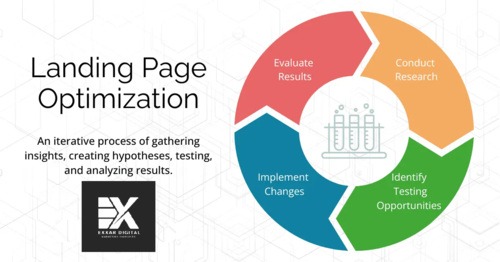
Landing page optimization is all about fine-tuning the diverse elements on your landing page so more visitors take the action you want, whether that’s signing up, buying something, or requesting a quote. Instead of guessing what might work, you rely on real data, insights, and feedback from your audience.
The great thing is you don’t have to wait until your page is live to start gathering information. Humble surveys or swift audience polls can benefit you understand what people expect, what they like, and what might stop them from converting.
Of course, no landing page is flawless on day one. The real magic happens after you launch it. Once your page is live, you track performance, study how visitors interact with it, and make measured improvements based on what the data tells you.
Optimising Landing Page for Better Results
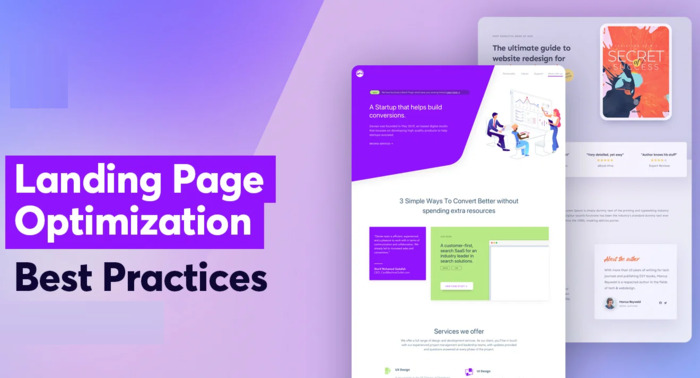
In digital marketing, a landing page is more than just a destination, it is a specialized tool designed for a single purpose: conversion. Whether your goal is to generate high-quality leads, drive product sales, or encourage newsletter sign-ups, every element on the page must work in harmony to guide the visitor toward that final action.
Optimizing a landing page is an ongoing process of refining the user experience (UX) and aligning your messaging with user intent. Here is how to transform a standard page into a high-performing conversion engine.
1. Craft a Compelling Visual Hierarchy
First impressions are formed in milliseconds. A well-structured layout ensures that the most important information is seen first.
The Hero Section: Your headline should be bold, clear, and focused on the primary benefit. Use a “sub-headline” to provide context and address the user’s pain points.
Above the Fold: Keep your primary Call to Action (CTA) and value proposition visible without requiring the user to scroll.
Whitespace: Use clean design to prevent cognitive overload. Give your text and buttons room to breathe so the visitor’s eye is naturally drawn to the conversion point.
2. Message Match and Clarity
Consistency is key to reducing “bounce rates.” If your ad promises a “Free SEO Audit,” but the landing page talks generally about “Digital Marketing Services,” you lose trust instantly.
Sync Headlines: Ensure the language on your landing page mirrors the copy in your ads or emails.
Focus on Benefits, Not Features: Instead of listing technical specifications, explain how your solution makes the customer’s life easier or more profitable.
3. Frictionless User Experience
If a page is hard to use, visitors will leave. Technical performance is a foundational pillar of optimization.
Site Speed: Every second of delay in load time can result in a significant drop in conversions. Optimize images and leverage caching to keep the page snappy.
Mobile-First Design: With a majority of traffic coming from mobile devices, ensure buttons are easy to tap and forms are easy to fill out on smaller screens.
Simplified Forms: Only ask for the information you absolutely need. Lengthy forms are one of the biggest barriers to lead generation.
4. Building Trust and Authority
Users are hesitant to share their data or money with brands they don’t trust. Social proof acts as a powerful psychological trigger.
Testimonials and Reviews: Showcase real feedback from satisfied clients.
Trust Badges: Include certifications, partner logos, or security seals to provide peace of mind.
Case Studies: Brief results-driven data points (e.g., “Increased ROI by 40%”) help validate your claims.
5. Data-Driven Refinement
Optimization is never “done.” To achieve elite performance, you must rely on data rather than intuition.
A/B Testing: Regularly test different versions of your headlines, CTA button colors, and images to see which resonates best with your audience.
Heatmaps: Use tools to see where users are clicking and where they are getting stuck.
Conversion Tracking: Set up robust tracking to identify exactly which traffic sources are yielding the best results.
The Golden Rule: A perfect landing page doesn’t try to do everything. It tries to do one thing perfectly. By removing distractions and focusing on the user’s journey, you turn passive clicks into active customers.
Before You Optimize, Identify What’s Holding You Back
Numerous businesses make the mistake of changing everything at once when they feel their landing page “isn’t working.” It’s like throwing a trickle of noodles at the wall just to see which one sticks, there’s no system behind it.
Effective landing page optimization doesn’t work like that. The first step is to pinpoint the genuine issues affecting your conversion rate. Once you know what the real problems are, you can fix them with precision.
Tools like heat maps are amazingly helpful for this. They show you precisely where visitors are clicking (and where they’re not). Are people skipping over your call-to-action button? Are they spending too much attention on something irrelevant, like a decorative stock image? These insights guide your next steps.
What Exactly Is a Landing Page?
Broadly speaking, a landing page is any page where a visitor first enters your website, whether they find you through a Google search, a social post, an ad, or by typing your URL directly. This means your homepage is also a landing page, even if you’ve never thought of it that way.
But in the marketing world, the term is used more precisely. Here, a landing page is a standalone page created for one clear purpose: to encourage visitors to take an explicit action. This might be making a purchase, filling out a form, downloading a guide, or signing up for a newsletter.
The Goal of Landing Page Optimization
The main objective of optimizing your landing page is simple: increase conversions. To accomplish that, you improve your copy, design, layout, visuals, and even the technical aspects of the page. Each enhancement contributes to creating a continuous, engaging, and convincing experience, eventually encouraging more visitors to take action.
Let’s Understand What is a Landing Page Optimization is:
A strong landing page experience is at the heart of any successful SEM or SEA campaign. If you want to increase conversions, reduce ad spend, or keep visitors engaged, your landing page must deliver on three essentials: relevant content, fast loading times, and smooth, simple navigation. When these pieces come together, you’re able to make the most of every visitor who lands on your page.
High-performing landing pages usually share two key traits:
- They address one clear user need
- They focus on one specific goal, whether that’s getting an email sign-up, encouraging a resource download, or booking a free demo
If you’ve done your homework and truly comprehend your audience, identifying their pain points and offering them something valuable should be straightforward.
So why, then, is the average conversion rate across industries still hovering around just 3.3%?
In this blog, we break down what makes a landing page truly effective and share the strategies top-performing websites use to constantly drive conversions, both through organic traffic and paid campaigns.
Understanding Landing Page Experience
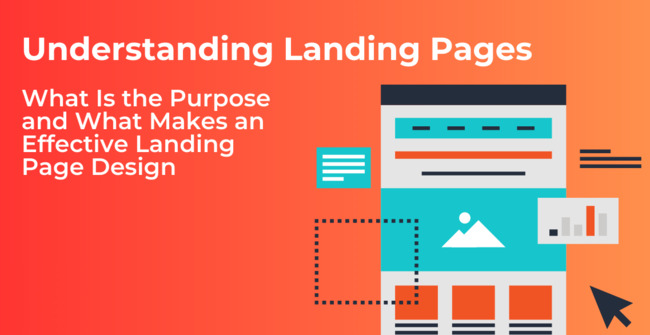
Your landing page experience is fundamentally how visitors feel and interact with your page after clicking on an ad or a link. A prodigious experience means the page matches their intent, loads speedily, and guides them effortlessly toward the action you want them to take.
Google puts it simply:
“Effective landing pages are key to getting conversions from your traffic. One of the best and easiest ways to get better results from your ads is to improve the speed of your landing pages.”
While speed is definitely significant, truly understanding how users experience your landing page goes far beyond load time. It’s about seeing your page from their perspective, what they expect, what confuses them, and what encourages them to move forward.
What Does a Good Landing Page Experience Look Like?
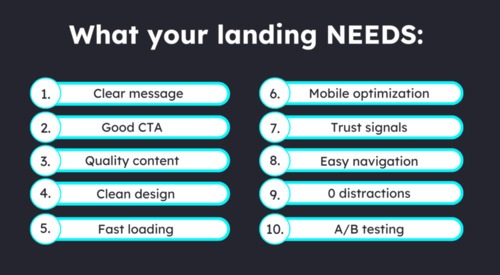
According to Google’s Quality Score for paid search, a strong landing page experience is shaped by several factors:
- Usefulness and relevance of your content – Does the page give visitors exactly what they came for?
- Ease of navigation – Can users quickly find the information they need without feeling lost?
- Number of links on the page – Too many distractions can pull visitors away from your main goal.
- Meeting user expectations – Does your page deliver on the promise made in the ad or link they clicked?
On the other hand, a poor landing page experience does more than just hurt your conversions. It can negatively impact your entire marketing strategy.
Lower SEO Rankings:
When your page loads slowly, feels clunky, or makes visitors bounce quickly, search engines take notice. These signals tell Google that users aren’t finding what they need, which can push your rankings down and reduce your organic traffic over time.
Higher Costs for SEA Campaigns:
Google Ads also evaluates your landing page through a Landing Page Experience Quality Score. If your page has irrelevant content, slow loading, or isn’t mobile-friendly, your score drops and your cost-per-click (CPC) goes up. This means you end up paying more for the same traffic and getting less return on your ad spend.
How to Measure Landing Page Performance?

To truly recognize how well your landing page is doing, you essential to look at a combination of metrics. These pointers help you assess user behaviour, engagement levels, and the technical health of your page, giving you a wide-ranging picture of its efficiency.
Here are the metrics to monitor on your landing page:
Content relevancy and SEO
Search Intent Alignment
This is more of a self-tracking metric where you safeguard that the content on your landing page meets the intent of the keyword (informational, transactional, or navigational).
Best Practice: Match the headline, content, and CTAs with the search intent of the target audience. For example, ExxarDigital users search for “ExxarDigital Services” or “ExxarDigital Company,” signalling they’re interested in taking a marketing plan.
Keyword Usage and Density
Cast-off to measure the number of times your target keyword appears on the page relative to the total word count. Aim for a keyword density of 1-2% to evade keyword stuffing while maintaining significance.
Best Practice: Place the chief keyword in the H1 tag, meta description, title tag, and the first 100 words of the content. Use natural variations and synonyms to improve context (LSI keywords).
Internal and External Links
Measures the number of links on your landing page and their placement in the content. Being tactical about the link placement supports users in navigating your page and engaging with it further.
Best Practice: Internal: Include 2-5 links to relevant pages to support SEO and user navigation. External: Link to 1-3 high-authority sources to establish credibility.
Tip: Don’t forget to apply a Schema Markup and contrivance schema types like FAQ, Breadcrumb, or Review schema to improve visibility in SERPs. Also, confirm there are no issues like noindex tags or blocked resources in Google Search Console for continuous indexability.
User Engagement is Vital
Page Bounce Rate
This metric supports you perceive the percentage of users who leave your page after viewing only one page. A high bounce rate often specifies that the page content isn’t meeting user expectations or lacks engaging elements to reassure further navigation.
Best Practice: Aim for a decent bounce rate below 40% (depending on the industry) and up to 55% for an average bounce rate. Anything above 70% shows insignificance or poor UX.
Staying Time on Page
The average duration a visitor stays on your landing page. This metric emphasises on how much time users vigorously spend on your page, which can specify engagement levels.
Good: Over 1.5 minutes for most pages
Poor: Less than 30 seconds (signals a lack of engagement)
Important Point: Ignore pages that characterise the exit point in a funnel, as these are expected to have suggestively less engagement.
Conversion Rate
The percentage of visitors who complete the desired action, such as filling out a form, signing up for a newsletter, or making a purchase. This is the ultimate indicator of landing page effectiveness.
Good: 2-5% for ecommerce or 10-20% for well-optimized lead generation pages
Poor: Below 1% (signals UX or messaging issues)
User’s Scroll Depth
Trails how far users scroll down the landing page. This metric displays whether users engage with content below the fold and can benefit from recognising where users lose interest.
Good: 75% or more of the page for long-form content
Poor: Below 50% (suggests users are losing interest primarily)
Click-Through Rate (CTR)
The percentage of users who are clicking on links, buttons, or CTAs. A high CTR shows that your CTAs are compelling and well-placed.
Good: 3-5% for SEM campaigns, 10-20% for organic pages
Poor: Below 2% (signals weak CTAs or unrelated content)
Website Performance
Core Web Vitals
Google’s key metrics to rate how well your landing page is behaving when users interrelate with it:
- Largest Contentful Paint (LCP): The time it takes for the chief content above the fold to load.
- Interaction to Next Paint (INP): The time it takes for the page to rejoin to user’s interactions (e.g., clicks, taps, or keyboard inputs) and display the next frame.
- Cumulative Layout Shift (CLS): Measures layout consistency to confirm elements don’t shift unpredictably.
To evade a “Failed” Core Web Vitals score, aim for under 2.5 seconds LCP, under 200 milliseconds INP, and less than 0.1 CLS. Of course, there are a lot of other site performance systems of measurement you can track to get an even fuller portrait of your landing page experience.
How to check your landing page experience

Assessing your landing page experience comprises using a mixture of tools and manual assessments to safeguard your page performs well across user experience, technical performance, and relevance.
Here are step-by-step instructions:
Check Indexability with Google Search Console
None of your optimization efforts will work if your landing page is not ascertainable by Google. Log in to Google Search Console and go to the URL Inspection Tool in the left-hand menu. Enter your landing page URL and assess the results:
Indexed: If the page is indexed, you’re upright to go.
Not Indexed: Check for details such as “noindex” meta tags, crawl errors, or exclusions in your robots.txt file, and then appeal a Reindex in the console.
Check Website Speed & Performance with Google PageSpeed Insights
Google PSI analyzes your page’s routine and delivers page load time and Core Web Vitals scores, along with diagnostics and guidelines on how to evade numerous problems.
Purely visit the tool, enter your landing page URL, and click “Analyze.” If this is your first time using this report, we recommend you go over our Google PageSpeed Insights guide to make the most out of your results.
Check Google Ads Quality Score with Google Ads
This measures the significance, speed, and overall experience of your landing page for paid campaigns.
Start by opening your Google Ads account and navigating to the Keywords tab. Review the Quality Score column (hover over the score for details) and pay attention to the Landing Page Experience component.
Check User Behaviour with Heatmaps & Session Recordings
Tracks user behaviour, counting where users click, how far they scroll, and where they drop off by using tools like Hotjar and Crazy Egg.
Qualities of a decent landing page experience (Checklist)
The requirements for a respectable landing page experience are compelling content, fast loading speed, prodigious UX and Core Web Vitals, mobile-friendliness, high content relevancy, ease of navigation, and safe browsing.
Alike to an upright page experience, Google goals to send users to landing pages that are the best conceivable destination for their search query.
Use the Checklist Below to Build a Qualified Landing Page Experience:
- Fast loading speed (under 2.75 seconds)
- Prodigious user experience (passed Core Web Vitals calculation on desktop and mobile)
- Safe browsing (SSL certificate and HTTPS encryption)
- High content relevancy (> 1.5 minutes average time on page, over 50% scroll depth, <50% bounce rate)
- Clear messaging and CTAs (3-5% CTR)
- Ease of navigation (> 1 page visited per session)
- No disturbing interstitials (no rage clicks in session recordings; ads, banners, and pop-ups don’t block the main content)
Why Is My Landing Page Experience Below Average in Google Ads?
A low-slung landing page experience score frequently branches from problems like:
- Irrelevant Content: The page doesn’t match the user’s intent or ad copy.
- Slow Loading Speed: Pages that take longer than 3 seconds irritate users.
- Poor Mobile Usability: Buttons are too small, and layouts are too messy for mobile users.
- Distracting Elements: Disturbing interstitials or unnecessary pop-ups.
- Weak Transparency: Lack of confidence signals like SSL certificates or clear business information.
7 Ways to Optimize Your Landing Page Optimisation For Conversions
Whether you’re trying to progress SEO rankings or SEA performance, the techniques underneath will benefit you create a landing page that brings a unified user experience and successfully converts visitors into leads or customers.
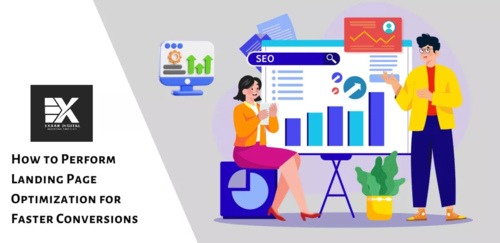
Improve Landing Page Speed
After analyzing 14,303 exclusive site visits across seven ecommerce websites, we found that visitors’ drop tolerance and disproportionally start to abandon a web page at 2.75s of the page load.
A fast-loading page retains users involved, decreases bounce rates, and progresses your SEO and Quality Score in Google Ads. To advance page load times, deliberate the following:
- Compress images and use WebP formatting;
- Minify CSS, JavaScript, and HTML to decrease file sizes and remove pointless code;
- Use a Content Delivery Network (CDN) to deliver content from servers closer to your users.
Pro Tip: Use tools like Google PageSpeed Insights or GTmetrix to recognize speed problems and actionable fixes.
Focus on Core Web Vitals Factors for Better Results
Core Web Vitals are uniform metrics formed by Google to appraise how real users relate with your website. Passing these three metrics, Largest Contentful Paint (LCP), Interaction to Next Paint (INP), and Cumulative Layout Shift (CLS), means you’re presenting a prodigious user experience.
A page that meets Google’s thresholds for Core Web Vitals is more expected to rank higher, cost less in Google Ads, and retain users engaged until they convert.
Optimize for the Right Keywords
Positioning your landing page with the precise keywords confirms it matches user intent, driving more appropriate traffic and cultivating conversions. The precise keywords can also lower your cost-per-click in Google Ads by cumulatively improving your Landing Page Experience Quality Score.
Best Practices for Keyword Optimization:
- Place your main keyword in the title tag, H1 heading, and meta description.
- Use associated terms (LSI keywords) certainly throughout the page to increase context.
- Evade keyword stuffing, which can damage both SEO and readability.
Example: For the keyword “affordable running shoes,” a landing page headline like “Shop Affordable Running Shoes with Free Shipping” straight addresses user intent.
Acclimate for Mobile Devices
With more than half of web traffic coming from mobile devices, a mobile-friendly landing page is crucial for conversions. A page that isn’t optimized for mobile can isolate users and upset your SEO rankings due to Google’s mobile-first indexing.
How to Make Your Page Mobile-Friendly:
- Use a responsive design to safeguard your page looks prodigious on any screen size.
- Confirm buttons and CTAs are large adequate to tap (minimum 48×48 pixels) and spaced sufficiently.
- Diminish huge pop-ups that can block content on mobile screens.
Simplify the Landing Page Design
A messy landing page devastates visitors and confuses them from taking the anticipated action. Streamlining the design supports users’ emphasis on the content and CTAs that matter.
Tips for Simplification:
- Use whitespace deliberately to highlight significant elements like headlines and CTAs.
- Limit the number of images and evade animations that can slow the page.
- Preserve a clear visual hierarchy with large, bold headings and brief paragraphs.
Pro Tip: Run A/B tests to regulate which design elements lead to advanced engagement and conversions.
Include the Appropriate Internal Links
The internal links on your landing page should assist users and shape credibility without sidetracking them from the main goal.
How to Use Links Effectively:
- Comprise internal links to supportive resources, such as FAQs or pricing pages.
- Add external links to convincing sources when providing supporting information, but safeguard these open in a new tab to retain users on your landing page.
- Sidestep unnecessary linking, which can weaken attention and harm the user journey.
Example: A landing page for an online marketing might contain an internal link to a price and package overview and an external link to an industry report supporting the structure.
Improve Your CTAs Buttons
Your call-to-action (CTA) is the most significant element of your landing page. It’s where conversions occur. A sick planned or unclear CTA can leave users confused or impassive.
How to Create Effective CTAs:
- Make It Actionable: Use clear, action-oriented phrases like “Start Free Trial” or “Get Discount.”
- Design for Impact: Use complementary colours and bold fonts to make the CTA button stand out.
- Position Strategically: Place the chief CTA above the fold and recurrence it in key sections throughout the page.
Example: Instead of a common “Submit” button, use “Get Free Consultation Now” to clearly state the assistance users will receive.
In Conclusion :
Refining your landing page experience isn’t about making one big change; it’s about steadily refining the content, design, and performance so every visitor gets precisely what they came for.
By aligning your page with user intent, speeding up load times, shortening navigation, and removing redundant distractions, you form a smoother journey that obviously leads to higher conversions.
Remember, landing page optimisation is an ongoing progression. Keep testing, preserve listening to user behaviour, and keep adjusting. When you delicately craft your landing page as a living, evolving asset, you not only increase conversions but also reinforce your SEO, advance your ad quality scores, and get more value from every marketing campaign.
A prodigious landing page experience doesn’t just appeal to visitors, it turns them into buying customers.