
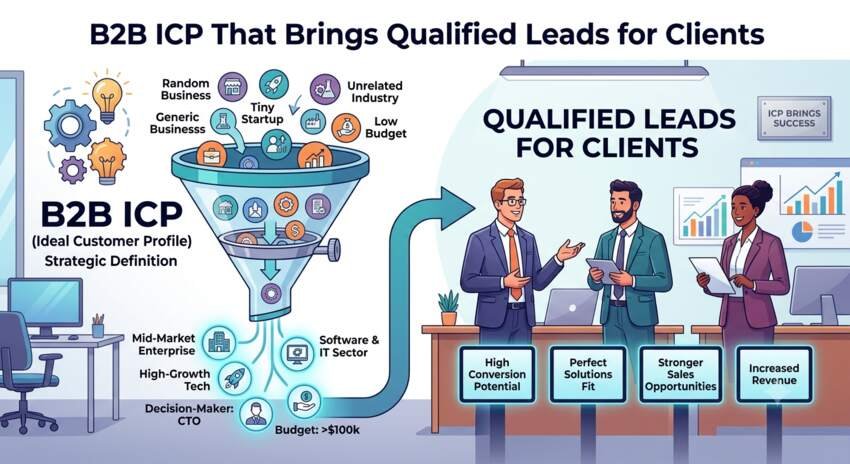
Generating B2B leads is not just about reaching more businesses, collecting email addresses, or increasing the number of people filling out contact forms. The real challenge is finding companies that genuinely need your client’s products or services, have the budget to invest, and are likely to become long-term customers. This is where an Ideal Customer Profile (ICP) becomes important.
A well-defined B2B ICP helps businesses identify the types of companies they should target, understand their purchasing requirements, and build marketing campaigns that attract high-quality prospects. Instead of spending money on audiences that are unlikely to convert, businesses can focus their marketing and sales efforts on accounts with a stronger potential to generate revenue.
For digital marketing agencies, lead generation companies, consultants, and B2B service providers, building an effective ICP is one of the most important steps towards delivering measurable results for clients.
In this guide, we will explain how to build a B2B Ideal Customer Profile from scratch, which characteristics to include, how to identify high-value accounts, and how to use ICP insights to generate qualified leads through SEO, Google Ads, LinkedIn marketing, email campaigns, and account-based marketing (ABM).
What Is a B2B Ideal Customer Profile (ICP)?
A B2B Ideal Customer Profile is a detailed description of the type of company that is most likely to purchase a business’s products or services and receive significant value from them. It focuses on company-level characteristics rather than individual buyer preferences. For example, suppose a marketing agency provides SEO and lead generation services to businesses. Its ideal customers might include:
B2B SaaS companies looking to increase organic traffic and product demonstrations.
Manufacturing companies that want enquiries from distributors and industrial buyers.
Logistics companies seeking qualified enquiries from importers and exporters.
Professional service firms looking to attract high-value corporate clients.
Technology companies expanding into international markets.
These companies may operate in different industries, but they share common characteristics, such as a need for consistent lead generation, an established sales process, and sufficient marketing budgets.
An effective ICP helps a business identify these shared characteristics and use them to create a more focused customer acquisition strategy.
ICP vs Buyer Persona: What Is the Difference?
Although ICPs and buyer personas are closely related, they serve different purposes.
| Comparison Factor | Ideal Customer Profile (ICP) | Buyer Persona |
|---|---|---|
| Main focus | Ideal company or account | Individual decision-maker |
| Target level | Organisation | Person |
| Key characteristics | Industry, revenue, company size, location | Job title, goals, challenges, preferences |
| Main objective | Identify valuable accounts | Understand purchasing behaviour |
| Marketing application | Account targeting and segmentation | Messaging and content personalisation |
| Example | SaaS company with 50–200 employees | Head of Marketing at a SaaS company |
For successful B2B lead generation, both are necessary. Your ICP identifies which companies to approach, while buyer personas help you understand the people responsible for making purchasing decisions.
Why Building a B2B ICP Matters for Qualified Lead Generation
Many businesses struggle with lead quality because their targeting is too broad. They run advertising campaigns, publish content, and send cold emails without having a clear understanding of which companies are most likely to become customers.
A properly developed ICP solves this problem by bringing focus to the entire customer acquisition process. Here are some important benefits.
1. Attracts More Relevant Business Enquiries
When you know the industries, company sizes, locations, and business challenges that match your client’s services, you can create marketing campaigns that reach relevant prospects.
For example, a cybersecurity company targeting enterprise IT departments should not spend most of its advertising budget reaching small businesses that cannot afford its solutions. By narrowing the audience, the company can attract enquiries from organisations with more relevant requirements.
2. Improves Marketing Budget Efficiency
An ICP helps businesses avoid spending money on audiences that have little purchasing potential. Instead of running generic campaigns, marketing teams can focus on specific industries, company sizes, job roles, and buying signals. For instance, a B2B agency might divide its advertising budget as follows:
| Campaign Segment | Budget Allocation | Target Audience |
|---|---|---|
| SaaS companies | 40% | Growing SaaS businesses |
| Manufacturing | 30% | Industrial manufacturers |
| Logistics | 20% | Freight and supply chain companies |
| Testing new segments | 10% | Emerging B2B opportunities |
Illustrative budget allocation, not an industry benchmark. This approach makes it easier to understand which segments generate qualified leads and where additional investment may be justified.
3. Helps Sales Teams Prioritise High-Value Prospects
Not every enquiry deserves the same level of sales attention. An ICP provides a framework for evaluating prospects based on how closely they match the ideal customer characteristics.
For example, a prospect from the right industry, with the appropriate company size, sufficient budget, and an immediate requirement, should generally receive more attention than an organisation that does not match these criteria. This improves sales prioritisation and reduces time spent following up with unsuitable prospects.
4. Creates More Relevant Marketing Messages
Different industries have different business challenges. A manufacturing company may be concerned about distributor acquisition, while a SaaS company may want more product demos and lower customer acquisition costs. An ICP helps marketers develop industry-specific messaging rather than relying on generic promotional content.
5. Supports Long-Term Customer Retention
The objective of an ICP is not simply to acquire customers. It is also to identify businesses that can benefit from a company’s offerings over the long term. When clients work with customers whose requirements match their expertise, they are more likely to deliver satisfactory results, build stronger relationships, and create opportunities for repeat business.
Key Features of a High-Quality B2B ICP
A useful ICP should be based on measurable business characteristics, actual customer data, and purchasing behaviour. The following elements help create a comprehensive profile.
1. Industry and Business Category
Start by identifying the industries where your client’s products or services provide the greatest value. Common B2B industries include:
Information technology and SaaS.
Manufacturing and engineering.
Logistics and transportation.
Healthcare and medical technology.
Financial and professional services.
Construction and infrastructure.
Wholesale and distribution.
E-commerce technology.
Avoid targeting every possible industry. Begin with sectors where your client has existing experience, strong case studies, or a competitive advantage.
2. Company Size and Employee Count
Company size is an important factor because it often influences purchasing requirements, operational complexity, and available budgets. You can classify businesses using employee count.
| Business Segment | Employee Count | Typical Characteristics |
|---|---|---|
| Micro business | 1–10 | Limited teams and smaller budgets |
| Small business | 11–50 | Developing operations and growth needs |
| Mid-sized business | 51–250 | Dedicated teams and structured processes |
| Large enterprise | 251–1,000 | Multiple departments and complex requirements |
| Enterprise | 1,000+ | Large-scale operations and procurement processes |
These are practical segmentation categories rather than universal company-size definitions. For example, a B2B software provider offering enterprise resource planning (ERP) solutions may prioritise manufacturers with 100–500 employees because their operational requirements are more complex.
3. Annual Revenue and Purchasing Capacity
Revenue helps estimate whether a company can afford the products or services being offered. For example:
A business earning ₹50 lakh annually may have limited capacity for an expensive enterprise solution.
A company generating ₹10 crore annually may have more room for specialised technology or marketing investments.
A business generating ₹100 crore or more may have dedicated procurement and technology budgets.
However, revenue should never be treated as the only indicator of purchasing capacity. Profitability, cash flow, growth plans, funding, and budget ownership also matter.
4. Geographic Location
Location plays an important role in B2B customer acquisition, especially when services depend on regional availability, local regulations, or specific markets. For example, an Indian logistics provider might target:
Manufacturers in Ahmedabad and Vadodara.
Exporters in Surat.
Industrial businesses in Pune.
Importers and distributors in Mumbai.
International companies looking for Indian supply chain partners.
A geographic ICP also helps improve local SEO, location-based advertising, and regional sales outreach.
5. Technology and Existing Tools
Technology adoption can reveal whether a company is ready to purchase a particular solution. For example, a marketing automation provider may prioritise businesses already using:
HubSpot.
Salesforce.
Zoho CRM.
Google Analytics 4.
Marketing automation platforms.
Customer data and reporting tools.
If a company already uses related software, it may have a clearer understanding of the problem your client’s solution addresses.
6. Business Challenges and Pain Points
This is one of the most important parts of ICP development. Identify the problems your client’s ideal customers are actively trying to solve. Examples include:
| Industry | Common Business Challenge | Potential Solution |
|---|---|---|
| SaaS | Low product demo bookings | B2B lead generation |
| Manufacturing | Difficulty acquiring distributors | Industrial marketing |
| Logistics | Inconsistent shipment enquiries | SEO and paid advertising |
| Healthcare technology | Limited hospital partnerships | Account-based marketing |
| Professional services | Unpredictable client acquisition | Content marketing and LinkedIn campaigns |
| Cybersecurity | Difficulty reaching enterprise buyers | Targeted outbound marketing |
Understanding these challenges allows marketers to create content and campaigns around actual purchasing needs.
7. Buying Authority and Decision-Making Structure
B2B purchases often involve multiple stakeholders. Depending on the product or service, decision-makers may include:
CEO or Managing Director.
Chief Marketing Officer.
Chief Technology Officer.
Head of Sales.
Procurement Manager.
IT Director.
Operations Manager.
Finance Director.
Your ICP should identify the departments and seniority levels involved in purchasing decisions. This information becomes particularly useful when building LinkedIn audiences, email prospect lists, and sales outreach campaigns.
8. Business Growth Stage
A company’s growth stage can help determine whether it is ready to purchase your client’s services. Consider these categories:
Startups: Looking for affordable solutions, market entry, and initial customer acquisition.
Growing businesses: Need scalable marketing, automation, technology, and operational improvements.
Established companies: Want better efficiency, market expansion, and competitive positioning.
Enterprise organisations: Require customised solutions, integration, compliance, and dedicated support.
For example, a marketing agency specialising in international SEO may prioritise established businesses planning to enter the US, UK, or Australian markets rather than newly launched companies with no expansion plans.
9. Purchasing Intent and Business Signals
An effective ICP should also consider whether a company is showing signs of being ready to purchase. Some useful buying signals include:
Recently raised funding.
Hiring new sales or marketing employees.
Expanding into new geographical markets.
Launching new products or services.
Adopting new technologies.
Increasing advertising activity.
Recruiting business development teams.
Experiencing rapid business growth.
These signals help identify companies that may need your client’s services sooner rather than later.
Step-by-Step Process to Build a B2B ICP That Generates Qualified Leads
Building an ICP requires more than selecting an industry and deciding which company size to target. You need a structured process that connects customer research, business data, market opportunities, and marketing execution. Here is a practical framework.
Step 1: Analyse Your Client’s Existing Customer Base
Start by reviewing your client’s existing customers. Look at their most successful accounts and identify the characteristics they have in common. Collect information such as:
Industry and sub-industry.
Annual business revenue.
Employee count.
Geographic location.
Products or services purchased.
Average contract value.
Customer acquisition cost.
Sales cycle duration.
Customer retention rate.
Profitability and lifetime value.
Pay special attention to customers who generate consistent revenue, stay longer, and require fewer resources to serve. For example, suppose your client has 50 active B2B customers. After analysing their performance, you discover that 30 customers belong to the manufacturing and industrial sectors.
Further analysis shows that these 30 customers generate 65% of total revenue. This indicates that manufacturing companies may represent a stronger ICP segment than other industries. Illustrative example. Actual customer distribution will vary by business.
Step 2: Interview Existing Customers and Sales Teams
Customer data tells you what is happening, but interviews help explain why customers make purchasing decisions. Speak with your client’s sales representatives, account managers, and existing customers. Ask questions such as:
What problem made you search for this solution?
What alternatives did you consider?
Why did you select this particular company?
What was the biggest challenge before purchasing?
Who participated in the final purchasing decision?
What results did you expect?
Which factors influenced your budget approval?
These conversations can uncover valuable insights that may not appear in CRM reports. For example, a logistics company might discover that its most profitable customers are not necessarily the largest manufacturers.
Instead, they are mid-sized exporters that need regular freight forwarding and customs clearance support. This insight can completely change the targeting strategy.
Step 3: Segment the Market Into Specific Business Categories
Once you understand the existing customer base, divide the broader market into meaningful segments. For a B2B digital marketing agency, segmentation could look like this:
| Segment | Industry | Company Size | Main Requirement |
|---|---|---|---|
| A | SaaS and technology | 50–250 employees | Product demos and qualified leads |
| B | Manufacturing | 50–500 employees | Distributor and buyer enquiries |
| C | Logistics | 20–200 employees | Shipment enquiries |
| D | Professional services | 10–100 employees | High-value client acquisition |
| E | Healthcare technology | 50–500 employees | Institutional partnerships |
Do not assume that every segment deserves equal attention. Evaluate each one based on market demand, purchasing capacity, service compatibility, competition, and expected profitability.
Step 4: Identify High-Value ICP Characteristics
Now determine which characteristics separate high-value customers from average or unsuitable prospects. You can create a scoring system based on the factors most relevant to your client’s business. For example:
| ICP Criteria | Weight | Scoring Consideration |
|---|---|---|
| Industry relevance | 25% | Does the business operate in a target industry? |
| Company size | 15% | Does its size match the service offering? |
| Revenue potential | 20% | Can it afford the solution? |
| Business requirement | 20% | Does it have a relevant problem? |
| Geographic fit | 10% | Is it within the target market? |
| Buying readiness | 10% | Is there an active purchasing signal? |
| Total | 100% |
The weights are illustrative and should be adjusted according to the client’s business model. You can score each prospect from 1 to 5 against every criterion. For example, a company scoring 85 out of 100 may be a high-priority account, while a company scoring 45 may require further qualification.
The important point is to make the scoring system reflect actual business value rather than simply giving more points to larger companies.
Step 5: Build Detailed Buyer Personas Alongside the ICP
After identifying the right companies, determine who makes or influences purchasing decisions within those organisations. Consider this example for a B2B SaaS company.
| Buyer Persona | Job Role | Main Concern | Preferred Content |
|---|---|---|---|
| Decision-maker | CEO | Business growth and ROI | Business cases and industry reports |
| Budget owner | CFO | Cost and financial returns | Pricing comparisons and ROI analysis |
| Technical evaluator | CTO | Security and integration | Product demos and technical documentation |
| Daily user | Operations Manager | Ease of use and productivity | Product tutorials and implementation guides |
This information helps your marketing team create different messages for different stakeholders. For example, a CFO may respond to a campaign highlighting cost savings, whereas a CTO may be more interested in integration capabilities and technical performance.
Step 6: Research Competitors and Market Opportunities
Competitor research helps you understand which types of companies are already purchasing similar solutions. Study:
Competitor customer industries.
Service positioning.
Case studies and testimonials.
Target company sizes.
Pricing structures.
Geographic coverage.
Customer reviews.
Marketing channels.
Common customer complaints.
You can also analyse competitors’ website content, LinkedIn activity, advertising messages, and industry-specific landing pages. Look for underserved segments where your client has a competitive advantage.
For example, if most competitors target large enterprises, your client might find an opportunity among mid-sized manufacturers that need specialised solutions but cannot afford enterprise-level pricing.
Step 7: Create a Negative ICP
Identifying unsuitable customers is just as important as identifying ideal customers. A negative ICP defines the types of companies your client should avoid targeting. Examples include:
Companies without sufficient purchasing budgets.
Businesses operating outside the service coverage area.
Organisations with requirements your client cannot fulfil.
Companies with no relevant purchasing need.
Businesses seeking only free consultations or unsupported customisation.
Organisations with unrealistic delivery expectations.
Companies that consistently generate high servicing costs without adequate returns.
A negative ICP helps reduce irrelevant enquiries and allows sales teams to spend more time on suitable opportunities.
Step 8: Validate the ICP Using Actual Lead and Sales Data
Never assume that your first ICP is perfect. Test it against actual marketing and sales performance. Track the following metrics:
Number of leads generated.
Marketing-qualified leads (MQLs).
Sales-qualified leads (SQLs).
Lead-to-meeting conversion rate.
Meeting-to-opportunity conversion rate.
Opportunity-to-customer conversion rate.
Average deal value.
Customer acquisition cost.
Customer lifetime value.
For example, suppose your agency targets two different customer segments.
| Performance Metric | Segment A: SaaS | Segment B: Manufacturing |
|---|---|---|
| Leads generated | 200 | 120 |
| Qualified leads | 40 | 48 |
| Qualified lead rate | 20% | 40% |
| Sales opportunities | 16 | 24 |
| New customers | 4 | 8 |
| Lead-to-customer conversion | 2% | 6.67% |
Illustrative campaign data for explaining ICP validation. Although the SaaS segment generated more enquiries, manufacturing delivered more qualified leads and customers.
This suggests that manufacturing may deserve a larger share of the marketing budget, provided its acquisition costs and customer profitability are also favourable.
B2B ICP Template: A Practical Example for Client Acquisition
To make ICP development easier, here is an example of how a digital marketing agency can define an ideal customer for its B2B lead generation services.
Sample Ideal Customer Profile
Mid-sized B2B manufacturing companies
Illustrative ICP for a B2B marketing agency
| ICP Attribute | Ideal Characteristics |
|---|---|
| Industry | Manufacturing and engineering |
| Company size | 50–500 employees |
| Annual revenue | ₹10–100 crore |
| Location | India, UAE, UK, Australia |
| Decision-makers | CEO, Marketing Head, Sales Director |
| Main requirement | Consistent qualified enquiries |
| Marketing budget | ₹1–5 lakh monthly |
| Growth stage | Established or expanding |
| Technology | CRM, website analytics, digital advertising |
| Buying signals | Market expansion, new product launches |
Primary pain points
Low-quality enquiries from existing campaigns.
Limited online visibility in industrial markets.
Difficulty reaching procurement managers.
Inconsistent distributor and buyer acquisition.
Recommended marketing channelsSEO and industry-specific landing pages.
Google Search Ads.
LinkedIn advertising and outreach.
B2B email marketing.
Account-based marketing.
Expected business outcome
More relevant business enquiries, stronger sales opportunities, and better alignment between marketing expenditure and revenue generation.
This template can be customised for SaaS companies, logistics providers, financial service firms, IT companies, consultants, and other B2B businesses.
How to Use Your B2B ICP to Generate Qualified Leads
Creating an ICP is only the first part of the process. Its real value comes from using it across different marketing and sales channels. Here are some practical ways to turn ICP research into lead generation opportunities.
1. SEO and Content Marketing
Use ICP insights to create content that addresses the specific challenges of your target companies. For example, if your client targets manufacturing businesses, relevant content topics could include:
Digital Marketing Strategies for Manufacturing Companies.
How Manufacturers Can Generate More B2B Enquiries.
SEO Strategies for Industrial Businesses.
Lead Generation Strategies for Industrial Suppliers.
How to Reach Procurement Managers Online.
Create industry-specific service pages, case studies, comparison articles, and educational resources. Key benefit: Your website attracts visitors who are actively searching for solutions related to your client’s services.
2. Google Ads and Paid Search Campaigns
Use your ICP to build more focused Google Ads campaigns. Instead of bidding on broad keywords, target searches that indicate a clear business requirement. For example:
| Broad Keyword | ICP-Focused Keyword |
|---|---|
| Marketing services | B2B marketing agency for manufacturers |
| Software company | CRM software for logistics companies |
| SEO services | SEO agency for SaaS businesses |
| Lead generation | B2B lead generation for industrial companies |
| Freight services | International freight forwarding for exporters |
Create dedicated landing pages for each industry or service category. This makes it easier to align the search query, advertising message, and landing page with the prospect’s actual needs.
3. LinkedIn Marketing and Account-Based Marketing
LinkedIn is particularly useful for reaching professionals involved in B2B purchasing decisions. Use your ICP to filter companies and decision-makers by:
Industry.
Company size.
Job title.
Seniority.
Department.
Location.
Company growth and hiring activity.
For example, if your client sells enterprise software to manufacturing businesses, you can develop campaigns targeting operations directors, IT heads, and managing directors within relevant manufacturing accounts.
Account-based marketing takes this approach further by creating personalised campaigns for a selected list of high-value companies.
4. B2B Email Marketing and Cold Outreach
ICP information helps you build more relevant prospect lists and personalise outreach messages. Instead of sending the same email to hundreds of businesses, segment prospects according to their industry, requirements, and purchasing signals. Example:
Hi [First Name],
I came across [Company Name] and noticed your focus on the manufacturing sector.
Many manufacturing businesses face challenges in generating consistent enquiries from distributors, procurement teams, and potential buyers.
We help B2B companies improve their online visibility and generate more relevant business enquiries through SEO, Google Ads, and targeted lead generation campaigns.
Would you be open to a brief conversation about your current customer acquisition strategy?
Best regards,
[Your Name]
The message works because it addresses a specific industry challenge instead of relying on generic sales language.
5. Marketing Automation and CRM Segmentation
Connect ICP data with your client’s CRM to improve lead management. For example, you can create different lead segments:
High-fit accounts.
Medium-fit accounts.
Low-fit accounts.
Sales-ready prospects.
Long-term nurturing opportunities.
Set up automated workflows based on lead behaviour. A prospect who downloads a pricing guide, visits a service page multiple times, and requests a consultation may deserve faster sales follow-up than someone who only reads a general blog article.
6. Retargeting and Conversion Optimisation
Use ICP information to create retargeting campaigns for relevant website visitors. For example, someone who visits a manufacturing SEO service page can receive advertisements featuring manufacturing case studies, industry-specific results, or consultation offers.
Similarly, landing pages can be customised to address the needs of different ICP segments. This helps maintain message consistency throughout the buying journey.
B2B Lead Qualification: How to Identify the Right Prospects
Not every lead generated through marketing campaigns is a qualified business opportunity. A prospect may download an ebook, submit a contact form, or click an advertisement without having any immediate intention to purchase.
This is why businesses should establish a clear lead qualification framework based on ICP characteristics.
MQL vs SQL vs PQL: Understanding Lead Quality
| Lead Type | Meaning | Example |
|---|---|---|
| Marketing Qualified Lead (MQL) | A prospect showing marketing engagement and potential fit | A manufacturing company downloads an industry guide |
| Sales Qualified Lead (SQL) | A prospect assessed by sales and considered suitable for direct engagement | A manufacturer requests a consultation and has an allocated budget |
| Product Qualified Lead (PQL) | A prospect whose product usage indicates potential purchase readiness | A SaaS user actively uses premium features during a trial |
The qualification process should combine two important factors:
Fit: Does the company match the client’s ICP?
Intent: Is the company showing genuine interest in purchasing?
A company may perfectly match the ICP but have no immediate buying requirement. Similarly, a company may show strong interest but lack the budget or operational suitability. The strongest opportunities generally demonstrate both.
Example of an ICP-Based Lead Scoring Model
You can introduce a 100-point lead scoring system to help sales teams prioritise prospects.
| Scoring Factor | Maximum Points |
|---|---|
| Industry match | 20 |
| Company size | 15 |
| Revenue and budget | 15 |
| Business requirement | 20 |
| Decision-making authority | 10 |
| Purchase intent | 15 |
| Geographic suitability | 5 |
| Total | 100 |
Suggested qualification categories:
80–100 points: High-priority prospect. Send to sales for immediate review.
60–79 points: Potentially qualified. Schedule follow-up and additional research.
40–59 points: Nurture through relevant marketing content.
Below 40 points: Low-priority prospect or disqualified.
These thresholds are suggested starting points, not universal standards. Review them against actual sales outcomes and adjust them over time.
Important B2B ICP Metrics to Measure Performance
An ICP should be evaluated using business performance indicators rather than simply the number of leads generated. The following metrics help determine whether your targeting strategy is working.
| KPI | What It Measures | Why It Matters |
|---|---|---|
| ICP Match Rate | Percentage of leads matching the ICP | Measures targeting accuracy |
| MQL-to-SQL Rate | Percentage of MQLs becoming SQLs | Evaluates lead quality |
| Lead-to-Customer Rate | Percentage of leads becoming customers | Measures acquisition effectiveness |
| Cost Per Qualified Lead | Marketing spend per qualified lead | Evaluates marketing efficiency |
| Customer Acquisition Cost | Total acquisition cost per new customer | Measures acquisition economics |
| Average Deal Value | Average revenue per closed deal | Identifies high-value segments |
| Customer Lifetime Value | Expected revenue from a customer relationship | Evaluates long-term customer value |
| Sales Cycle Length | Time required to close a customer | Helps forecast revenue |
Example: Measuring the Impact of Better ICP Targeting
Suppose a B2B marketing agency spends ₹2,00,000 per month on lead generation. After refining its ICP, the agency compares its campaign performance.
| Metric | Before ICP Refinement | After ICP Refinement |
|---|---|---|
| Total leads | 200 | 120 |
| Qualified leads | 30 | 60 |
| Qualified lead rate | 15% | 50% |
| Marketing spend | ₹2,00,000 | ₹2,00,000 |
| Cost per qualified lead | ₹6,667 | ₹3,333 |
| New customers | 3 | 6 |
Hypothetical example for demonstrating the potential impact of ICP optimisation. Figures are not guaranteed results or industry benchmarks. The interesting point is that the agency generated 40% fewer leads but doubled its qualified leads.
Its cost per qualified lead also decreased by approximately 50%. This demonstrates why lead generation should focus on attracting suitable prospects rather than maximising enquiry volume.
Common Mistakes to Avoid When Building a B2B ICP
Even experienced marketing teams can make mistakes while developing an Ideal Customer Profile. Here are some common problems and how to avoid them.
1. Targeting Too Many Industries
Trying to reach every industry makes marketing campaigns less focused. A marketing agency targeting manufacturers, hospitals, SaaS companies, restaurants, retailers, and financial institutions with the same message will struggle to communicate its value effectively.
Solution: Start with two or three promising industry segments and expand after evaluating their performance.
2. Confusing Buyer Personas With ICPs
A CEO or Marketing Manager is not an ICP. These are individual buyer personas.
Solution: First identify the ideal company, then identify the people responsible for purchasing decisions within that company.
3. Relying Only on Company Revenue
A company with high annual revenue may not necessarily need your client’s services. For example, a large organisation may already have an established internal marketing department and long-term agency partnerships.
Solution: Evaluate revenue alongside business requirements, purchasing intent, budget availability, and service compatibility.
4. Ignoring Negative ICP Characteristics
Marketing teams sometimes focus entirely on finding ideal customers and overlook unsuitable prospects.
Solution: Define which companies should be excluded from advertising campaigns, sales prospecting, and outbound marketing.
5. Building an ICP Without Sales Team Feedback
Marketing teams may believe that certain leads are valuable because they generate enquiries. However, sales representatives often have a better understanding of whether those prospects have genuine purchasing potential.
Solution: Review lead quality with the sales team regularly and use closed-won and lost opportunity data to improve targeting.
6. Never Updating the ICP
Markets change, customer requirements evolve, and new business opportunities emerge. An ICP created two years ago may no longer reflect the client’s current business model.
Solution: Review ICP performance quarterly and conduct a more comprehensive reassessment at least annually or whenever the business strategy changes significantly.
7. Measuring Success Through Lead Volume Alone
A campaign generating 500 enquiries may appear successful, but if only five are qualified, its commercial value could be limited.
Solution: Measure qualified leads, sales opportunities, customer acquisition costs, revenue, and profitability.
B2B ICP vs Traditional Lead Generation: Which Approach Is Better?
Traditional lead generation often focuses on reaching a broad audience and collecting as many enquiries as possible. ICP-based lead generation takes a more targeted approach.
| Comparison | Traditional Lead Generation | ICP-Based Lead Generation |
|---|---|---|
| Targeting | Broad audience | Clearly defined business segments |
| Lead volume | Often prioritised | Quality prioritised |
| Audience research | General market research | Detailed account research |
| Marketing messages | Generic messaging | Industry-specific messaging |
| Lead qualification | Often happens after acquisition | Integrated into targeting and sales |
| Advertising budget | May reach unsuitable prospects | Focuses on relevant segments |
| Sales alignment | Can be limited | Stronger marketing and sales alignment |
| Performance measurement | Total leads and clicks | Qualified leads, opportunities, and revenue |
| Long-term value | Depends on lead quality | Designed around customer fit and value |
Neither approach is automatically successful. However, when the objective is to generate profitable B2B customers, an ICP-based approach provides a stronger foundation for targeted marketing and sales activities.
How to Build and Implement a B2B ICP in 90 Days
If you are developing an ICP for a new client or improving an existing lead generation strategy, a 90-day implementation plan can help organise the process. Here is a practical roadmap.
90-Day B2B ICP Implementation Roadmap
Days 1–15: Customer and business research
Analyse existing customers.
Review CRM and sales data.
Interview sales representatives.
Identify profitable customer segments.
Research phase
Days 16–30: ICP development
Define industry and company size.
Establish revenue and geographic criteria.
Identify pain points and buying signals.
Build buyer personas and negative ICPs.
Strategy phase
Days 31–45: Prospect identification
Research target accounts.
Build prospect lists.
Identify decision-makers.
Introduce lead scoring criteria.
Data preparation
Days 46–60: Marketing campaign launch
Launch targeted SEO and Google Ads campaigns.
Start LinkedIn outreach.
Create personalised email campaigns.
Develop industry-specific landing pages.
Execution phaseDays 61–75: Performance monitoring
Measure qualified lead generation.
Evaluate cost per qualified lead.
Review lead-to-opportunity conversion.
Collect sales team feedback.
Optimisation phaseDays 76–90: ICP refinement and scaling
Identify the best-performing segments.
Remove unsuitable audiences.
Improve messaging and targeting.
Allocate more budget to profitable segments.
Growth phase
At the end of 90 days, your client should have a documented ICP, a validated prospect segmentation strategy, a lead qualification framework, and campaign performance data to support future decisions.
The timeline is a suggested implementation framework. Actual results depend on the sales cycle, available data, budget, and campaign complexity.
Tools to Help Build and Manage a B2B ICP
The right tools make it easier to research companies, identify decision-makers, analyse customer data, and manage qualified prospects. Here are some useful platforms.
Useful for identifying target companies, researching decision-makers, filtering prospects, and discovering relevant account activity. Best for: B2B account research and prospecting.
2. HubSpot CRM
Helps manage contacts, segment leads, track sales activities, and create automated marketing workflows. Best for: CRM management and lead qualification.
Supports B2B prospect discovery, company research, contact identification, and outbound sales activities. Best for: Prospect research and outbound prospecting.
Helps businesses manage accounts, sales opportunities, customer relationships, and complex sales processes. Best for: Enterprise CRM and sales operations.
Provides B2B company and contact intelligence that can support account identification and prospect segmentation. Best for: Company intelligence and prospect research.
Helps analyse website traffic, user acquisition sources, engagement, and conversion behaviour. Best for: Website performance and conversion analysis.
You do not need every tool to build an effective ICP. Start with your client’s CRM, customer records, website analytics, and a reliable prospect research platform.
Add more tools when they solve a specific operational problem. When collecting B2B contact information, also follow applicable privacy, consent, and data protection requirements.
Real-World B2B ICP Examples Across Different Industries
To understand how ICPs work in practice, consider these examples from different B2B business categories.
Example 1: SaaS Company
Business: Cloud-based project management software provider. Ideal Customer Profile:
Industry: IT, consulting, and professional services.
Company size: 50–500 employees.
Decision-makers: CTO, COO, and Operations Head.
Business challenge: Inefficient project management and team collaboration.
Buying signal: Hiring new project managers or expanding operations.
Recommended strategy: LinkedIn marketing, targeted Google Ads, SEO, product demos, and email nurturing.
Example 2: Manufacturing Company
Business: Industrial equipment manufacturer. Ideal Customer Profile:
Industry: Engineering, construction, and manufacturing.
Company size: 50–1,000 employees.
Decision-makers: Procurement Managers, Plant Heads, and Managing Directors.
Business challenge: Finding reliable equipment suppliers.
Buying signal: New production facilities and capacity expansion.
Recommended strategy: Industry-specific SEO, Google Search Ads, technical product pages, distributor outreach, and trade-focused content.
Example 3: Logistics and Freight Forwarding Company
Business: International freight forwarding and customs clearance provider. Ideal Customer Profile:
Industry: Exporters, importers, and manufacturing.
Company size: 20–500 employees.
Geographic focus: India, UAE, and international trade routes.
Decision-makers: Supply Chain Managers, Export Managers, and Procurement Heads.
Business challenge: Reliable international shipping and customs clearance.
Buying signal: Increasing export volumes or entering new international markets.
Recommended strategy: Location-based SEO, Google Ads, logistics industry content, LinkedIn outreach, and targeted email campaigns.
Example 4: B2B Digital Marketing Agency
Business: Full-service digital marketing agency. Ideal Customer Profile:
Industry: SaaS, manufacturing, healthcare technology, and professional services.
Company size: 20–500 employees.
Decision-makers: Founders, CEOs, CMOs, and Marketing Directors.
Business challenge: Inconsistent lead generation and high customer acquisition costs.
Buying signal: New market expansion, marketing team hiring, or increasing advertising expenditure.
Recommended strategy: SEO, Google Ads, LinkedIn campaigns, account-based marketing, and personalised sales outreach.
These examples demonstrate that ICP development should be tailored to the business model, target market, service offering, and purchasing behaviour of each client.
Frequently Asked Questions (FAQs)
1. What is a B2B Ideal Customer Profile (ICP)?
A B2B Ideal Customer Profile is a detailed description of the type of company most likely to purchase a business’s products or services. It includes characteristics such as industry, company size, revenue, location, purchasing capacity, business challenges, and buying signals.
2. How does an ICP help generate qualified B2B leads?
An ICP helps businesses focus their marketing efforts on companies that match their ideal customer characteristics. This improves audience targeting, reduces irrelevant enquiries, supports better lead qualification, and helps sales teams prioritise valuable opportunities.
3. What is the difference between an ICP and a buyer persona?
An ICP describes the ideal organisation a business wants to acquire, while a buyer persona describes the individual decision-maker within that organisation. For example, a manufacturing company with 100–500 employees may be an ICP, while its Procurement Manager or CEO may be a buyer persona.
4. What information should be included in a B2B ICP?
A comprehensive ICP should include industry, company size, annual revenue, geographic location, business model, technology adoption, decision-making structure, purchasing budget, pain points, growth stage, and buying signals.
5. How many ICPs should a B2B company have?
Most businesses should begin with one primary ICP and identify two or three closely related segments. However, companies serving multiple industries or markets may require separate ICPs for different products, services, or customer categories.
6. How do you identify high-quality B2B prospects?
Evaluate prospects using company fit, purchasing capacity, industry relevance, business requirements, decision-making authority, and purchase intent. Combining these characteristics through a lead scoring framework helps identify prospects with stronger conversion potential.
7. Which tools are useful for B2B ICP development?
LinkedIn Sales Navigator, HubSpot CRM, Apollo.io, Salesforce, ZoomInfo, and Google Analytics 4 are useful tools for researching companies, managing customer information, identifying decision-makers, and analysing marketing performance.
8. How often should a business update its ICP?
Businesses should review their ICP performance quarterly and conduct a more comprehensive review annually. However, significant changes in customer demand, market conditions, service offerings, or business strategy may require an earlier update.
9. What is a negative ICP?
A negative ICP defines the companies that are not suitable customers for a business. These may include organisations with insufficient budgets, irrelevant requirements, unsuitable locations, or needs that fall outside the company’s service capabilities.
10. What is the most important KPI for measuring ICP success?
There is no single KPI that measures ICP success. However, qualified lead rate, cost per qualified lead, MQL-to-SQL conversion, opportunity-to-customer conversion, customer acquisition cost, and customer lifetime value provide a more complete picture of performance.
Conclusion: Build a Smarter B2B ICP to Generate Better Business Opportunities
Generating qualified B2B leads requires more than increasing advertising budgets or expanding your prospect lists. It starts with understanding which companies are most likely to benefit from your client’s products or services. A well-defined Ideal Customer Profile provides that direction.
By analysing existing customers, identifying profitable industries, understanding business challenges, researching decision-makers, and evaluating purchasing signals, you can develop a focused customer acquisition strategy.
The next step is to connect your ICP with SEO, Google Ads, LinkedIn marketing, email outreach, CRM segmentation, and account-based marketing. Monitor the results regularly and refine your targeting based on actual lead quality, conversion rates, and customer profitability.
Remember, the objective is not to generate the highest number of enquiries. It is to attract the right businesses, create meaningful sales opportunities, and help clients acquire customers who deliver long-term value. A strong B2B ICP turns lead generation from a volume-driven activity into a more focused, measurable, and revenue-oriented growth strategy.