

Google Ads’ Performance Tracking & Conversion Optimization is a critical aspect of running successful paid campaigns, focused on measuring user actions and continuously improving results. It involves tracking key metrics such as clicks, impressions, conversions, and cost per acquisition (CPA) to understand how effectively ads are driving desired outcomes, whether that’s purchases, sign-ups, or leads.
By implementing tools like conversion tracking, analytics integration, and event-based monitoring, marketers gain deeper insights into user behaviour across the customer journey. This data enables informed decision-making, allowing advertisers to refine targeting, adjust bidding strategies, and optimize ad creatives.
Conversion optimization goes a step further by using techniques such as A/B testing, landing page improvements, and audience segmentation to maximize the value of each click. Together, performance tracking and conversion optimization ensure that advertising budgets are spent efficiently while continuously enhancing return on investment (ROI).
What is Performance Tracking in Digital Advertising?
Google Ads’ Performance Tracking & Conversion Optimization is the backbone of successful digital marketing campaigns. It allows advertisers to measure what happens after users interact with ads, whether they make a purchase, sign up, or take any valuable action. Google Ads provides built-in tools to monitor these actions, known as conversions. Conversion tracking is essentially a free tool that helps businesses understand which ads, keywords, and campaigns are delivering results.
Importance of Conversion Optimization in Google Ads
Without optimization, tracking data is just numbers. Conversion optimization uses this data to improve campaign performance. It ensures your advertising budget is spent efficiently and generates maximum returns.
In simple terms:
- Tracking shows what is happening
- Optimization improves what should happen next
Key Features of Google Ads Performance Tracking

Google Ads performance tracking includes several important features that help advertisers measure and improve their campaigns effectively. One of the core features is conversion tracking, which allows businesses to monitor specific user actions such as purchases, sign-ups, or phone calls after someone clicks on an ad. Along with this, conversion value measurement helps assign a monetary value to each action, enabling advertisers to understand the true return on investment.
Another key feature is attribution modelling, which determines how credit for a conversion is distributed across different touchpoints in the customer journey. Real-time performance data provides instant access to metrics like clicks, impressions, and conversions, allowing marketers to make quick and informed decisions.
Google Ads also offers detailed audience and demographic insights, helping advertisers understand who is engaging with their ads based on factors like age, location, and device. Cross-device tracking further enhances this by showing how users interact with ads across multiple devices, giving a more complete picture of user behaviour.
Additionally, integration with tools like Google Analytics enables deeper analysis of website activity beyond ad interactions. Custom reports and dashboards allow advertisers to focus on specific performance indicators, making analysis more efficient. Finally, features like call tracking and smart bidding insights help optimize campaigns by measuring offline actions and using automated strategies to improve results.
Conversion Tracking System
Google Ads offers a comprehensive system to track user actions across multiple channels.
Website Conversion Tracking
This tracks actions like purchases, form submissions, and downloads. A small code (Google tag) is placed on your website to capture these events.
App Conversion Tracking
It monitors app installs and in-app actions, helping businesses understand mobile user behaviour.
Offline Conversion Tracking
This feature connects CRM data with Google Ads, allowing businesses to track actions like signed contracts or in-store purchases.
Google Tag & Tag Manager Integration
The Google tag simplifies data collection across websites and apps, improving accuracy and enabling seamless tracking.
Cross-Device Tracking Capabilities
Users often switch devices before converting. Google Ads can track these cross-device interactions, giving a more complete view of customer journeys.
Advanced Conversion Optimization Features in Google Ads
Advanced conversion optimization features in Google Ads go beyond basic tracking by using smart tools like automation, audience signals, and machine learning to improve results. They help you understand not just what users do, but why they convert, making it easier to fine-tune your ads, targeting, and landing pages.
In simple terms, these features act like a guide, continuously learning from user behaviour and helping you make better decisions so your campaigns deliver stronger, more meaningful outcomes.
Smart Bidding Strategies
Smart Bidding uses machine learning to optimize bids automatically based on conversion data.
Target CPA & Target ROAS
- Target CPA (Cost Per Acquisition): Focuses on getting conversions at a specific cost.
- Target ROAS (Return on Ad Spend): Optimizes for maximum revenue.
These strategies rely heavily on accurate conversion data to perform effectively.
Maximize Conversions Strategy
This strategy automatically adjusts bids to generate the highest number of conversions within your budget.
Optimization Score & Recommendations
Google Ads provides an optimization score (0–100%) that indicates how well your campaigns are set up for success. It also offers actionable recommendations to improve performance.
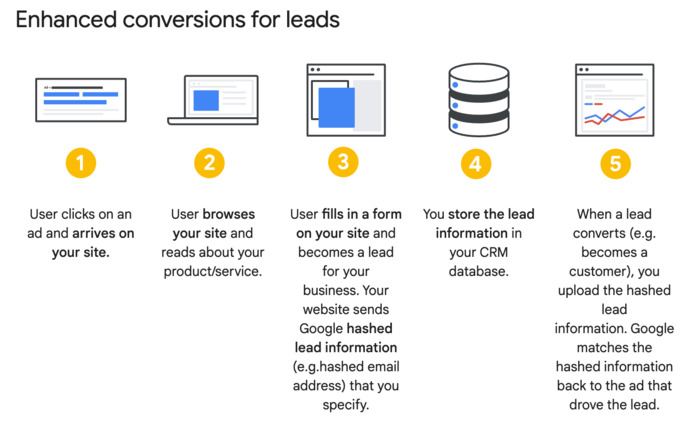
Enhanced Conversions
Enhanced conversions improve tracking accuracy by using first-party data in a privacy-safe way, especially useful in a cookie-less environment.
Metrics That Drive Optimization in Google Ads
Metrics that drive optimization in Google Ads are like your campaign’s health check, they show you what’s working and what needs attention. Key numbers like click-through rate (CTR), cost per conversion, and return on ad spend (ROAS) help you understand how people are interacting with your ads.
When you look at these metrics regularly, it becomes easier to make smarter decisions, whether it’s tweaking your ad copy, adjusting your budget, or refining your audience, so your campaigns keep improving over time.
Conversion Rate
The percentage of users who complete a desired action after clicking an ad.
Conversion Value
Measures the financial value of conversions, helping businesses focus on high-value actions.
Return on Ad Spend (ROAS)
ROAS calculates how much revenue is generated for every dollar spent on ads.
Benefits of Google Ads Performance Tracking

Google Ads performance tracking helps you clearly see what’s actually working in your campaigns and what’s not, so you’re not just guessing where your money is going. It gives you real insights into how people interact with your ads, whether they click, convert, or drop off, so you can make smarter, more confident decisions.
The biggest benefit is control and efficiency. With the right data in front of you, you can fine-tune your ads, spend your budget more wisely, and focus on what truly brings results. Over time, this means better performance, higher returns, and campaigns that keep getting stronger with every improvement.
Improved ROI Measurement
Businesses can clearly see which campaigns generate revenue and adjust strategies accordingly.
Better Audience Insights
Tracking helps identify customer behaviour patterns, preferences, and buying journeys.
Data-Driven Decision Making
Instead of guessing, marketers rely on real data to make informed decisions.
How Conversion Data Improves Campaigns in Google Ads?
Conversion data in Google Ads is like a feedback loop that shows you what’s actually driving results, not just clicks, but real actions like purchases or sign-ups. It helps you understand which keywords, ads, and audiences are truly working, so you can focus your efforts where they matter most.
Instead of guessing, you’re making decisions based on real behaviour. Over time, this means you can refine your targeting, improve your messaging, and allocate your budget more effectively, leading to campaigns that feel smarter, more efficient, and consistently better at delivering results.
Campaign Refinement
Conversion data helps identify underperforming campaigns and optimize them.
Keyword Optimization
Advertisers can focus on keywords that drive conversions rather than just traffic.
Budget Allocation
Funds can be redirected to high-performing campaigns for better returns.
Common Challenges & Solutions of Conversion Data in Google Ads
Working with conversion data in Google Ads can be incredibly valuable, but it also comes with a few common challenges that many advertisers face. One major challenge is inaccurate or incomplete tracking.
If conversion tracking isn’t set up properly, you might miss important actions or double-count results. The solution is to regularly audit your tracking setup, test conversions, and ensure everything is firing correctly so you can trust your data.
Another issue is low conversion volume, especially in new or small campaigns. When there isn’t enough data, it becomes harder to make informed decisions or use automated bidding effectively. In this case, expanding your audience, adjusting budgets, or focusing on higher-traffic keywords can help generate more data over time.
Many advertisers also struggle with attribution, understanding which touchpoints deserve credit for a conversion. Relying on a single model can be misleading, so exploring different attribution models can give a more balanced view of performance.
Data interpretation can also be tricky. Seeing numbers is one thing, but knowing what actions to take is another. A practical approach is to focus on a few key metrics and make gradual changes instead of trying to fix everything at once.
Lastly, privacy changes and tracking limitations can affect how much data you can collect. While this can’t be fully controlled, using first-party data, consent-based tracking, and integrated tools can help you adapt and continue optimizing effectively.
Overall, the key is to treat conversion data as a guide, keep testing, stay flexible, and use insights to continuously improve your marketing campaigns.
Data Accuracy Issues
Improper tag implementation can lead to incorrect data. Solution: Use tools like Google Tag Manager and test tracking regularly.
Privacy & Consent Compliance
With increasing privacy regulations, tracking must comply with user consent policies.
Best Practices for Conversion Optimization in Google Ads
Best practices for conversion optimization in Google Ads are all about making small, smart improvements that add up over time. It starts with understanding your audience, what they need, what they’re searching for, and what motivates them to take action. From there, creating clear, relevant ads and matching them with user-friendly landing pages can make a big difference in turning clicks into real results.
It’s also important to keep testing and learning. Simple changes like tweaking your ad copy, experimenting with different headlines, or adjusting your targeting can reveal what truly works. By regularly reviewing your data and making gradual improvements, you can build campaigns that feel more aligned with your audience and consistently perform better.
Setting Clear Goals
Define what counts as a conversion (sales, leads, downloads).
Using Automation Effectively
Leverage Smart Bidding and automated recommendations.
Continuous Testing & Experimentation
Use A/B testing and campaign experiments to improve performance.
FAQs on Google Ads’ Performance Tracking & Conversion Optimization
1. What is Google Ads conversion tracking?
Google Ads conversion tracking is a powerful feature that helps you understand what happens after someone clicks on your ad. Instead of just seeing clicks and impressions, you can track meaningful actions like purchases, form submissions, phone calls, or newsletter sign-ups.
Think of it as a way to connect the dots between your advertising efforts and actual business results. It gives you clear insights into what’s working and what’s not, so you can make smarter decisions and focus on strategies that truly drive growth.
2. Why is conversion optimization important?
Conversion optimization is all about getting the most value from your advertising budget. It’s not just about bringing people to your website, it’s about encouraging them to take action once they arrive.
By improving elements like ad copy, targeting, and landing page experience, you can increase the chances of turning visitors into customers. This means better returns on your investment, lower wasted spend, and more efficient campaigns that consistently deliver results.
3. What are Smart Bidding strategies?
Smart Bidding strategies in Google Ads use advanced machine learning to automatically adjust your bids in real time. Instead of manually setting bids for every keyword or audience, Google analyzes a wide range of signals, such as user behaviour, device, location, and time of day, to determine the best bid for each auction.
The goal is to maximize conversions or conversion value while staying within your budget. It’s like having an intelligent assistant constantly optimizing your campaigns behind the scenes.
4. How does cross-device tracking work?
Cross-device tracking allows you to see how users interact with your ads across different devices, such as smartphones, tablets, and desktops. For example, someone might click your ad on their mobile phone but complete a purchase later on their laptop. Without cross-device tracking, this journey would look incomplete.
By connecting these interactions, you get a more accurate picture of the customer journey, helping you understand how people really engage with your brand and where your ads are making an impact.
5. What is ROAS in Google Ads?
ROAS, or Return on Ad Spend, is a key metric that tells you how much revenue you earn for every amount you spend on advertising. For example, if you spend ₹1,000 on ads and generate ₹5,000 in revenue, your ROAS is 5:1. It’s a simple yet powerful way to measure the effectiveness of your campaigns. A higher ROAS means your ads are performing well and generating strong returns, while a lower ROAS may indicate that adjustments are needed.
6. How can I improve my conversion rate?
Improving your conversion rate requires a combination of strategy, testing, and continuous refinement. Start by targeting the right audience, people who are genuinely interested in your product or service. Next, ensure your landing pages are clear, fast-loading, and user-friendly, with strong calls-to-action that guide visitors toward taking the next step.
You can also experiment with different ad creatives, headlines, and offers to see what resonates best. Leveraging Smart Bidding strategies and regularly analyzing your data will help you identify opportunities for improvement and steadily increase your results over time.
Conclusion
Google Ads’ Performance Tracking & Conversion Optimization is essential for any business aiming to succeed in digital advertising. By leveraging advanced tracking tools, automation, and data-driven insights, businesses can significantly improve their ROI and campaign efficiency. With features like conversion tracking, Smart Bidding, and enhanced data insights, advertisers can move beyond guesswork and make strategic decisions that drive real results.