

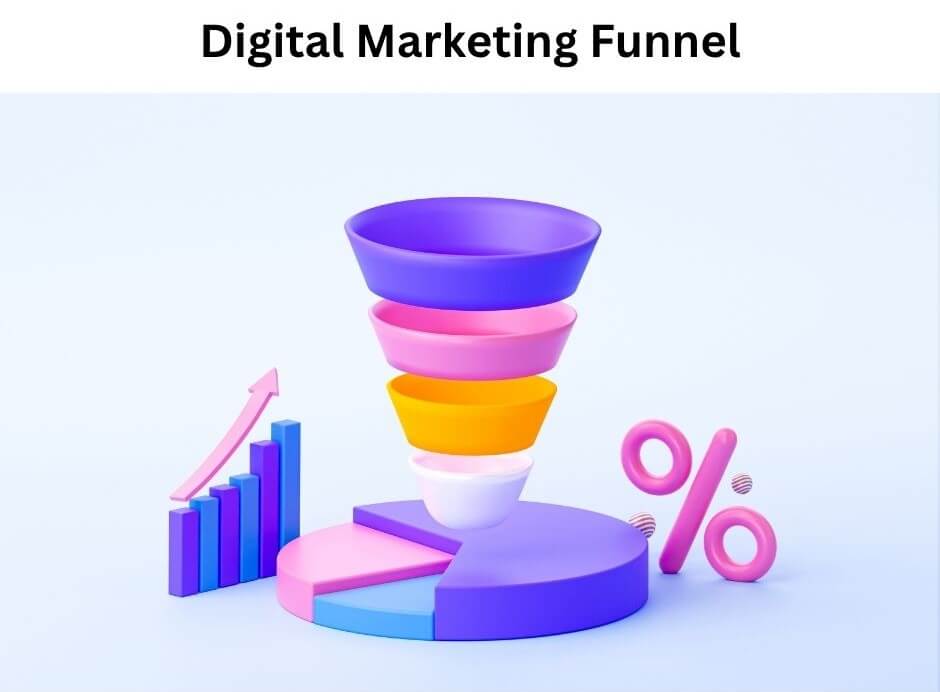
We’ve all been there and many professionals are still going through that way. You’ve decanted hours into crafting the seamless digital marketing funnel. You’ve got compelling ads, a glossy landing page, and an exciting lead magnet. Yet, the leads aren’t rolling in.
It means your digital marketing funnel doesn’t perform. Your funnel, it appears, is less of a sensibly constructed pathway and more of a dripping bucket.
It’s an annoyingly common scenario. The digital marketing funnel is a crucial model for guiding likely customers, but it’s not a magical bullet. If yours isn’t distributing, it’s likely suffering from one or more serious flaws. Let’s dive into the most common reasons your digital marketing funnel isn’t producing leads and, more prominently, how to patch those leaks.
Why is Your Digital Marketing Funnel a Failure?
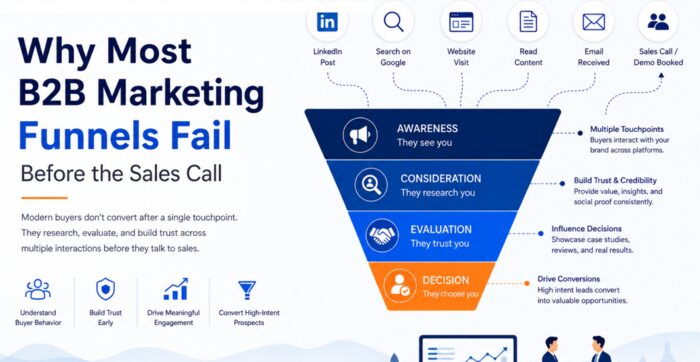
You’re Casting Your Net in the Wrong Pond: Misguided Audience Targeting
Visualize trying to sell snow shovels in a humid bliss. Sounds illogical, right? Yet, several businesses make a parallel mistake by targeting the wrong audience.
- The Problem: Your marketing efforts might be generating clicks and website visits, but if these visitors aren’t sincerely interested in your product or service, they’ll never convert into quality leads. This leads to high traffic numbers but awful conversion rates. You might be fascinating “curious” visitors rather than “potential customers.”
- The Fix: Go back to basics. Evidently outline your Ideal Customer Profile (ICP). What are their demographics? What are their pain points? Where do they spend their time online? Usage this evidence to polish your ad targeting, content topics, and keyword strategy. Appeal to the right people, not just any people.
The User Journey is a Rocky Road: Poor User Experience (UX)
Even if you charm the flawless audience, a bouncy journey will send them running. Friction in your funnel acts like a smooth on enthusiasm.
- The Problem:
- Slow & Cluttered Websites: If your landing pages gross ages to load, are confusing to navigate, or aren’t optimized for mobile devices, visitors will bounce quicker than you can say “conversion.”
- Form Fatigue: Asking for too much information (phone number, company size, blood type?) too primary in the lead generation process is a vast deterrent. People are uncertain to give up personal data until they trust that it is reputable.
- Invisible CTAs: If your Call-to-Action (CTA) is general (“Click Here”) or gets lost in the page design, visitors won’t distinguish what you need them to do next.
- Slow & Cluttered Websites: If your landing pages gross ages to load, are confusing to navigate, or aren’t optimized for mobile devices, visitors will bounce quicker than you can say “conversion.”
- The Fix:
- Optimize for Speed and Clarity: Confirm your website and landing pages load swiftly, are visually tempting, and have a clear, logical flow.
- Simplify Forms: Only ask for crucial information at the early lead capture stage (e.g., name and email). You can gather more data later through broadminded profiling or during a sales conversation.
- Prominent & Benefit-Oriented CTAs: Make your CTAs stand out and evidently state the advantage of clicking (e.g., “Download Your Free Guide,” “Get a Free Demo”).
- Optimize for Speed and Clarity: Confirm your website and landing pages load swiftly, are visually tempting, and have a clear, logical flow.
Your Offer Falls Flat: Weak Content or Irrelevant Lead Magnets
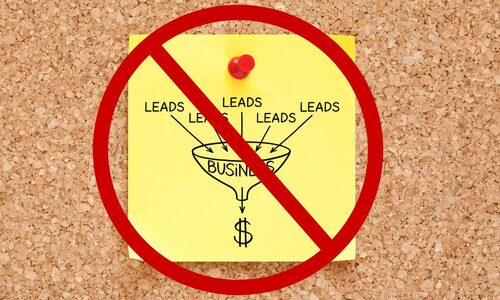
What are you offering in exchange for a prospect’s respected contact information? If it’s not captivating, they won’t taste.
- The Problem:
- Mismatched Messaging: If your ad aptitudes one thing, but the landing page delivers something else, you instantly lose your audience’s faith.
- Unimpressive Lead Magnets: A nonspecific e-book from five years ago or a “sign up for our newsletter” widget won’t cut it. The bid desires to deliver perceptible value and address a precise pain point.
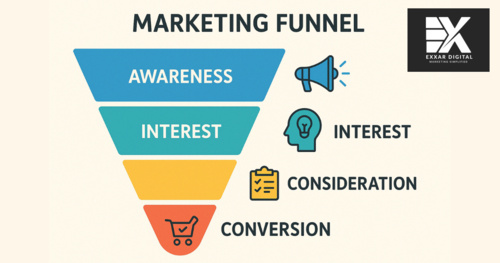
- Selling Too Soon: At the top of the funnel (Awareness Stage), people are researching problems, not vendors. Blatantly salesy content at this stage will isolate prospects.
- Mismatched Messaging: If your ad aptitudes one thing, but the landing page delivers something else, you instantly lose your audience’s faith.
- The Fix:
- Ensure Message Congruence: Double-check that your ads, landing pages, and bids are all melodic the same tune.
- Create Irresistible Lead Magnets: Develop high-value assets like inclusive guides, actionable checklists, special templates, or free tools that straight solve a problem for your target audience.
- Educate, Don’t Just Sell: Craft enlightening content for the primary stages of the funnel. Position yourself as a supportive expert, not just a salesperson.
- Ensure Message Congruence: Double-check that your ads, landing pages, and bids are all melodic the same tune.
The Funnel Has a Giant Hole: A Broken Lead Nurturing Process
Getting a lead is only half the battle. Numerous funnels stop cold after the primary contact, leaving hopeful prospects to go stale.
- The Problem:
- No Follow-Up: A downloaded guide or a webinar sign-up doesn’t mean a sale is forthcoming. Without an arranged follow-up, leads overlook about you.
- Generic Communication: Sending a similar bland email system to each lead, irrespective of their precise interest or entry point into your funnel, is detached and inappropriate.
- Selling Too Soon (Again): Pushing for a demo or a purchase too destructively in primary nurturing emails will scare off leads who aren’t prepared.
- No Follow-Up: A downloaded guide or a webinar sign-up doesn’t mean a sale is forthcoming. Without an arranged follow-up, leads overlook about you.
- The Fix:
- Automated Nurturing Sequences: Implement email automation that distributes valuable, pertinent content over time, guiding leads through the Consideration and Decision stages.
- Segment & Personalize: Segment your leads based on their interests, actions, or where they are in the buying cycle. Tailor your communication to address their precise requirements.
- Build Trust, Then Convert: Emphasis on building an association and providing value. Announce calls to action for demos or consultations when the lead has revealed clear signs of engagement and intent.
- Automated Nurturing Sequences: Implement email automation that distributes valuable, pertinent content over time, guiding leads through the Consideration and Decision stages.
You’re Flying Blind: Lack of Analytics and Optimization
The digital marketing scenery is moving ahead. What worked yesterday might not work today. Without constant monitoring and adjustment, your funnel will become unproductive.
- The Problem:
- “Set It and Forget It” Mentality: Assuming your funnel will continually accomplish without intervention is a formula for failure.
- Ignoring the Data: You might have Google Analytics or CRM data, but if you’re not frequently reviewing it to recognize holdups and drop-off points, you can’t fix them.
- “Set It and Forget It” Mentality: Assuming your funnel will continually accomplish without intervention is a formula for failure.
- The Fix:
- Implement Robust Analytics: Routine tools like Google Analytics, your CRM, and marketing automation platforms to pathway key metrics at each stage of your funnel (e.g., click-through rates, conversion rates, bounce, form achievement rates).
- Regular A/B Testing: Uninterruptedly test diverse elements: headlines, ad copy, CTA buttons, form fields, email subject lines, and landing page layouts. Even small enhancements can suggestively increase lead generation.
- Iterate and Optimize: Use the data to classify weak points and then thoroughly progress them. This is an ongoing procedure, not a one-time task.
- Implement Robust Analytics: Routine tools like Google Analytics, your CRM, and marketing automation platforms to pathway key metrics at each stage of your funnel (e.g., click-through rates, conversion rates, bounce, form achievement rates).
Here are the most shared motives why a digital marketing funnel fails to produce leads:
- Targeting the Wrong Audience
- Unqualified Traffic: If your marketing efforts (ads, content, SEO) are appealing to people who are interested but not an ideal fit for your product/service, they will never become quality leads. You’ll get high traffic but zero conversions.
- Poor Audience Definition: You haven’t clearly defined your Ideal Customer Profile (ICP) and their specific pain points. Generic messaging attracts no one effectively.
- Friction and Poor User Experience (UX)
- Confusing/Slow Website: If your landing pages are messy, load slowly, or are not mobile-optimized, visitors will purely leave (high bounce rate) before they can even arrive at the lead stage.
- Too Much Friction on Forms: Asking for too much information (e.g., company name, job title, phone number) too early in the funnel scares people off. They are not ready for a long commitment.
- Unclear Next Steps (CTAs): If the Call-to-Action (CTA) is weak (“Click Here”) or not prominent, visitors won’t know what to do next to become a lead.
- Weak or Misaligned Content/Offer
- Misaligned Messaging: The ad or piece of content that got the person to click doesn’t match the landing page or the offer. This breaks trust immediately.
- Weak Lead Magnet/Offer: The incentive you’re offering to exchange for contact information (the “lead magnet” like an e-book, checklist, or webinar) isn’t valuable, relevant, or compelling enough to justify giving up their email address.
- Selling Too Soon: Your content at the top of the funnel (Awareness stage) is overly promotional instead of educational. People in the early stages are researching problems, not vendors.
- A Broken Lead Nurturing Process
- Gaps Between Stages (The “Leaky” Funnel): Many funnels stop once the lead magnet is downloaded. If you don’t have an automated, relevant email sequence to follow up, educate, and build a relationship, the lead goes “cold.”
- Lack of Personalization: Sending a one-size-fits-all email sequence to every lead, regardless of which content they downloaded or which page they visited, makes your brand feel generic and irrelevant.
- No Follow-Up: Leads often require multiple touch-points (an average of 8+) before they are ready to buy. Failing to follow up consistently and strategically means a lost opportunity.
- Lack of Analytics and Optimization
- “Set It and Forget It”: Funnels are not a one-time setup. Without constant monitoring and A/B testing, you can’t identify where the “leaks” are. You need to know which stage has the highest drop-off rate.
- Ignoring Data: Having analytics (like Google Analytics, CRM data, etc.) but failing to act on them prevents you from fixing the bottlenecks (e.g., “Our form completion rate is 50%, but our form fill rate is only 10%. We need to shorten the form.”)
In short, a digital marketing funnel is a tool, not a guarantee. It requires a clear strategy, high-quality execution, a customer-centric focus, and continuous optimization to effectively guide a prospect from visitor to qualified lead.
A fruitful digital marketing funnel isn’t about setting it up once and waiting for leads to flood in. It’s about tactical design, incessant monitoring, and persistent optimization.
By addressing these mutual pitfalls, you can transform your dripping strainer into a significant lead-generating machine. What’s the biggest challenge you face with your digital marketing funnel? Share your thoughts in the comments below!