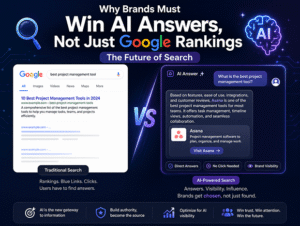


The world of Search Engine Optimization (SEO) is in a relentless state of flux, but perhaps no force has brought about such noteworthy shifts as Artificial Intelligence (AI). From how content is being created to how search engines comprehend and rank information, AI is reshaping the scenery at an unparalleled pace. For SEO professionals and content creators, this isn’t a threat; it’s a chance to progress and refine strategies.
So, how do you navigate SEO in the age of AI? It’s all about converging on core values while acceptance new technologies and seeing the subtle (and not-so-subtle) changes in user behavior and search engine algorithms.
SEO Best Practices in the Age of AI
The new rule for SEO in the Age of AI is simple: write for humans first, then gently optimize for the machine.
The best practice is to focus relentlessly on people-first content that demonstrates real E-E-A-T (Experience, Expertise, Authoritativeness, and Trustworthiness). Don’t just chase keywords; provide genuine, in-depth value, answer common questions directly, and structure your information clearly with headings and lists.
To humanize this approach, you must inject your unique perspective, share personal stories, use a conversational tone, and fact-check any AI-generated drafts to ensure accuracy and authentic opinion. The goal is to make content that is so helpful, trustworthy, and engaging that it naturally becomes the source an AI model wants to cite.
The Enduring Power of High-Quality, Human-Centric Content
While AI tools can produce content at amazing speeds, the demand for sincerely insightful, authoritative, and engaging human-written content remains dominant.
- Expertise, Experience, Authority, Trust (E-E-A-T) is More Critical Than Ever: Google’s emphasis on E-E-A-T endures to cultivate. AI-generated content frequently struggles to carry factual expertise or personal experience. Emphasis on representing profound knowledge, providing exclusive insights, and building faith with your audience. This means citing sources, including author bios, and ensuring realistic precision.
- Originality and Depth: Don’t just regurgitate data. AI outshines at brief existing data. Your content desires to offer fresh viewpoints, crack complex problems, or provide in-depth analysis that goes outside what an AI can speedily assemble.
- Engagement is Key: AI can write comprehensible sentences, but can it certainly fascinate an audience, induce emotion, or spark discussion? Human writers recognize tone, humor, and storytelling. Emphasis on creating content that resounds with your readers, keeping them on the page and inspiring interaction.
Semantic SEO and Topic Clusters
AI-powered search engines are far more classy than their keyword-matching forerunners. They recognize the meaning and context behind queries.
- Move Beyond Keywords, Embrace Topics: Instead of merely targeting distinct keywords, ponder in terms of inclusive topics and subtopics. What are all the associated questions a user might ask about a specific subject?
- Implement Topic Clusters: Organize your content into “pillar pages” that deliver a broad summary of a topic, reinforced by “cluster content” that probes into detailed subtopics. Link these pages tactically to shape semantic authority. This aids search engines realize the depth of your expertise on a subject.
- Leverage Latent Semantic Indexing (LSI) Keywords: These are terms semantically linked to your main keyword. AI helps recognize these connections. Using them naturally in your content signals to search engines a profounder considerate of the subject.
Optimizing for Conversational Search and Voice SEO
Voice search assistants like Siri, Alexa, and Google Assistant are powered by AI and are changing how people query info.
- Answer Direct Questions: Voice queries are frequently phrased as natural language questions (e.g., “What’s the best Italian restaurant near me?”). Optimize your content to straight answer these questions, possibly in an FAQ section or with clear, brief headings.
- Use Long-Tail Keywords: Voice search tends to contain longer, more informal phrases. Research and target these lengthier keyword variations.
- Featured Snippets are Gold: Google often pulls answers for voice queries straight from featured snippets. Structure your content to be a chief candidate for these projecting search results.
User Experience (UX) as an AI Ranking Factor
AI algorithms are progressively intensive on empathetic user fulfilment. An optimistic user experience signals high-quality content and a reliable site.
- Core Web Vitals: These metrics (Loading Performance, Interactivity, Visual Stability) are directly related to UX and are confirmed ranking factors. Optimize your site for speed, responsiveness, and stability.
- Mobile-First Indexing: This isn’t new, but it’s more important than ever. Ensure your site offers a seamless experience on mobile devices.
- Intuitive Navigation and Readability: AI can “read” your site’s structure. Make it easy for users (and bots) to find what they’re looking for. Use clear headings, short paragraphs, and accessible language.
Embracing AI Tools for SEO Efficiency
While human creativity remains king in Search Engine Optimisation, AI can be an amazingly influential supporter.
- Keyword Research: AI-powered tools can discover hidden keyword opportunities, analyze competitor strategies, and foresee search trends more competently.
- Content Ideation and Outlining: Use AI to breakthrough blog post ideas, produce outlines, and even write preliminary drafts that a human editor can then refine and uplift.
- Technical SEO Audits: AI can rapidly scan your site for technical issues like broken links, crawl errors, and site speed problems.
- Data Analysis: AI can aid you make sense of massive amounts of data from Google Analytics and Search Console, classifying patterns and opportunities that might otherwise be missed.
Imagine AI helping to modernize your content creation progression, freeing up human writers for higher-level tasks:
Data Integrity and Structured Data for AI Consumption
AI-powered search engines, like humans, essential efficient data to entirely comprehend the context of your page. Treating your site as a database for AI is crucial.
- Implement Structured Data (Schema Markup): This is the language AI appreciates best. Use relevant Schema types (e.g., Article, FAQPage, Product, Recipe) to obviously tell search engines what your content means, not just what it says. This is critical for entitlement in rich results and Knowledge Graph inclusion.
- Zero-Party and First-Party Data Focus: With privacy concerns rising, third-party cookies are decreasing. AI models worth branded data. Attention on collecting and utilizing zero-party data (data users voluntarily share, like preferences) and first-party data (data collected straight from user interactions on your site). This exclusive data can inform content strategy and personalised user experiences, which AI rewards.
- Maintain Data Accuracy: Subsequently AI often masses information from multiple sources, inaccuracies on your site can rapidly lead to a loss of trust and authority. Implement severe fact-checking and real-time data synchronization (particularly for inventory, pricing, or event details).
Technical SEO: The Non-Negotiable Foundation for AI Crawling
AI algorithms rely on flawlessly structured, crawlable websites. Any technical barrier can restrict the AI from correctly assessing your content’s value.

- Crawl Budget Optimization: With the explosion of content (much of it AI-assisted), search engine bots are more choosy. Safeguard your robots.txt and sitemap proficiently guide crawlers to your most vital, high-quality pages, maximizing your crawl budget.
- Canonicalization and Deduplication: AI-generated content can upsurge the risk of duplicate content. Use canonical tags authentically to agree the single, authoritative version of a page, avoiding dilution of link equity and misperception for the AI.
- Accessibility as a Ranking Factor: AI systems are progressively prioritizing sites that are reachable to all users (screen readers, keyboard navigation, etc.). Treating convenience as an essential technical necessity is not only ethical but also directly impacts your SEO performance, as it signals a high-quality user experience.
Adaptability and Monitoring the AI-SEO Feedback Loop
The AI landscape is fluid. An effective SEO strategy requires nonstop testing and an agile tactic to algorithm changes.
- Continuous Learning and Tool Adoption: Stay current on chief Large Language Model (LLM) updates and how they impact search ranking and content generation. Be ready to integrate new AI tools into your workflow that propose competence and strategic advantages.
- Monitor SERP Feature Shifts: AI is swiftly changing the Search Engine Results Page (SERP) with new features like Generative AI Overviews or advanced carousels. Monitor which SERP features your content qualifies for (and why) and regulate your structure and formatting (e.g., using lists, tables, and short paragraphs) to target them.
Analyze User Intent Nuances: AI benefits search engines well forecast user intent. Your analytics must progress beyond humble keyword metrics. Analyze engagement signals (time on page, scroll depth, bounce rate) precisely for diverse user intents (informational vs. transactional) to recognize if your content actually satisfies the multifaceted requirements identified by the AI.
Conclusion: A Symbiotic Relationship
The age of AI in SEO is not about humans versus machines; it’s about a reciprocal relationship. AI can knob the heavy lifting of data analysis, technical audits, and even initial content drafts, permitting human SEOs and content creators to emphasis on strategy, creativity, and building honest connections with their audience.
By arranging high-quality, human-centric content, thoughtful semantic search, optimizing for conversational queries, confirming an outstanding user experience, and tactically leveraging AI tools, you can not only endure but thrive in this exhilarating new era of SEO. The future of search is intellectual, and your strategy should be too.