
In today’s competitive digital world, businesses can no longer trust exclusively on traditional marketing. Whether you own a startup, run a local business, or manage a growing enterprise, hiring a digital marketing agency can accelerate growth, reinforce your online presence, and improve customer engagement.
But before you partner with one, it’s significant to understand what precisely you can expect from the onboarding process to strategy development, communication, reporting, and results. This guide will benefit you make informed decisions and get the most value from your investment.
Things to Check Before Hiring a Digital Marketing Agency
A Clear Understanding of Your Business Goals Before Going Digital
Before embarking on a digital transformation, it’s decisive to have a clear understanding of your detailed business goals. These goals should outline what you hope to achieve, such as increasing sales, improving operational effectiveness, or enhancing customer experience.
Without clearly well-defined objectives, your digital initiatives risk being unclear, wasting resources, and failing to deliver meaningful return on investment (ROI). An accurate understanding ensures that all technology choices and implementation strategies straight support the desired business outcomes.
A professional digital marketing agency doesn’t jump straight into campaigns. The first step is to consider your business:
- Your products or services
- Your target audience
- Your current marketing challenges
- Your short- and long-term goals
Expect discussions around revenue targets, brand positioning, customer pain points, and your competitive environment. This discovery phase supports creating a strategy tailored to your detailed requirements.
A Comprehensive Digital Marketing Strategy
An all-inclusive digital marketing strategy is a long-term, high-level blueprint that aligns all online activities, such as SEO, content marketing, social media, and paid advertising, with your overarching business objectives.
It begins with defining clear, measurable goals (like cumulative lead generation or brand awareness) and developing thorough buyer personas to comprehend your audience.
The strategy safeguards that every digital touchpoint is coordinated, data-driven, and unceasingly optimized using analytics to maximize ROI and establish lasting customer relationships.
Once the digital marketing agency recognizes your business, they build a customized plan. This frequently includes:
- SEO (Search Engine Optimization) for organic visibility
- PPC advertising (Google Ads, Meta Ads, etc.)
- Social media marketing
- Content marketing & blogging
- Email marketing & automation
- Website optimization and landing page improvements
A reliable marketing agency will clarify why each element is significant and how it aligns with your goals.
Transparent Pricing and Clear Deliverables from Digital Marketing Agency
Choosing a digital marketing agency entails transparent pricing and a clear definition of deliverables to build belief and accountability. Agencies should deliver a thorough breakdown of all costs, including retainers, ad spend management fees, and project-based rates, avoiding hidden charges.
Equally significant is establishing clear, measurable outputs (the deliverables), such as a quantified number of blog posts, expected SEO ranking improvements, or certain hours of consultation, so that both parties know exactly what achievement looks like and what services are being paid for. This simplicity confirms the client can truthfully assess the return on investment (ROI).
One of the major concerns clients have is cost. A good agency provides:
- A clear pricing structure
- Transparent monthly retainers or project-based fees
- A defined scope of work
- Expected timelines
You should know precisely what you’re paying for, whether it’s ads management, content creation, SEO audits, or analytics tracking.
Expert Execution, Tools, and Technology Being Used by Digital Marketing Agency
Expert execution in a digital marketing agency relies profoundly on a classy MarTech (Marketing Technology) stack and specialized team expertise. This stack naturally includes SEO and analytics tools like Semrush and Google Analytics for data-driven strategy and performance measurement.
Marketing automation platforms such as HubSpot or Mailchimp are used for well-organised lead nurturing and email campaigns, while Social Media Management tools like Hootsuite or Sprout Social rationalize content scheduling and engagement across platforms.
The integration of these tools and AI-powered solutions safeguards that campaigns are performed with precision, allowing for real-time optimization and maximizing the client’s return on investment (ROI).
Digital agencies bring specialized talent and tools that most businesses lack inside. When you hire one, you gain access to:
- Certified advertising professionals
- SEO experts
- Content writers and graphic designers
- Conversion rate optimization specialists
- Tools like SEMrush, Ahrefs, HubSpot, Canva, Hootsuite, etc.
Expect them to do the heavy lifting while you focus on running your business.
Consistent Communication and Updates with Marketing Agency
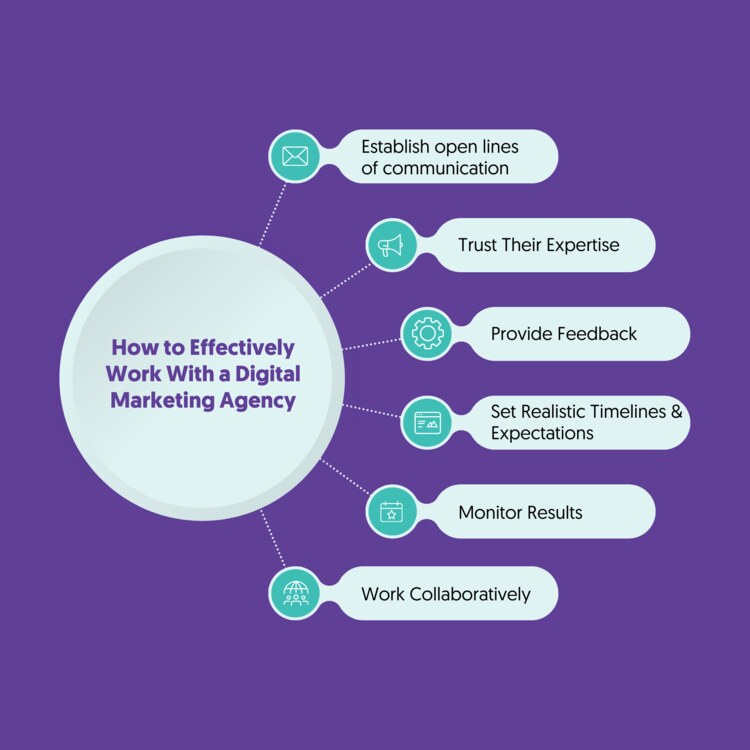
Steady communication and updates are vital for a fruitful partnership between a business and its marketing agency. Consistent check-ins, whether weekly or bi-weekly, confirm that both parties are aligned on strategy adjustments, performance metrics, and upcoming initiatives.
This practice comprises the agency providing transparent reporting on key performance indicators (KPIs) and discussing what they learned from the data. Establishing an open feedback loop prevents mistakes, consents for quick campaign optimization, and ensures the marketing efforts uninterruptedly support the evolving business goals.
Communication makes or breaks agency relationships. A good agency will:
- Schedule regular meetings (weekly, biweekly, or monthly)
- Provide progress updates
- Discuss challenges and new opportunities
- Share ongoing campaign insights
This ensures you know exactly what is happening at every stage.
Get Data-Driven Reports and Insights from Marketing Agency
Receiving data-driven reports and insights is essential for evaluating the success of digital marketing efforts and making informed future decisions.
Effective agencies deliver reports that move beyond simple activity tracking, focusing instead on Key Performance Indicators (KPIs) straight tied to your business goals, such as Cost Per Acquisition (CPA) or Return on Ad Spend (ROAS).
These reports should not just present raw data, but also comprise actionable insights, meaning the agency explains what the data signifies, why performance shifted, and recommends clear next steps for optimizing campaigns and improving ROI.
Digital marketing is computable, and your agency should share detailed reports such as:
- Website traffic growth
- Ad performance metrics
- Social media engagement
- Keyword ranking improvements
- Leads generated and conversions
Reports should be easy to understand and linked back to your business goals.
Expect Realistic Expectations from Marketing Agency — Not Overnight Results
Businesses need to expect realistic outcomes from their marketing agency, recognizing that noteworthy results, particularly in areas like SEO, take time and sustained effort.
Agencies must set expectations by clearly communicating possible timelines and acknowledging that there are no prompt “magic bullet” solutions in digital marketing.
Businesses should be wary of any agency promising immediate, dramatic guarantees, as this clarity prevents disappointment, fosters a trust-based relationship, and permits for persistence while foundational strategies are implemented and optimized.
A credible agency will never promise overnight success. Here’s what realistic timelines look like:
- SEO: 5–8 months to see great improvements
- Facebook/Google Ads: Immediate data, but 1–2 months for optimization
- Content marketing: Reliable growth over months
- Branding: Gradual improvement
Expect honesty about what’s attainable and how long it may take.
Collaboration and Input From Your Side to the Marketing Agency
Effective collaboration requires lively input from your side to provide the marketing agency with decisive context and resources. You must willingly share important information, including in-depth knowledge of your product/service, access to internal sales data, and insights into your target customer’s pain points that the agency cannot attain outside.
Furthermore, timely feedback and rapid decision-making on campaign approvals or content drafts are critical, as delays can meaningfully impede campaign momentum and overall marketing performance. Treating the agency as an extension of your own team confirms the final strategies are intensely aligned with your core business expertise.
The agency will prerequisite your cooperation as well. They may ask for:
- Brand assets and guidelines
- Past marketing data
- Product/service information
- Approvals for content or ads
- Access to your website, CRM, and social media accounts
Fruitful marketing requires teamwork between the agency and your internal team.
Adaptability and Continuous Optimization for Online Success
Adaptability and nonstop optimization are non-negotiable for sustained online victory, given the continuous evolution of search engine algorithms and consumer behaviour.
Digital strategies should never be static; they must be unceasingly monitored using real-time data to identify under-performing areas. This requires the readiness to pivot rapidly, adjusting targeting, content, and ad creatives based on performance metrics and emerging trends.
Embracing this cycle of testing, measuring, and refining confirms marketing efforts remain appropriate, efficient, and capable of generating the best conceivable ROI in a dynamic digital landscape. The digital landscape changes quickly. A good agency will:
- Adjust strategies based on performance
- Recommend new campaign ideas
- Optimize ads, landing pages, and content
- Stay updated with platform changes and trends
Expect a partner who evolves with your business and the market.
Develop Your Long-Term Partnership Mindset with Marketing Agency
Developing a long-term partnership mindset with your marketing agency shifts the relationship from a transactional vendor engagement to a strategic, collaborative alliance.
This tactic recognizes that the utmost marketing successes often emerge from sustained effort and deep mutual understanding refined over time.
By committing to a long-term view, both parties can assuredly invest in foundational strategies, like extensive SEO work or complex content strategies, knowing they will have the essential time to mature, eventually leading to higher Customer Lifetime Value (CLV) and maximized, enduring growth.
Digital marketing works best when viewed as a long-term investment. A reliable agency focuses on sustainable growth, not quick fixes. Over time, expect:
- Better brand visibility
- Stronger customer trust
- Higher quality leads
- Improved ROI
- Consistent business growth
A good agency becomes an extension of your team, not just a vendor.
In Conclusion :
Hiring a digital marketing agency can be a game-changer for your business, but knowing what to expect helps you select the right partner and set the right expectations. Look for an agency that offers transparency, communication, expertise, data-driven strategies, and a commitment to long-term success. With the right collaboration, your business can build a strong digital presence and achieve sustainable growth.