The ecommerce world has changed intensely with the rise of artificial intelligence. Store owners can no longer rely on traditional SEO methods alone. AI-driven search engines, smarter customer behaviour tracking, and machine-learning–powered ranking factors now regulate which stores succeed and which get buried.
This is why optimising an ecommerce store for maximising SEO results in AI has become a decisive strategy for all online businesses. Whether you’re a beginner or an experienced ecommerce marketer, this article breaks down everything you prerequisite to know to stay ahead in the AI-powered SEO era.
Introduction to Optimising an Ecommerce Store for Maximising SEO Results in AI
AI is reshaping how customers search, shop, and interact with ecommerce stores. Search engines now understand context, user intent, product relevance, and behaviour patterns more accurately. To stay competitive, ecommerce stores must optimise their content, speed, structure, and experience in a way that aligns with AI algorithms.
What AI Means for Modern Ecommerce SEO?
AI is transforming modern eCommerce SEO by shifting the focus from purely chasing keywords to optimizing for user intent and AI visibility. It automates tasks like keyword research, content generation for product descriptions, and technical SEO audits, making optimization faster and more detailed.

Significantly, as search engines progressively use generative AI for summaries (like Google’s AI Overviews), modern SEO must also emphasise on having high-quality, structured data to be cited within these AI-generated answers, which can sometimes replace traditional click-through traffic. This evolution makes hyper-personalization and clear, authoritative content essential for winning organic search visibility.
How Search Engines Now Use AI?
Modern search engines now heavily leverage AI and Large Language Models (LLMs) to go beyond modest keyword matching and deliver direct answers. This shift is most visible in features like Google’s AI Overviews (part of the Search Generative Experience, or SGE) and Microsoft Bing’s Copilot Search.
- Instead of just listing links, AI analyzes the context and intent of a query using models like Gemini (Google) and GPT-4 (Bing) to generate a concise, conversational summary or answer right at the top of the results page.
- Beyond generative answers, AI is used to improve ranking algorithms (like Google’s RankBrain and BERT) by a healthier understanding of the meaning (semantics) of content and the user’s need, leading to more pertinent and personalized traditional search results.
- This integration also powers new forms of search, including conversational follow-up questions, image search (like Google Lens), and other tools that make searching an interactive experience rather than just a transaction.
Search engines use artificial intelligence to:
- Understand user intent
- Identify product relevance
- Analyse behaviour and engagement
- Improve ranking accuracy
Google Search Generative Experience (SGE) and Bing Copilot now summarise information directly, making AI-ready SEO vital.
AI-Powered Customer Behaviours
AI-Powered Customer Behaviours refer to the ways consumer interactions and purchasing habits are influenced, analyzed, and predicted by Artificial Intelligence.
This chiefly involves the expectation of hyper-personalisation, where customers anticipate vastly appropriate product recommendations, tailored content, and dynamic pricing based on their individual data.
These behaviours are often facilitated by AI-driven tools like chatbots, for instance, 24/7 customer service and projecting analytics that anticipate requirements, leading to increased demand for unified, real-time, and efficient digital experiences.
However, this is balanced by a growing consumer awareness and concern for data privacy and the ethical transparency of the AI systems being used to track and influence their decisions.
Customers expect:
- Personalised suggestions
- Smarter search results
- Faster page loading
- High-quality product information
This shift means ecommerce websites must reflect AI-first optimisation.
Foundations of Ecommerce SEO Before Adding AI
The foundations of Ecommerce SEO, established long before AI was integrated, centre on creating a technically sound and user-friendly website that evidently communicates product information to search engines.
Key pillars include in-depth keyword research focused on transactional (buy/shop) and long-tail phrases, along with thorough Technical SEO to ensure fast loading speeds, mobile-friendliness, and a crawlable site architecture with logical URL structures and breadcrumb navigation.
Importantly, it requires detailed On-Page Optimization of product and category pages using unique, keyword-rich descriptions, optimized image alt-text, and the implementation of Structured Data (Schema Markup) to generate rich snippets that help products stand out in search results.
The foundation of eCommerce SEO, regardless of AI’s involvement, rests on a solid technical structure and user-centric content.
- First, the Technical SEO must be flawless: this involves creating a clear, shallow site architecture (Home > Category > Product), ensuring fast page speed (Core Web Vitals), and implementing structured data (Schema markup) to label product details like price, reviews, and availability so search engines can easily understand them.
- Second, Keyword Strategy must be rooted in customer intent, focusing on transactional terms (“buy,” “best,” “for sale”) for product pages, and using long-tail keywords that reflect specific customer questions.
- Finally, On-Page Optimization requires unique, descriptive product content and category descriptions, proper use of title tags and headings, and high-quality, optimized product images—these fundamentals are what AI-driven systems build upon and reference.
Technical SEO Essentials
Technical SEO focuses on optimizing a website’s infrastructure to improve Crawlability and Indexability, ensuring search engine bots can competently find, understand, and store content.
Essential elements include optimizing page speed (via Core Web Vitals), guaranteeing mobile-friendliness, and implementing HTTPS for site security, all of which are direct ranking factors that advance user experience.
Significantly, a well-structured XML Sitemap and proper use of the robots.txt file guide crawlers, while Canonical Tags and Structured Data (Schema markup) help resolve duplicate content issues and provide context for rich snippets.
Strong foundations include:
- Fast website speed
- Mobile responsiveness
- Structured URL hierarchy
- SSL security
On-Page and Off-Page SEO Basics
On-Page SEO refers to all optimization efforts performed directly within your website’s content and HTML source code to help search engines understand what your content is about. This includes optimizing title tags, meta descriptions, headers (H1-H6), URL structure, and ensuring content uses relevant keywords while being high-quality and unique.
Off-Page SEO, conversely, involves actions taken outside your website to stimulate its authority and trustworthiness. The chief component is link building, where securing high-quality backlinks from authoritative, relevant external sites signals to search engines that your content is valuable and credible, driving higher organic rankings. This also includes social media marketing and brand mentions.
Before AI, you must master:
- High-quality content
- Internal linking
- Backlinks
- Optimised titles and meta descriptions
Why Optimising Ecommerce Store for Maximising SEO Results in AI Is Crucial?
Rise of AI Search (Google SGE, Bing Copilot)
AI-powered search engines now extract product info directly from your site. If your content, schema, and structure aren’t AI-friendly, your store may not appear in AI answers.
Higher Competition Among Ecommerce Brands
Higher competition among e-commerce brands is driven by low barriers to entry and the rapid digital transformation that saturates the market with similar products. This fierce rivalry forces companies to engage in continuous innovation, chiefly around the customer experience, focusing on factors like hyper-personalization, superior logistics (e.g., real-time tracking), and exceptional 24/7 customer service to differentiate themselves.
The main impact is intense pricing pressure, which squeezes profit margins, making customer retention through loyalty and an all-in-one user experience the ultimate battleground.
More stores are entering the market, and AI-ready optimisation determines who ranks higher.
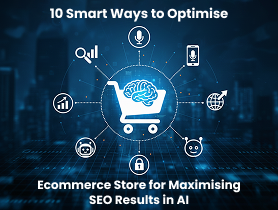
10 AI-Driven Strategies for Optimising an Ecommerce Store for Maximising SEO Results in AI
AI-driven strategies for eCommerce optimization focus on scale, personalization, and visibility in generative search. AI tools automate the mass creation of SEO-friendly product descriptions and meta tags, freeing human teams for strategic work.
More importantly, AI excels at analyzing user intent and competitor data to discover niche, high-converting long-tail keywords and conversational queries that are the backbone of modern search.
Significantly, it helps in ensuring structured data (Schema markup) is correct and comprehensive, which is vital for getting product information cited in Google’s AI
Overviews and other generative search features.
AI-Enhanced Keyword Research & Search Intent Analysis
AI tools detect:
- Voice search keywords
- Conversational queries
- Long-tail ecommerce-specific keywords
- Competitor gaps
This improves product and category visibility.
Smart Product Descriptions Using AI
AI helps create:
- SEO-optimised descriptions
- Emotion-driven copy
- Keyword-rich product benefits
But avoid duplicate AI content, always refine manually.
Personalised Category Pages Based on User Behaviour
Dynamic category pages adapt based on:
- Past searches
- Purchase history
- Browsing behaviour
Search engines reward behavioural relevance.
AI-Powered Image Optimisation
AI compresses, renames, tags, and improves images using:
- Alt text generation
- Automatic resizing
- Product detection
Better images = better ranking.
Voice Search Optimisation for Ecommerce
Customers increasingly ask AI assistants for:
- “Best running shoes under $150”
- “Buy organic skincare near me”
- “Top-rated gaming laptops”
Use natural, conversational language in product titles and FAQs.
AI-Based Internal Linking Strategies
AI tools connect relevant products, resulting in:
- Better crawlability
- Higher time on site
- Increased cross-selling
Structured Data & Schema Automation
Schema is essential for AI SEO. Add:
- Product schema
- Review rating schema
- Price & availability schema
- Breadcrumb schema
This helps AI understand your products instantly.
Predictive SEO Analytics
AI forecasts:
- Trending products
- Search volume shifts
- Seasonal demand
This helps you optimise pages before competitors do.
AI Chatbots that Boost On-Site Engagement
Engagement affects SEO indirectly. AI chatbots:
- Answer questions
- Recommend products
- Reduce bounce rate
Google rewards sites with high user interaction.
Automated A/B Testing for Better UX & Conversion
AI tests layout variations to improve:
- Product page design
- Checkout flow
- CTA buttons
- Site navigation
Better UX leads to higher rankings.
Common SEO Mistakes Ecommerce Stores Make in the AI Era
The biggest mistake eCommerce stores make in the AI era is over-relying on unedited AI content for product and category descriptions, which results in thin, unoriginal, or robotic-sounding text that fails Google’s Helpful Content System.
Besides, by neglecting E-E-A-T (Experience, Expertise, Authoritativeness, and Trustworthiness), many fail to add exclusive human elements like genuine product experience, authentic reviews, and high-quality images.
Finally, they often fail the technical SEO basics, particularly page speed (Core Web Vitals) and correct Schema markup, which are critical for search engines (and AI) to crawl, understand, and cite product information correctly.
Overusing AI-Generated Content
Google penalises repetitive or low-quality AI content. Always edit manually.
Poor Mobile Optimisation
Most ecommerce traffic comes from mobile, and AI search prioritises mobile-friendly stores.
Real-Life Examples of Ecommerce Stores Using AI for SEO
Fashion Retail AI SEO Example
A clothing store used AI to auto-tag product images and saw a 35% increase in search visibility.
Electronics Ecommerce AI Example
An electronics retailer used AI-driven predictive analytics, boosting seasonal rankings by 42%.
Tools to Use for AI Ecommerce SEO Visualisation & Tracking
Popular AI SEO Tools
- Surfer SEO
- Jasper
- Ahrefs AI
- Semrush AI
Analytics & Reporting Tools
- Google Analytics 4
- Microsoft Clarity
- Shopify Analytics
Frequently Asked Questions
What does AI SEO mean for ecommerce?
It means using AI tools and search engine algorithms to improve rankings, traffic, and conversions.
Do product descriptions need AI optimisation?
Yes, AI helps analyse intent, improve clarity, and increase organic visibility.
Is schema markup important for AI?
Absolutely. AI search relies heavily on structured data.
Can AI replace human SEO experts?
No, AI supports SEO, but humans provide strategy and creativity.
Do AI chatbots help with SEO?
Yes, by improving engagement and reducing bounce rates.
Should small stores invest in AI SEO?
Yes, AI tools help small stores compete with large brands.
In Conclusion :
Understanding how to optimise an ecommerce store for maximising SEO results in AI is essential for staying competitive in 2026 and beyond. With the right AI tools, smart keyword strategies, advanced product optimisation, and strong technical SEO, stores can meaningfully boost visibility, traffic, and sales.
AI isn’t replacing SEO, it’s improving it. Now is the perfect time to make your ecommerce store AI-ready and future-proof your SEO success.