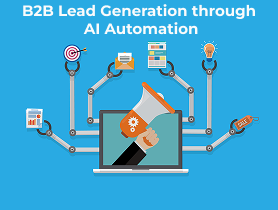
B2B companies are under pressure. Sales cycles are longer. Buyers are smarter. Competition is fierce. That’s why Most Effective Ways for B2B Lead Generation through AI Automation has become one of the most searched growth topics in modern marketing.
Artificial intelligence is no longer optional, it’s essential.
When used correctly, AI automation helps businesses classify prospects, nurture leads, personalize communication, and close deals quicker than ever before.
In this comprehensive guide, you’ll realize practical, real-world strategies to implement AI-driven lead generation that really converts.
Most Effective Ways for B2B Lead Generation through AI Automation
Introduction to AI-Powered B2B Lead Generation
B2B lead generation has changed intensely in the last five years. Decision-makers now expect personalization, speed, and relevance. AI automation makes that conceivable.
Instead of manually searching for prospects, businesses now use AI systems to analyze data, detect buying signals, and prioritize high-intent leads.
Platforms like HubSpot and Salesforce integrate AI features that help sales teams focus only on leads most probable to convert.
Why Traditional Lead Generation Is Failing?
Traditional lead generation is hitting a wall because the modern buyer has evolved far faster than the average sales script. Here is why the old-school playbook is losing its punch:
- Digital Fatigue and Skepticism: People are bombarded with thousands of digital ads and “cold” messages daily. This has created a natural defence mechanism where buyers instinctively ignore unsolicited outreach and generic marketing funnels.
- Information Symmetry: In the past, sales reps held the power because they controlled the information. Today, buyers do 70% to 80% of their research independently online before ever talking to a human, making traditional “educational” gatekeeping obsolete.
- The Rise of Privacy and Friction: Between strict data privacy laws (like GDPR) and the universal loathing of gated content, forcing someone to fill out a 10-field form just to see a PDF is now seen as a barrier rather than a value-add.
- Quality over Quantity: Traditional methods often prioritize “MQLs” (Marketing Qualified Leads) based on clicks rather than intent. This leads to a bloated pipeline full of people who aren’t actually ready to buy, wasting the sales team’s time and resources.
In short, the “spray and pray” era is being replaced by demand generation, where the goal is to build trust and affinity long before the “lead” ever enters your system.
Traditional cold calling and generic email blasts are losing effectiveness because:
- Buyers research independently
- Inboxes are overcrowded
- Generic messaging lacks personalization
- Sales cycles are longer
Manual processes simply can’t keep up.
How AI Automation Changes the Game for B2B Lead Generation?
In 2026, the shift from manual “spray and pray” tactics to AI-driven automation is no longer a luxury, it’s the baseline for B2B survival. While traditional lead gen focused on volume, AI has shifted the focus to intent and precision.
Here is how AI automation is fundamentally changing the game:
-
The Death of the “Cold” Outreach
Traditional lead generation relied on static lists and cold calling. AI has replaced this with Intent-Based Outreach.
- Website Identification: Tools now identify the anonymous 98% of website visitors who don’t fill out forms, allowing you to see which companies are researching your solution in real-time.
- Signal Monitoring: AI “agents” monitor the web for “trigger events”, like a target company getting new funding, a leadership change, or a sudden spike in specific keyword searches allowing you to reach out exactly when the window of opportunity opens.
-
Hyper-Personalization at “Impossible” Scale
In the past, personalizing 1,000 emails meant 1,000 hours of manual research. Today, Generative AI does this in seconds.
- Bespoke Content: AI can scan a prospect’s latest LinkedIn post, their company’s annual report, and their tech stack to draft an email that feels like it was written by a peer, not a bot.
- Dynamic Landing Pages: When a lead clicks through, the website they see can automatically adapt its case studies and hero images to match their specific industry and pain points.
-
Predictive Lead Scoring
Instead of a simple “points for clicks” system, AI uses Predictive Modeling to analyze thousands of data points from your CRM.
- It identifies the “hidden patterns” of your most successful deals and flags new leads that share those traits.
- The Result: Sales teams stop wasting time on “looky-loos” and focus 100% of their energy on prospects with a statistically high probability of closing.
-
The Rise of “Agentic” Lead Follow-Up
The “speed to lead” gap is being closed by AI Agents. Research shows that the chance of conversion drops by 80% if you wait longer than five minutes to follow up.
- 24/7 Qualification: AI agents can handle initial discovery via chat or email, answer complex product questions, and even book a meeting directly onto a sales rep’s calendar while the human team is asleep.
Comparison: Traditional vs. AI-Driven Lead Gen
| Feature | Traditional Lead Gen | AI-Driven Lead Gen (2026) |
| Data Source | Static, purchased lists | Real-time intent & first-party data |
| Personalization | Templates with [Name] tags | Deeply researched, bespoke messaging |
| Speed | Manual (Hours/Days) | Instant (Seconds/Minutes) |
| Lead Quality | Quantity over quality | Predictive “Ready-to-Buy” scores |
| Effort | High manual labor | High strategic oversight |
AI systems can:
- Analyze millions of data points instantly
- Predict buying intent
- Personalize messaging at scale
- Automate repetitive tasks
This increases efficiency while reducing human error. Simply put, AI works smarter—not harder.
Predictive Analytics for Smarter B2B Leads Prospect Targeting
In 2026, the primary differentiator in B2B success is no longer who has the largest database, but who has the most predictive one. Predictive analytics has transformed prospecting from a reactive “catch-up” game into a proactive “anticipation” strategy.
Here is how predictive analytics is enabling smarter B2B targeting:
-
Predictive Lead Scoring (The “Crystal Ball”)
Traditional scoring is static (e.g., +5 points for a download). Predictive scoring uses machine learning models (like Random Forest or Gradient Boosting) to analyze thousands of historical data points and live signals.
- Pattern Recognition: It identifies “hidden” traits of your best customers that humans miss, such as the specific sequence of pages visited or the exact technographic stack a company uses before they buy.
- Dynamic Weighting: The system automatically reduces the “score” of vanity metrics (like email opens) and increases the weight of high-intent actions (like multiple visits to a specific comparison guide).
-
Intent-Based “Surfacing”
Predictive tools don’t just wait for a lead to arrive; they tell you who is in the market before they even visit your site.
- Third-Party Intent Signals: By monitoring the “B2B web” (forums, review sites, news), AI predicts which accounts are currently researching solutions in your category.
- Trigger Events: The system flags companies undergoing “buying moments,” such as a recent round of funding, a leadership change in a key department, or an expansion into a new region like India or Australia.
-
Account-Based Marketing (ABM) on Steroids
Predictive analytics allows for a 1:Many approach that feels like 1:1.
- Propensity to Buy: You can segment your entire TAM (Total Addressable Market) and focus your ad spend only on the top 5% of accounts with the highest statistical likelihood of converting this quarter.
- Stakeholder Mapping: In B2B, there are often 6–10 decision-makers. Predictive models help identify the “Buying Committee”, predicting who the gatekeeper, the champion, and the economic buyer are within a target account.
-
Next-Best-Action Modelling
Once a prospect is identified, the “game” is about the follow-up. Predictive analytics removes the guesswork from the sales play:
- Optimal Timing: It predicts when a specific prospect is most likely to engage (e.g., “Send this email Tuesday at 10:00 AM for this specific lead”).
- Content Recommendations: It suggests the exact case study or whitepaper that has historically moved similar prospects from the “consideration” stage to the “decision” stage.
Comparison: Traditional vs. Predictive Prospecting
| Feature | Traditional Prospecting | Predictive Prospecting (2026) |
| Strategy | Broad outreach based on job titles | Targeted outreach based on intent signals |
| Timing | Based on sales rep’s schedule | Based on the buyer’s predicted readiness |
| Focus | High volume of “MQLs” | High quality of “High-Propensity” accounts |
| Data Usage | Static CRM records | Real-time behavioral & external data |
Key Insight for 2026: Predictive analytics is shifting the ROI focus from Cost Per Lead (CPL) to Pipeline Velocity. It’s not about getting more leads; it’s about getting the right leads through the funnel faster.
Predictive analytics is one of the Most Effective Ways for B2B Lead Generation through AI Automation.
Understanding Buyer Intent Data
AI tools analyse behaviours like:
- Website visits
- Content downloads
- Email engagement
- Social interactions
These signals reveal which companies are actively researching solutions.
AI-Based Lead Scoring Models
Instead of guessing which leads are qualified, AI assigns scores based on:
- Company size
- Industry
- Engagement level
- Budget indicators
This allows sales teams to focus on warm prospects instead of wasting time.
AI Chatbots for 24/7 Lead Qualification
Chatbots are no longer robotic and annoying. Modern conversational AI tools powered by OpenAI technology provide human-like interactions.
Conversational AI in B2B Marketing and Lead Generation
In 2026, the B2B landscape has moved past simple chatbots. Conversational AI is now a sophisticated, “agentic” layer of the sales funnel that doesn’t just answer questions, it reasons, qualifies, and converts.
Here is how Conversational AI is reshaping B2B lead generation:
-
From “If-Then” Bots to Contextual Agents
Traditional chatbots followed rigid decision trees. Modern Conversational AI uses Large Language Models (LLMs) to understand the nuance of B2B inquiries.
- Multi-Turn Reasoning: These agents can handle complex, multi-part questions (e.g., “How does your API integrate with Salesforce, and what are the latency implications for users in Australia?”) without breaking the flow.
- Persistent Memory: In 2026, these systems remember a prospect across different sessions. If a lead returns three days later, the AI picks up the conversation exactly where it left off, referencing previous pain points.
-
Real-Time Lead Qualification (The “Form-Less” Funnel)
Static lead forms are increasingly viewed as high-friction barriers. Conversational AI replaces them with interactive discovery.
- Natural Qualification: Instead of a 10-field form, the AI qualifies the lead through a natural dialogue, identifying the prospect’s budget, authority, and timeline (BANT) in minutes.
- Instant Handoff: Once a lead meets “Sales Qualified” criteria, the AI can check a rep’s live calendar and book a meeting directly within the chat interface, maintaining momentum when interest is highest.
-
24/7 Global Coverage
For companies targeting international markets (like India, Australia, or the US), Conversational AI eliminates timezone bottlenecks.
- Multilingual Expertise: Modern agents can switch between dozens of languages fluently, allowing a company in Ahmedabad to provide high-level technical support and sales discovery to a prospect in Sydney at 2:00 AM local time.
- Consistent Brand Voice: Unlike human teams that may vary in tone, AI ensures that every interaction perfectly aligns with your brand’s specific positioning and compliance standards.
-
The “Copilot” for Sales Reps
Conversational AI isn’t just external; it works internally to help sales teams close deals faster.
- Live Coaching: During a live human-to-human call, AI can listen in real-time, surfacing relevant case studies or “rebuttal cards” on the rep’s screen when a competitor is mentioned.
- Automated CRM Hygiene: After a conversation (whether AI-led or human-led), the system automatically summarizes the key takeaways, updates the CRM fields, and drafts the follow-up email sequence based on the specific intent signals detected.
Impact Metrics for 2026
| Metric | Impact of Conversational AI |
| Speed to Lead | Reduced from hours to < 10 seconds |
| Conversion Rate | Average 3.3x improvement from traffic to meeting |
| Sales Productivity | Reps spend 40-50% more time in direct customer talk |
| Sales Cycle Length | Reduced by up to 25% through faster qualification |
The 2026 Reality: 80% of B2B sales interactions now occur in digital channels powered by AI. The goal has shifted from “capturing a lead” to “initiating a relationship” through immediate, high-value dialogue.
AI chatbots can:
- Answer FAQs instantly
- Qualify leads
- Collect contact details
- Route inquiries to sales reps
They work 24/7 without breaks.
Automating Meeting Scheduling
AI assistants integrate with calendars and book meetings automatically. No more back-and-forth emails.
Hyper-Personalized Email Outreach Using AI
Personalization drives conversions. AI tools analyze data to create tailored email campaigns.
AI Content Personalization Engines
Instead of sending the same email to 1,000 contacts, AI customizes:
- Subject lines
- Product recommendations
- Industry-specific case studies
Marketing automation platforms like Marketo help execute these campaigns at scale.
Behavioural Trigger Campaigns
AI triggers emails based on actions such as:
- Visiting pricing pages
- Watching webinars
- Downloading whitepapers
This ensures perfect timing.
AI-Powered LinkedIn & Social Selling
Social selling has become a powerhouse for B2B growth, especially on LinkedIn.
Automated Prospecting Tools
AI tools scan LinkedIn profiles to:
- Identify decision-makers
- Analyze job changes
- Detect company growth signals
Social Listening & Engagement
AI monitors conversations in your industry. When someone mentions a pain point your product solves, you can engage instantly.
Content Marketing Automation with AI
Content fuels lead generation. AI accelerates production and distribution.
AI-Generated SEO Content
AI tools:
- Identify trending keywords
- Optimize headlines
- Generate drafts
- Suggest improvements
This keeps your website visible in search results.
Smart Content Distribution
AI determines:
- Best posting times
- Ideal platforms
- Audience segments
Automation ensures your content reaches the right people.
CRM Automation & Workflow Optimization
Customer relationship management systems now include AI-driven automation.
Intelligent Pipeline Management
AI forecasts deal closure probability and suggests next steps.
Automated Follow-Ups
Missed follow-ups kill deals. AI prevents that by:
- Sending reminders
- Triggering emails
- Updating CRM records automatically
Account-Based Marketing (ABM) with AI
ABM focuses on high-value target accounts instead of broad audiences.
Target Account Identification
AI identifies companies that:
- Match your ideal customer profile
- Show buying signals
- Have budget readiness
Personalized Campaign Automation
Each account receives tailored content, ads, and outreach messages.
Data Enrichment & Lead Intelligence Tools
Clean data equals better conversions.
Third-Party Data Integration
AI tools integrate external databases to enrich records with:
- Revenue estimates
- Employee counts
- Technology stacks
Real-Time Data Updates
Outdated information hurts sales. AI updates records automatically.
Measuring Success: KPIs for AI Lead Generation
Tracking performance ensures ROI.
Conversion Metrics
Key metrics include:
- Cost per lead
- Lead-to-opportunity rate
- Opportunity-to-close ratio
ROI Tracking
AI dashboards provide real-time insights into:
- Revenue impact
- Campaign performance
- Sales velocity
FAQs on B2B Lead Generation through AI Automation
-
What is AI automation in B2B lead generation?
AI automation uses machine learning and data analytics to identify, nurture, and convert business prospects automatically.
-
Is AI expensive for small B2B companies?
Not necessarily. Many tools offer scalable pricing models suitable for startups.
-
Does AI replace sales teams?
No. AI supports sales teams by automating repetitive tasks and providing insights.
-
How quickly can AI improve lead quality?
Most companies see measurable improvements within 3–6 months.
-
Which industries benefit most from AI lead generation?
Technology, SaaS, manufacturing, finance, and professional services benefit significantly.
-
Is AI lead generation compliant with data privacy laws?
Yes, if implemented with proper consent management and GDPR-compliant tools.
In Conclusion :
The Most Effective Ways for B2B Lead Generation through AI Automation revolve around smarter targeting, personalization, automation, and data intelligence. Businesses that embrace AI don’t just generate more leads, they generate better leads.
AI isn’t the future anymore. It’s the present. Companies that implement predictive analytics, chatbots, CRM automation, and AI-driven personalization today will dominate tomorrow’s markets. Now’s the time to act.