

Introduction to User-Generated Content (UGC)
The Influence of User-Generated Content on Customer-Focused Digital Marketing has transformed the way brands engage with their audiences.
In the current digital landscape, consumers are not merely audience members; they are also content creators. Items like reviews, social media posts, testimonials, unboxing videos, and blog comments are all categorized as User-Generated Content (UGC).
User-Generated Content (UGC) has completely reshaped customer-centric digital marketing by putting real people at the heart of brand communication. Instead of relying only on polished ads, brands now leverage authentic content created by their own customers, like reviews, testimonials, photos, and social media posts, which feels more relatable and trustworthy.
The biggest impact of UGC is credibility. Today’s consumers are more likely to trust another customer’s experience than a brand’s promotional message. When people see genuine feedback or real-life usage, it reduces hesitation and builds confidence in the buying decision.
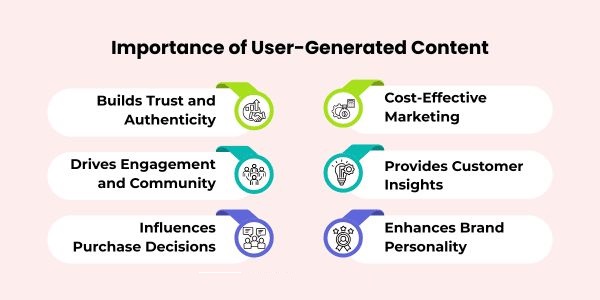
UGC also strengthens emotional connection. It shows that a brand values its customers and listens to their voices, making the audience feel more involved and appreciated. This naturally boosts engagement, as people are more inclined to interact with content they can relate to.
Another key impact is improved conversion rates. When potential buyers see real users enjoying a product or service, it creates social proof, encouraging them to take action. It also helps brands better understand customer preferences, allowing them to tailor campaigns more effectively.
In simple terms, UGC makes marketing feel less like selling and more like a genuine conversation, where customers become advocates, storytellers, and even brand ambassadors.
UGC represents any type of content produced by consumers instead of brands. It showcases authentic experiences, opinions, and narratives. In contrast to traditional advertising that communicates to customers, UGC interacts with them. This transformation has altered the landscape entirely.
The main point is this: contemporary consumers place more trust in individuals than in advertisements. They depend on the opinions of their peers prior to making buying decisions. Research from Nielsen indicates that 92% of consumers trust recommendations from other people more than they do brand messages.
The Rise of Customer-Centric Marketing

Customer-focused marketing places the customer at the heart of every approach. Rather than inquiring, “How can we sell this product?” companies now ask, “What are the genuine needs of the customer?”
This change occurred because digital advancements have empowered consumers. Social media channels, online forums, and review websites have granted customers a platform. Brands that pay attention and react gain loyalty.
Traditional vs Modern Marketing Approaches
| Traditional Marketing | Customer-Centric Marketing |
| Brand-controlled messaging | Customer-influenced messaging |
| One-way communication | Two-way engagement |
| Focus on product features | Focus on customer experience |
| Paid advertising dominance | Organic community-driven growth |
UGC fits perfectly into this modern approach because it naturally amplifies the customer’s voice.
Why UGC Builds Trust and Authenticity?
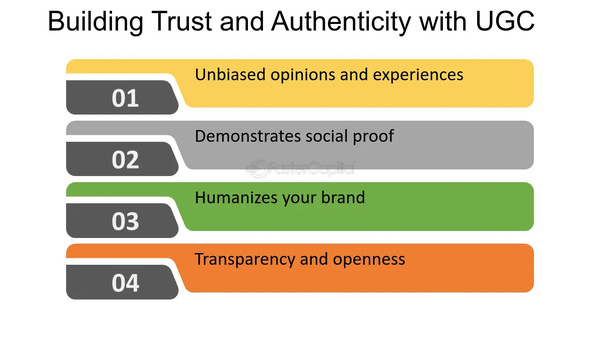
User-Generated Content (UGC) has become the “digital word-of-mouth” of the modern era, largely because it strips away the polished, often clinical feel of corporate advertising.
Here is why it is so effective at building trust:
- Social Proof: Seeing a real person use a product in their daily life provides immediate validation. It shifts the narrative from “the company says this is good” to “my peers say this works.”
- The “Flaws and All” Factor: Unlike high-budget brand shoots, UGC is often unscripted and raw. This lack of perfection makes the content feel more honest and relatable, which lowers a consumer’s natural skepticism.
- Relatability: Consumers are more likely to trust someone who looks and lives like them rather than a celebrity spokesperson. UGC creates a community-driven environment where the brand feels like a participant rather than just a seller.
The Bottom Line: People don’t buy from logos; they buy from people. UGC bridges the gap between a brand’s promise and the actual customer experience.
Confidence is the foundation of digital marketing. Shoppers are quick to spot polished promotions. What they desire is sincerity. When actual customers express their genuine experiences, it resonates with them.
A spontaneous video review appears more authentic than a rehearsed advertisement. Flaws can enhance trustworthiness.
Psychology Behind Social Proof
At its core, Social Proof is a psychological and social phenomenon where people copy the actions of others in an attempt to undertake behavior in a given situation. It’s a mental shortcut we use to navigate uncertainty.
When we aren’t sure how to act, we look to the “herd” to see what is acceptable, safe, or trending. Here is the psychology that drives it:
The Uncertainty Principle
When a person is in a situation where they are unsure of the correct way to behave, they will often look to others for cues. This is why “Best Seller” tags or “Join 50,000 others” are so effective, they signal that the path has already been vetted by others, reducing the perceived risk of a “wrong” choice.
Similarity (The Peer Effect)
Social proof is most powerful when we perceive the people we are observing to be similar to ourselves. We are more likely to follow the lead of a peer or a neighbour than a distant celebrity. This is why niche-specific testimonials often outperform generic ones.
The Wisdom of the Crowd
This is the belief that a large group of people is collectively smarter than an individual. In marketing, this manifests as:
- High Volume: “Over 1 million served.”
- Approval Ratings: 4.8/5 star ratings based on thousands of reviews.
- User Numbers: Showing a live count of people currently viewing a product.
Expert & Celebrity Authority
While peer similarity is huge, we also defer to “Halo Effect” figures. If an industry expert or a public figure we admire uses a product, we subconsciously transfer our trust in that person onto the product itself.
FOMO (Fear of Missing Out)
Social proof creates a sense of belonging. If everyone is doing it, those who aren’t feel “out of the loop.” This creates a psychological urgency to join the group to avoid social exclusion or missing out on a perceived benefit.
Social proof is a psychological principle where people copy the actions of others. If many customers praise a product, new buyers feel safer choosing it.
UGC creates visible proof that others are satisfied. This reduces purchase anxiety and increases confidence.
Impact of User-Generated Content on Customer-Centric Digital Marketing Strategy
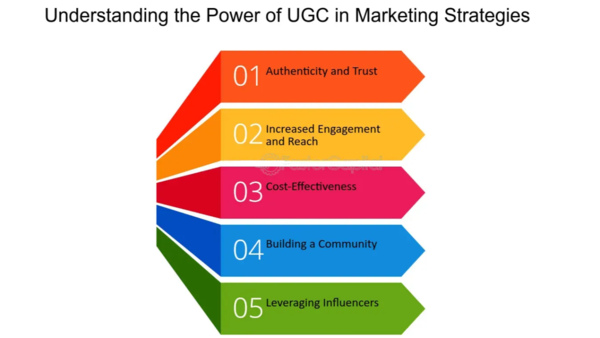
User-generated content (UGC) is the ultimate bridge between a brand’s promise and a customer’s reality. In a customer-centric digital marketing strategy, UGC moves the focus away from “selling” and toward “solving” and “sharing.”
Here is how UGC reshapes a customer-centric approach:
Shifting the Narrative from Brand to Buyer
A traditional strategy is brand-centric (e.g., “Our solar panels are the most efficient”). A customer-centric strategy fueled by UGC is human-centric (e.g., “Look how much this family saved on their monthly power bill”).
- Impact: It transforms the customer from a passive recipient of ads into an active advocate for the brand.
Radical Transparency and Reduced Risk
Modern consumers are highly skeptical of corporate claims. UGC acts as a “field test” that proves a product works in real-world conditions.
- The “Real-World” Proof: For high-consideration investments like home infrastructure or long-term services, seeing a peer’s unboxing or installation video reduces the “perceived risk” of a bad purchase.
Strengthening the “Community” Pillar
Customer-centricity is about building a relationship, not just a transaction.
- Engagement: When a brand features a customer’s photo or story, it triggers a “halo effect” of loyalty. Other customers see this and feel that the brand actually listens to and values its community, encouraging them to engage as well.
Continuous Feedback Loops
UGC provides raw, honest data that no focus group can match.
- Product Development: By monitoring what customers highlight in their own content or what they complain about, a company can pivot its strategy to better meet actual user needs. This is the definition of being customer-centric.
Comparison: Traditional vs. UGC-Driven Strategy
| Feature | Traditional Strategy | UGC-Driven Strategy |
| Voice | Corporate & Polished | Authentic & Relatable |
| Trust Source | Brand Authority | Peer Validation |
| Content Cost | High (Production/Studios) | Low (Community-led) |
| Customer Role | Target Audience | Brand Co-Creator |
The Human Element: In regions like India and Australia, where community trust and local testimonials carry immense weight, UGC acts as the digital equivalent of a “neighbour’s recommendation,” which is often more powerful than any paid advertisement.
The Impact of User-Generated Content on Customer-Centric Digital Marketing becomes clear when we look at engagement, personalization, and loyalty. UGC transforms passive audiences into active communities. Instead of broadcasting messages, brands curate and amplify customer voices.
Role of Reviews and Testimonials
Online reviews directly influence purchasing decisions. Positive testimonials can dramatically increase conversion rates. Even negative reviews, when handled correctly, build credibility. Responding publicly shows transparency. It proves the brand values customer feedback.
Social Media and Community Building
Platforms like Instagram and TikTok thrive on user participation. Hashtag campaigns, challenges, and customer shout-outs encourage community involvement. When customers see their content featured by a brand, they feel valued. That emotional connection strengthens loyalty.
Platforms Driving UGC Growth
In 2026, the growth of User-Generated Content (UGC) is no longer just about social media posts; it is about integrated commerce ecosystems. Platforms have shifted from being places where people talk about products to places where they buy them instantly based on peer validation.
Here are the primary platforms and tools driving this growth:
The “Big Three” of Short-Form Video
Short-form video remains the dominant format for UGC, but the strategy has evolved into “Social Commerce”:
- TikTok (and TikTok Shop): Currently the leader in “discovery-to-purchase” flow. The TikTok Shop affiliate model allows everyday users to become “selling creators,” making UGC a direct revenue stream rather than just a top-of-funnel brand awareness tool.
- Instagram (Reels & Shoppable Ads): Instagram has doubled down on “Social Proof Carousels” and “Spark Ads” (where brands pay to boost organic posts from real users).
- YouTube Shorts: Growing rapidly as a destination for long-tail search. In 2026, YouTube’s integration of “Shopping” features in Shorts allows for unboxing and review content to link directly to product pages.
UGC Marketplace & Management Platforms
For brands that lack a steady stream of organic content, specialized marketplaces have bridged the gap:
- Collabstr & Billo: Popular for small-to-medium businesses. They allow brands to “buy” authentic-looking UGC from a vetted network of creators who produce unboxings, demos, and testimonials.
- Insense: Specifically designed for performance marketers. It helps brands source UGC that is pre-optimized for Meta and TikTok paid ads.
- Upfluence & Modash: These tools help brands identify which of their existing customers have the most social influence, allowing them to turn loyal buyers into brand ambassadors.
Trust & Review Aggregators
Visual proof is moving onto the website itself to reduce bounce rates:
- Yotpo & Bazaarvoice: These platforms automate the collection of customer photos and video reviews. In 2026, they use AI to “verify” the provenance of content, ensuring that deepfakes or AI-generated fake reviews don’t dilute brand trust.
- Taggbox: Aggregates UGC from across the web (Instagram, Twitter, LinkedIn) and displays it in “shoppable galleries” on your website’s homepage or product pages.
B2B & Niche Communities
UGC isn’t just for lifestyle brands anymore:
- LinkedIn: In 2026, LinkedIn has seen a surge in “Employee Advocacy” content. Brands are encouraging employees to share “behind-the-scenes” stories, which acts as a powerful form of B2B UGC.
- Reddit & Quora: These remain the “gold standard” for unfiltered peer advice. Brands are increasingly monitoring these platforms to find organic testimonials to feature (with permission) in their marketing.
Comparison: Growth Drivers by Platform Type
| Platform Type | Primary Driver | Best For |
| Social Media | Algorithm-driven discovery | High-volume reach & viral potential |
| Marketplaces | Brief-based creation | Quick ad-creative for new products |
| Review Tools | Post-purchase automation | Converting website traffic into sales |
| B2B Platforms | Thought leadership/Advocacy | Building professional trust & authority |
The 2026 Shift: We are seeing a move from “Influencer Marketing” (paid celebrities) to “Creator-UGC” (authentic users). Consumers now value the “Similarity Effect”, they trust people who look, live, and shop like them.
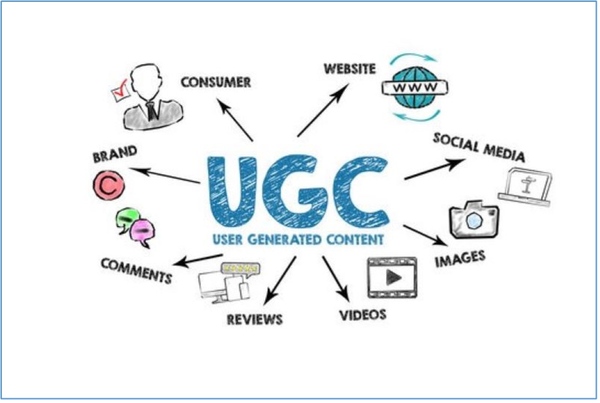
UGC appears across:
- Social media platforms
- E-commerce product pages
- Community forums
- Review websites
- Video-sharing platforms
Brands that integrate UGC across multiple channels create consistent customer-driven messaging.
For example, companies like GoPro built entire campaigns around customer videos. Instead of producing expensive ads, they showcase user adventures, and it works brilliantly.
Benefits of UGC for Brands
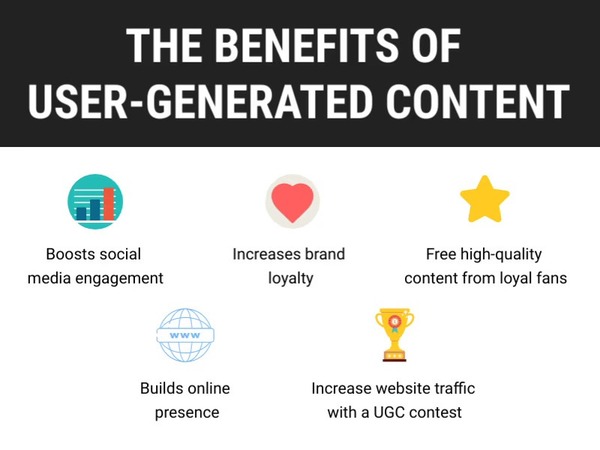
The advantages of UGC go beyond engagement.
Cost-Effective Content Creation
UGC reduces production costs while increasing authenticity.
Higher Engagement Rates
People engage more with peer content than branded promotions.
Improved Brand Loyalty
Featuring customers builds emotional connections.
Increased Conversion Rates
Social proof directly impacts purchase decisions.
Better Market Insights
UGC reveals real customer preferences and concerns.
SEO Advantages of UGC
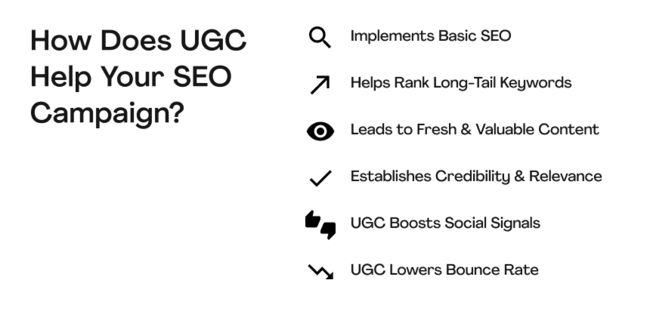
Integrating User-Generated Content (UGC) into your digital marketing strategy isn’t just a “social” win; it’s a powerful SEO engine. Search engines like Google prioritize helpful, relevant, and frequently updated content, all of which are native characteristics of UGC.
Here are the primary SEO advantages of leveraging customer content:
The “Freshness” Signal
Google’s algorithm favors websites that are regularly updated.
- The Advantage: Manually updating service pages or blog posts is time-consuming. However, a stream of incoming customer reviews, comments, or a dynamic Instagram feed integration provides a constant flow of new text for search spiders to crawl.
- Impact: This “freshness” signals to search engines that your site is active and relevant, which can improve crawl frequency and rankings.
Dominating Long-Tail Keywords
Customers don’t talk like marketers. They use natural, conversational language to describe their problems and your solutions.
- The Advantage: While a professional might target “high-efficiency residential solar panels,” a customer in a review might write, “Best solar setup for a 3-bedroom house in Ahmedabad heat.”
- Impact: UGC naturally populates your site with these “long-tail” phrases, helping you rank for specific, high-intent queries that you might have missed in your standard keyword research.
Boosting E-E-A-T (Experience & Trust)
Google’s Search Quality Rater Guidelines place heavy emphasis on Experience, Expertise, Authoritativeness, and Trustworthiness (E-E-A-T).
- The Advantage: Nothing proves “Experience” better than a third-party customer detailing their journey.
- Impact: Reviews and testimonials serve as a trust signal not just for humans, but for algorithms. High-volume, positive reviews (especially on Google Business Profiles) directly influence local SEO rankings.
Improving User Behaviour Metrics
SEO is no longer just about keywords; it’s about how users interact with your site.
- Reduced Bounce Rate: Visitors spend more time on pages that feature authentic photos or video testimonials compared to pages with generic stock imagery.
- Higher CTR: When UGC (like star ratings) appears in Search Engine Results Pages (SERPs) via Schema Markup, your click-through rate significantly increases.
SEO Comparison: Brand Content vs. UGC
| SEO Factor | Brand-Created Content | User-Generated Content |
| Language | Technical/Professional | Conversational/Natural |
| Keyword Focus | Short-tail/Commercial | Long-tail/Informational |
| Update Frequency | Periodic | Continuous |
| Trust Signal | Low (Self-proclaimed) | High (Third-party verified) |
Pro-Tip for 2026: The “Search-to-Social” Loop
In 2026, search engines are increasingly indexing “social” signals. By encouraging customers to post on platforms like Reddit or LinkedIn and then embedding that content on your site, you create a cross-platform authority loop that boosts your overall domain strength.
UGC improves search engine rankings because it constantly generates fresh, relevant content. Product reviews add keyword-rich material to websites.
Challenges and Risks of UGC in Digital Marketing
While User-Generated Content (UGC) is a powerful trust-builder, it introduces a unique set of risks that can damage a brand’s reputation or lead to legal trouble if not managed with a clear framework.
In 2026, the landscape has become even more complex due to the rise of AI and stricter global regulations. Here are the primary challenges:
1. Legal and Licensing Risks
One of the most common pitfalls is assuming that a “tag” or a “hashtag” constitutes a legal right to use content.
Copyright Infringement: In 2026, creators are increasingly suing brands for using their content in paid ads without explicit licensing. Reposting on your social feed (Organic) is often fine, but using it in a Meta or TikTok ad (Paid) requires a specific contract.
Usage Windows: Licensing is rarely “forever.” Many brands face legal action for continuing to run ads with creator content after the 6-month or 1-year agreement has expired.
2. The Rise of “Synthetic” (AI) Fake UGC
As of February 2026, the market is being flooded with AI-generated “fake” reviews and testimonials.
The Trust Deficit: If your audience discovers that a “customer testimonial” was actually generated by an AI model, your brand’s authenticity is destroyed instantly.
Regulatory Compliance: In India, the updated IT Rules 2026 now mandate that any “Synthetically Generated Information” (SGI) must be clearly labeled. Failure to label AI-assisted content can lead to account suspension or legal penalties.
3. Brand Safety and Negative Feedback
Unlike brand-created content, you cannot control what a user says.
The “Viral Backlash”: A single piece of negative UGC—like a video of a faulty solar panel installation—can spread faster than 1,000 positive reviews.
Ad Adjacency: On platforms like TikTok or YouTube, your paid ads might accidentally appear next to harmful or controversial user content, leading to “context loss” and negative brand perception.
4. Ethical Concerns and Disclosure
Transparency is the “currency” of 2026 marketing.
Hidden Sponsorships: Both the FTC (US) and consumer protection boards in India/Australia require clear disclosure (e.g., #Ad or #PaidPartnership) if a user was incentivized with a gift or discount.
Exploitation: There is a growing ethical debate regarding brands that profit immensely from user content without offering fair compensation or recognition to the original creator.
Risk Mitigation Matrix
| Risk Category | Challenge | 2026 Solution |
| Legal | Unauthorized ad usage | Use a Digital Rights Management (DRM) tool to track licenses. |
| Reputation | Negative viral UGC | Implement a “Tiers of Response” framework (ignore vs. engage). |
| Authenticity | AI-generated “Fake” UGC | Use AI-detection filters and prioritize “Verified Buyer” reviews. |
| Compliance | Lack of #Ad disclosure | Automated “Compliance Checks” for all boosted creator posts. |
The 3-Hour Rule: In India, as of February 2026, platforms and brands are now often required to remove unlawful synthetic content (deepfakes/misinformation) within 3 hours of a government or court order. Speed in moderation is now a legal requirement.
While powerful, UGC comes with challenges.
Quality Control
Not all content aligns with brand standards.
Negative Feedback
Public complaints can spread quickly.
Legal Issues
Using customer content without permission can cause copyright problems.
Managing Brand Reputation
Brands must monitor content carefully. Clear guidelines, moderation tools, and transparent communication help maintain balance between authenticity and brand safety.
Measuring UGC Performance
Key performance indicators (KPIs) include:
- Engagement rate
- Click-through rate
- Conversion rate
- Customer retention
- Sentiment analysis
Tracking these metrics helps marketers understand ROI and refine strategies.
Legal and Ethical Considerations
Always obtain permission before reposting customer content. Be transparent about sponsored posts. Protect user privacy and comply with data regulations. Ethical marketing builds long-term trust, and trust fuels customer-centric success.
Best Practices for Leveraging UGC
To maximize results:
- Create branded hashtags.
- Encourage reviews after purchase.
- Offer incentives or recognition.
- Showcase customer stories.
- Respond promptly to feedback.
- Use AI moderation tools carefully.
Future Trends in Customer-Centric UGC Marketing

The future looks exciting. AI tools will help analyze sentiment and detect inappropriate content. Micro-communities will grow stronger. Customers will demand even more transparency. Brands that empower customers will thrive. Those that ignore them may struggle to stay relevant.
Frequently Asked Questions (FAQs)
1. What is User-Generated Content?
User-Generated Content (UGC) refers to any form of content, such as reviews, photos, videos, social media posts, or testimonials, created by customers or users rather than the brand itself. It reflects real experiences and opinions, making it more relatable and trustworthy for potential customers.
2. Why is UGC Important in Digital Marketing?
UGC plays a crucial role in digital marketing because it builds trust and authenticity. Consumers are more likely to believe content shared by other users than branded advertisements. It also boosts engagement, encourages community participation, and helps brands connect with their audience on a more personal level.
3. How Does UGC Improve SEO?
UGC contributes to SEO by continuously adding fresh and relevant content to a website. Customer reviews, comments, and discussions often include natural keywords that improve search engine rankings. This dynamic content also signals to search engines that the website is active and valuable to users.
4. Can Negative UGC Harm a Brand?
Negative UGC can impact a brand’s image if left unaddressed. However, when handled professionally and transparently, it can actually strengthen credibility. Responding thoughtfully to criticism shows that a brand values feedback and is committed to improving customer experience.
5. Is Permission Required to Use Customer Content?
Yes, it is essential to obtain permission before using or reposting customer content. This ensures respect for user rights and helps maintain trust. Many brands request consent through direct messages, comments, or by encouraging users to agree to specific terms when sharing content.
6. What Industries Benefit Most from UGC?
Several industries benefit significantly from UGC, especially those that rely on visual appeal and customer experiences. These include e-commerce, travel, fashion, technology, and hospitality. In these sectors, real user experiences strongly influence purchasing decisions and brand perception.
In Conclusion :
The influence of User-Generated Content on customer-focused digital marketing is clear. UGC enhances trust, increases engagement, and turns customers into advocates for the brand. In a time when authenticity influences buying choices, brands that acknowledge customer perspectives obtain a significant competitive advantage.
By prioritizing openness, community, and substantial interaction, companies can create enduring connections. In the current digital marketplace, building relationships is paramount.