Facebook remains an important marketing channel for businesses that want to build brand awareness, engage customers, generate leads, and increase sales. However, getting consistent reach is no longer as simple as publishing a post, adding a few hashtags, and waiting for people to engage.
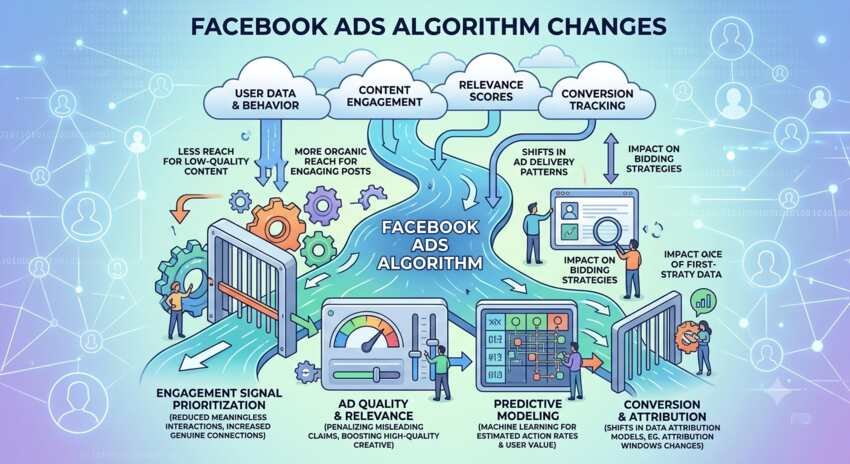
Facebook’s recommendation and ranking systems increasingly use AI to predict what people may find useful, entertaining, or relevant. At the same time, Meta is investing in original content, Reels, personalized recommendations, and AI-powered advertising tools.
For businesses, this means increasing Facebook reach requires a combination of relevant content, audience understanding, creative testing, and consistent performance measurement.
There is also an important distinction between organic reach and paid reach. Organic reach depends on how Facebook distributes unpaid content, while paid reach depends on advertising delivery, campaign objectives, audience signals, creative quality, and budget. Both are influenced by relevance, but they do not work in exactly the same way.
Meta reported that improvements to Facebook Feed and video ranking delivered a 7% increase in views of organic Feed and video posts in Q4 2025. It also reported surfacing more than 25% more same-day Reels compared with Q3 2025.
These are platform-level results reported by Meta, not a promise that every business will experience the same growth. This guide explains the latest relevant Facebook algorithm developments, how they affect businesses, and practical ways to improve organic and paid reach.
What Is the Facebook Algorithm?
The Facebook algorithm is a collection of ranking and recommendation systems that determine which content appears to each person across Facebook Feed, Reels, video, and other surfaces.
Rather than showing every post in chronological order, Facebook predicts which content is likely to be relevant to an individual user. These predictions can incorporate signals such as previous interactions, viewing behaviour, content characteristics, relationships, and direct feedback.
For example, if someone regularly watches home renovation videos, comments on interior design posts, and shares DIY projects, Facebook may recommend more content related to home improvement.
For a business, this creates an opportunity to reach people who have shown an interest in a relevant topic, even if they have never followed its Page. However, the system does not simply reward every post that receives a large number of likes. The relevance of the content, the type of interaction, and whether users find the experience worthwhile also matter.
Organic Reach vs. Paid Reach
| Factor | Organic reach | Paid reach |
|---|---|---|
| Main distribution source | Feed, Reels, recommendations, and followers | Facebook ad placements and campaign delivery |
| Budget requirement | No media spend required | Requires an advertising budget |
| Main optimization focus | Relevance, originality, audience response, content quality | Campaign objective, creative, audience signals, budget, and conversion performance |
| Typical use case | Community building, education, brand visibility | Lead generation, sales, retargeting, and scalable awareness |
| Measurement | Reach, views, shares, meaningful interactions, follows | Reach, impressions, CPM, clicks, conversions, CPA, ROAS |
A business should not rely entirely on one method. Organic content can help establish credibility and reveal which topics resonate with an audience, while paid campaigns can help distribute proven messages to a selected audience or achieve a specific marketing objective.
Major Facebook Algorithm Changes Businesses Should Understand
Facebook’s ranking systems evolve continuously, so it is more useful to understand the direction of these changes than to chase every algorithm rumour.
1. AI-driven recommendations are becoming more personalized
Facebook increasingly uses AI to recommend content based on what it predicts each person will find relevant. Its ranking systems consider a range of signals rather than relying on a single engagement metric.
In October 2026, Meta also announced new AI-powered tools called Your algorithm, allowing users to express interests in their own words and adjust the topics they want to see in Feed and Reels. Meta says these recommendations can respond to user feedback in real time.
What this means for businesses: Content should have a clear topic and deliver a specific benefit. If your Page publishes useful information about skincare, for example, practical skincare routines, ingredient explainers, and product-use demonstrations give the audience a more consistent reason to engage.
A Page that publishes unrelated topics without a clear audience may find it harder to build a recognizable content identity.
2. Original content is receiving greater emphasis
Meta has explicitly stated that it is prioritizing original content in Facebook Feed and Reels while reducing the distribution of unoriginal material. In its March 2026 update, Meta reported that both views and time spent watching original Facebook Reels approximately doubled in the second half of 2025 compared with the same period in 2024. Original content can include:
Videos filmed by your business or creative team.
Product demonstrations and behind-the-scenes footage.
Original tutorials, educational explainers, and expert advice.
Customer stories shared with appropriate permission.
Commentary that adds substantial analysis or new information to existing material.
Simply downloading another creator’s video and adding a logo, border, or minor edits may not make it meaningfully original. Practical example: A footwear retailer could create a Reel comparing different shoe soles, demonstrating how to clean them, or explaining how to choose walking shoes. This provides more distinctive value than reposting a generic footwear video.
3. Reels and video remain important discovery formats
Reels give businesses an opportunity to reach people who do not already follow their Page. Meta reported that Facebook was surfacing more than 25% more same-day Reels in Q4 2025 than in Q3 2025.
This suggests that timely content can be relevant to Facebook’s evolving discovery experience, although it does not establish a universal publishing-time rule for every Page. Businesses can use Reels to:
Demonstrate products in action.
Answer common customer questions.
Share quick educational tips.
Explain how a service solves a problem.
Present customer experiences and behind-the-scenes activities.
The first few seconds should make the topic clear. For example, a video that begins with “Three mistakes that make your Facebook ad budget less effective” immediately communicates its value to a marketing audience.
There is no universally optimal Reel length. A 15-second video can work well for a single tip, while a more detailed demonstration may need 45–60 seconds or longer. The important thing is to maintain the viewer’s interest throughout the video.
4. Meaningful interactions matter more than superficial engagement
Likes can indicate that someone appreciates a post, but they do not explain the full value of that interaction. Meta has described using multiple predictions to rank content, including the likelihood that someone will comment, share, or otherwise find a post valuable.
No single action perfectly measures content quality. This means businesses should create content people genuinely want to discuss, save for later, or share with someone who could benefit from it.
For example, a tax consultant might publish a clear checklist of documents that small businesses should prepare before filing returns. Such a post offers practical value and may prompt people to share it with colleagues.
Avoid engagement bait such as “Like this post if you agree” when the main purpose is to manipulate engagement. Instead, invite authentic discussion through useful questions and relevant information.
5. Facebook is investing in AI-powered advertising
Organic ranking changes are not the same as paid advertising changes. Meta also continues to improve the AI models used to select and rank ads. In January 2026, Meta reported that its Q4 2025 advertising ranking improvements contributed to a 3.5% increase in Facebook ad clicks.
Meta also reported a 12% increase in ads quality after improvements involving Facebook Stories and other placements. These are Meta-reported results from its own systems, not guaranteed performance improvements for individual advertisers.
For advertisers, this reinforces the importance of supplying useful campaign signals, strong creative assets, and accurate conversion data. Rather than relying on one ad indefinitely, businesses should test different creative concepts and evaluate whether the additional reach results in valuable customer actions.
How Facebook Determines Which Content Gets More Reach
Facebook does not publish one universal formula that businesses can use to predict the reach of every post. Its ranking systems combine multiple signals and predictions, and the importance of those signals can vary by content type, user, and placement. The following factors are useful for planning a content strategy, although they should not be interpreted as a confirmed ranking-weight formula.
1. Audience relevance
Content that matches a person’s interests and viewing habits has a better opportunity to be recommended to that person.
2. Meaningful interactions
Comments, shares, and other interactions can help indicate whether a post is valuable to its audience. The number of likes alone does not tell the whole story.
3. Video viewing behaviour
For video, watch time and viewing behaviour help indicate whether people find the content worth watching.
4. Originality and content quality
Original content that provides new information or entertainment is better aligned with Meta’s stated direction than duplicated or minimally edited material.
5. Timeliness and context
Timely content can be useful when it addresses a current event, seasonal need, or active audience interest. Publishing time alone does not guarantee higher distribution.
These principles are consistent with Meta’s published explanations of content ranking and its recent focus on original, relevant recommendations.
10 Practical Ways to Increase Facebook Reach
Understanding the algorithm is useful, but the real challenge is turning that knowledge into a repeatable marketing strategy. These ten methods can help businesses improve their chances of reaching the right people.
1. Create content around two or three core themes
A Facebook Page should have a clear reason for existing. If your audience follows you for digital marketing advice, most of your posts should support that interest. For example, a digital marketing agency might focus on:
Facebook and Google Ads tips.
SEO and AI search updates.
Case studies and marketing performance insights.
These themes create a consistent content experience while leaving room for experiments. Avoid publishing unrelated content simply to fill the calendar. Instead, review which topics attract relevant engagement and develop them further.
2. Publish original Reels with a strong opening
Reels can help businesses introduce their products, expertise, or services to people who have not encountered the brand before. A practical Reel structure is:
0–3s
Hook
Identify the problem or promise a useful takeaway.
Example: “Your Facebook ads are getting clicks, but why aren’t they generating leads?”
3–20s
Value
Explain one useful idea, demonstrate a product, or show a practical solution.
Final
Next step
Invite viewers to explore a related resource, ask a genuine question, or visit the relevant service page.
Use clear audio, readable captions, appropriate framing, and a visual style that suits your audience. Avoid long introductions that delay the promised information.
3. Give people a reason to share your posts
Shares can introduce your content to people outside your existing audience. Create material that solves a problem, explains a complicated subject, or helps someone make a decision. Examples include:
A checklist for choosing a reliable service provider.
A comparison of two product options.
A short tutorial that saves time.
A seasonal maintenance guide.
A practical industry update with an explanation of its implications.
Do not assume that every share carries the same ranking value or that private shares are always the most important signal. The more useful lesson is to produce content people naturally want to pass along.
4. Encourage genuine conversations
Comments can help you understand customer concerns and create relationships with potential buyers. Instead of asking people to leave a meaningless comment, ask questions that connect directly to the content.
For example, a skincare business could ask, “Which step in your morning skincare routine do you find most confusing?” A marketing agency could ask, “What is the biggest challenge you face when measuring lead quality?” Respond thoughtfully and use recurring questions as ideas for future posts.
5. Maintain a consistent publishing schedule
Consistency helps you build a sustainable content process and learn which formats work for your audience. The Omnichat reference article recommends experimenting with approximately 3–5 quality posts per week.
Treat this as a starting point for testing, not an official Facebook ranking rule or a guaranteed optimal frequency. A small business might begin with three posts each week:
Monday: Educational carousel or image post.
Wednesday: Original Reel or product demonstration.
Friday: Customer story, FAQ, or industry insight.
After four weeks, review reach, shares, engagement, and conversions. Increase or reduce the frequency according to performance and your team’s ability to maintain quality.
6. Make your content easy to understand on mobile
Many people browse social media on their phones, often while doing something else. Your message should be clear without requiring extensive effort. Use these practical guidelines:
Put the main benefit near the beginning.
Use readable text and strong visual contrast.
Break complicated explanations into short sections.
Add accurate captions to spoken videos.
Avoid cluttered graphics and tiny text.
Make the next step obvious when the post has a commercial purpose.
For example, a furniture retailer should show the product clearly, explain its main benefit, and include essential details such as size, material, or available options.
7. Turn customer questions into content
Customer questions provide a direct source of content ideas. If customers repeatedly ask about pricing, delivery, installation, returns, or product suitability, create posts that answer those questions.
A solar installation company, for example, could publish a short series explaining how site assessments work, what affects installation costs, and what customers should ask before selecting a battery. This approach helps the business produce useful content without relying entirely on trends or generic social media templates.
8. Use insights to identify your strongest formats
Do not decide that a post has succeeded simply because it received more likes than usual. Review Facebook Page insights and available professional dashboard metrics to understand what happened.
| Metric | What it tells you | How to use it |
|---|---|---|
| Reach | Number of unique people who saw the content | Assess audience exposure |
| Impressions | Total number of times content was displayed | Compare overall distribution with unique reach |
| Video watch time | How long viewers watched | Identify content that sustains attention |
| Shares | How often people passed the content along | Find useful or highly relatable topics |
| Comments | Audience discussion and feedback | Identify questions and conversation themes |
| Link clicks | Visits driven by the post | Evaluate traffic generation |
| Follows | New followers gained | Assess whether discovery attracts an ongoing audience |
| Conversions | Desired actions attributed to the content or campaign | Connect marketing activity with business outcomes |
Compare similar content types and account for differences in format, topic, and distribution. A Reel and a link post may have different performance patterns, so comparing them using only raw reach may be misleading.
9. Collaborate with relevant creators and communities
Partnerships can introduce your brand to audiences that already care about your subject. For example, a local fitness studio might collaborate with a qualified fitness creator to produce an educational video about beginner workout routines. A home décor store could work with an interior design professional on a room-planning guide.
Choose collaborators based on audience relevance, credibility, and content quality rather than follower count alone. Get permission to reuse content, clearly disclose paid partnerships where required, and ensure the collaboration adds value for both audiences.
10. Use paid promotion strategically
Organic reach is useful, but some business goals require more predictable distribution. Facebook Ads can help businesses reach selected audiences, promote important offers, generate enquiries, and retarget eligible audiences. The right approach depends on the objective and the quality of the creative.
A practical strategy is to identify organic posts that already demonstrate strong audience interest and test paid promotion where appropriate. However, organic engagement does not guarantee that a post will perform well as an advertisement. For paid campaigns, measure cost per result, lead quality, purchases, and return on ad spend—not reach alone.
How to Increase Facebook Ads Reach Without Wasting Budget
Increasing paid reach is not simply a matter of raising the daily budget. Businesses need to balance audience size, creative quality, campaign objectives, and conversion performance.
1. Choose the right campaign objective
Select the objective that reflects the result you actually want.
| Business goal | Campaign approach to consider | Main metric |
|---|---|---|
| Brand awareness | Awareness | Reach, frequency, and relevant awareness metrics |
| Website traffic | Traffic | Landing-page views and qualified website visits |
| Lead generation | Leads | Qualified leads and cost per qualified lead |
| Online sales | Sales | Purchases, CPA, and ROAS |
| Customer conversations | Engagement or suitable messaging setup | Qualified conversations and resulting sales |
Campaign objectives and available optimization options can change, so check the current Ads Manager settings before launching.
2. Test multiple creative concepts
A common mistake is to create one advertisement and assume it will appeal to every potential customer. Instead, test different approaches, such as:
A short product demonstration.
A customer testimonial used with permission.
A problem-and-solution video.
A benefit-focused static image.
A comparison or educational carousel.
Change one major variable at a time where practical. This makes it easier to understand whether the message, format, or offer is contributing to the results.
3. Avoid unnecessarily narrow targeting
Audience targeting should reflect your product, location, customer profile, and campaign objective. Very narrow targeting can restrict delivery, while overly broad targeting may expose the campaign to people who are unlikely to buy.
Test suitable audience sizes and use Meta’s available audience suggestions and automation where appropriate. Evaluate the results based on qualified outcomes rather than assuming a particular audience setting will always be superior.
4. Monitor frequency and creative fatigue
Reach counts unique people, while impressions count total displays. The relationship between these metrics helps you understand how frequently your ads are being shown. A simple estimate is:
Suppose an ad receives 30,000 impressions and reaches 10,000 people.
This means the ad generated an average of three impressions per person reached during the reporting period. A frequency of 3 is not automatically too high. The appropriate level depends on campaign duration, audience size, creative quality, and the product being advertised. Look for signs of fatigue, such as declining engagement, rising CPA, or falling conversion rates, before deciding to refresh the creative.
5. Improve the landing page and follow-up process
More reach will not solve a poor conversion experience. Make sure your landing page loads reliably, communicates the offer clearly, and works well on mobile devices. Forms should request only necessary information, and customers should receive timely responses after submitting an enquiry.
For lead-generation campaigns, consider tracking the journey from advertisement to qualified lead and final sale. This helps identify whether poor results are caused by the ad, the landing page, or the sales process.
Features and Benefits of an Effective Facebook Reach Strategy
A strong Facebook marketing strategy combines content creation, analytics, community management, and advertising optimization.
| Feature | Benefit for businesses | Example |
|---|---|---|
| AI-powered recommendations | Opportunity to reach relevant non-followers | An educational Reel reaches people interested in digital marketing |
| Original video content | Creates a distinctive brand experience | A retailer demonstrates how its product works |
| Audience insights | Helps identify successful topics and formats | A clinic discovers that its FAQ videos attract more relevant enquiries |
| Community management | Builds trust through helpful responses | A business answers product questions in the comments |
| Creative testing | Identifies messages that resonate with customers | Two ad concepts are compared using the same campaign objective |
| Paid promotion | Extends distribution to selected audiences | A local business promotes a seasonal offer |
| Conversion tracking | Connects advertising activity to business results | An e-commerce store measures purchases and revenue |
| Messaging automation | Helps handle enquiries more efficiently | A store uses automated replies for opening hours and product availability |
The greatest benefit comes from combining these features rather than relying on one tactic. For example, original content may attract attention, community management may build trust, and paid campaigns may help convert that interest into sales.
A Practical Example: Increasing Facebook Reach for a Small Business
Imagine a footwear retailer that publishes four Facebook posts each week but struggles to reach new customers. Its existing content consists mostly of product images with prices and promotional captions. Although the Page has an established follower base, most posts generate limited interaction. The retailer decides to test a new strategy over four weeks.
Illustrative four-week improvement plan
The following numbers are hypothetical targets and examples, not guaranteed outcomes.
Week 1: Improve content
Replace some static promotional posts with original Reels demonstrating shoe comfort, styling options, and product features.
Week 2: Encourage useful interactions
Publish a footwear buying guide, answer common questions, and respond to customer comments.
Week 3: Review performance
Identify which posts attract non-followers, generate shares, and drive product-page visits.
Week 4: Test paid distribution
Test a suitable advertisement using the strongest product creative and measure purchases, cost per purchase, and revenue.
Suppose the retailer’s average weekly organic reach increases from 8,000 people to 10,000 people after the changes. The percentage increase would be:
This represents a hypothetical 25% increase in weekly reach. To understand whether the strategy is genuinely beneficial, the retailer should also check whether website visits, product enquiries, and purchases improve. A reach increase is useful, but a sustainable marketing strategy must ultimately support the business’s goals.
How to Measure Facebook Reach and Engagement
Tracking the right metrics helps you distinguish between content that attracts attention and content that contributes to business growth.
Calculate Facebook reach rate
A commonly used Page-level calculation is:
For example, if a Page has 5,000 followers and a post reaches 1,500 unique people:
The post’s reach is equivalent to 30% of the Page’s follower count. However, this is a comparison ratio, not the percentage of followers who necessarily saw the post. Facebook can recommend content to non-followers, and reach can exceed the follower count.
Calculate engagement rate by reach
A useful internal comparison is:
Suppose a post reaches 2,000 people and receives 100 selected engagements.
Its engagement rate by reach is 5% under this calculation.
Be consistent about which interactions you include. Likes, comments, shares, clicks, and other interactions may be reported separately in Facebook Insights, so define your metric before comparing posts.
Measure the results that matter
For organic content, prioritize reach, meaningful interactions, video viewing behaviour, follows, and relevant website visits. For paid campaigns, also track cost per result, qualified leads, purchases, customer acquisition cost, and ROAS.
Review results over comparable periods. Seasonality, changes in posting frequency, audience size, paid distribution, and external events can all affect reach.
Common Facebook Reach Mistakes to Avoid
Even well-designed content can struggle when the overall strategy is poorly executed.
Buying followers or engagement: Inflated numbers do not establish genuine customer interest and can distort your performance analysis.
- Reposting other creators’ videos without adding value: Meta has stated that duplicated content and minor edits may be deprioritized in Feed and Reels.
Publishing only promotional content: Repeated sales messages may give people little reason to engage with your Page.
Using engagement bait: Encourage authentic conversations rather than asking for likes or shares solely to manipulate distribution.
Ignoring comments and messages: Unanswered questions can undermine customer trust and create missed sales opportunities.
Changing too many campaign variables at once: This makes it difficult to identify which changes influenced performance.
Judging success by reach alone: Large audiences are not necessarily profitable audiences.
Following unverified algorithm hacks: Claims about fixed ranking percentages, guaranteed posting times, or secret engagement formulas should be treated cautiously unless supported by reliable evidence.
Frequently Asked Questions About Facebook Algorithm Changes and Reach
1. What are the latest Facebook algorithm changes in 2026?
Recent developments include continued investment in AI-powered content recommendations, greater emphasis on original content, and improvements to Feed and video ranking. In October 2026, Meta also announced AI-powered controls that let users express their interests in their own words and adjust Feed and Reels recommendations.
2. How can I increase organic reach on Facebook?
Publish original, useful content; experiment with Reels; encourage genuine discussions; respond to customer questions; and use Facebook Insights to identify which topics resonate with your audience. Consistency and quality are more sustainable than relying on engagement tricks.
3. Does Facebook prioritize Reels over other content?
Reels are an important discovery format, and Meta continues to invest in video recommendations. However, it is not accurate to assume that every Reel will outperform every image, text, or link post. Compare formats based on your audience, content objectives, and actual results.
4. How many times should a business post on Facebook each week?
A business could start by testing three to five quality posts per week, then adjust according to performance and available resources. This is a practical starting point rather than an official algorithm requirement. Consistently useful content is more important than meeting a fixed posting quota.
5. Do comments and shares increase Facebook reach?
Comments and shares can provide useful signals about how people respond to content. However, no single interaction guarantees wider distribution. Focus on posts that genuinely help, entertain, or inform your audience rather than trying to manufacture engagement.
6. Why is my Facebook reach declining?
Possible reasons include changes in audience interests, content relevance, posting consistency, competition for attention, creative fatigue, and changes to recommendation systems. Review recent posts, compare similar formats, check available distribution and recommendation eligibility information, and test improvements systematically.
7. Can a Facebook Page reach more people than its number of followers?
Yes. Facebook may recommend eligible content to people who do not follow the Page. For this reason, a post’s reach can exceed its follower count. Track non-follower reach and the number of relevant new followers to understand whether that exposure is useful.
8. Does Facebook penalize AI-generated content?
AI assistance alone does not automatically mean content will receive reduced reach. The important considerations include originality, authenticity, usefulness, and compliance with Facebook’s applicable content policies. Low-value duplication and minimally edited copies can be deprioritized. Review current Meta policies for any disclosure requirements that apply to your content.
9. Is paid advertising necessary to increase Facebook reach?
No. Businesses can build organic reach through relevant content and community engagement. Paid advertising is useful when you need additional distribution, specific campaign objectives, or more controlled delivery. The best balance depends on your resources and marketing goals.
10. How long does it take to improve Facebook reach?
There is no guaranteed timeline. Some posts may attract wider distribution quickly, while consistent improvement in audience quality and business results may require several weeks or longer. A four-week testing period is a useful starting point for comparing content formats, although low-volume accounts may need more time to collect meaningful data.
Conclusion: Build Your Facebook Reach Strategy Around People, Not Hacks
Facebook’s algorithm continues to evolve toward personalized, AI-driven content discovery. Meta’s recent updates reinforce the importance of relevant recommendations, original content, and better advertising technology. For businesses, the most practical response is to focus on what audiences genuinely value.
Create original Reels and useful posts, maintain a clear content strategy, respond to customer questions, test creative concepts, and review performance consistently. When organic content shows promise, consider whether paid distribution can help achieve your business objectives.
Most importantly, measure more than views and likes. Track relevant website visits, qualified enquiries, purchases, and revenue to determine whether your Facebook strategy is contributing to sustainable growth.
There is no single tactic that guarantees higher reach. But a disciplined approach built around relevant content, meaningful customer relationships, and accurate measurement gives businesses a stronger foundation for adapting to Facebook algorithm changes.