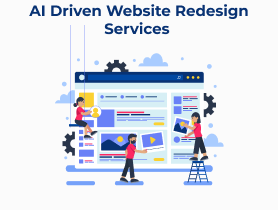
In this day and age, with everything moving so quickly online, businesses really need to keep their websites up-to-date. That’s where services that use AI to redo websites come in handy. These smart tools leverage artificial intelligence, machine learning, and data analysis to turn websites into platforms that work great and are easy for people to use.
Instead of just hoping something works, AI looks at how people act, figures out what’s coming next, and automatically makes the design better. What does this mean? Websites that load faster, happier visitors, and more sales. Let’s dive into the key features that make these services such a big deal.
Core Features of AI Driven Website Redesign Services
-
Intelligent User Behaviour Analysis
Basically, Intelligent User Behaviour Analysis, or IUBA, uses smart tech like machine learning and data mining to turn what users do online into useful info about their mindset and how things are running.
Instead of just seeing where people click, it looks at stuff like how long they stay on a page, how they move around, and if they pause, all to guess what a user wants and what they’ll do next, right away.
Once these systems know what’s typical for users, they can spot weird stuff, like possible scams or someone trying to take over an account, and at the same time, make the online experience more tailored to each person.
For marketing, this means websites can stop just looking at age and location and instead react on the fly to what a user is thinking and what they like at that moment.
One of the most powerful features of ai driven website redesign services is advanced behaviour tracking.
Real-Time Data Collection
AI tools monitor:
- Click patterns
- Scroll depth
- Bounce rates
- Session duration
- Navigation paths
Unlike traditional analytics, AI interprets patterns instantly and suggests improvements.
Predictive Insights
AI doesn’t just analyze past data, it predicts future user actions. This allows designers to:
- Reposition important CTAs
- Simplify navigation menus
- Reduce friction points
- Personalize content placement
By understanding user intent, websites become more intuitive and conversion-focused.
-
Automated Web Design Optimization
Basically, automated web design optimization uses smart tech like AI and machine learning to tweak how a website looks, how well it runs, and how people interact with it, all without you having to do it yourself all the time. These systems watch what’s happening live and make small changes to get more people to click on things and stick around.
What Makes Automated Optimization Tick:
AI can create tons of different website looks, moving buttons or changing picture sizes to see what makes people stay on the page longer.
These systems automatically shrink images, change them to newer formats, and make sure the important stuff at the top of the page loads super fast.
Algorithms look at what a visitor has done before or where they came from to show them content that matches what they’re looking for.
Instead of just running one test, automation can constantly test different designs and send more people to the one that’s working best, all in real time.
How it Helps Your Website’s Search Ranking and User Experience:
Because search engines care a lot about how fast your site loads and how stable it is, automated optimization automatically improves your ranking by keeping those scores high. It takes the guesswork out of design, making sure your site is actually user-friendly based on real data, not just what looks good. Website Design plays a crucial role in engagement. AI enhances it dramatically.
Smart Layout Adjustments
AI evaluates:
- Colour contrast
- Font readability
- Button placement
- Visual hierarchy
It automatically tests different layouts using A/B testing and identifies the highest-performing design.
Continuous Testing & Improvement
Instead of manual redesign cycles, AI constantly runs experiments. If one version increases conversions by 8%, it automatically prioritizes it. This ensures ongoing optimization without extra workload.
-
Adaptive & Responsive Design Intelligence
Adaptive and Responsive Design Intelligence represents the evolution of web design from static, device-based layouts to fluid, context-aware interfaces. While traditional design focuses on screen size, “Design Intelligence” adds a layer of AI to adjust for intent, environment, and user behaviour.
-
Responsive vs. Adaptive: The Intelligent Shift
While often used interchangeably, intelligence-driven systems combine both to provide the best possible experience:
| Feature | Responsive Intelligence | Adaptive Intelligence |
| Logic | Fluid grids that “flow” into any size. | Pre-defined layouts for specific “breakpoints.” |
| AI Layer | Automatically adjusts typography and image scaling based on visual importance. | Server-side detection that serves a lightweight version for slow connections. |
| Primary Goal | Visual consistency across all devices. | Performance and functional optimization per device. |
Core Pillars of Design Intelligence
- Contextual Awareness: The interface changes based on external factors. For example, a site might switch to high-contrast mode if sensors detect bright sunlight or transition to a “Dark Mode” theme based on the user’s local time.
- Predictive Component Loading: Machine learning models predict which elements a user is most likely to interact with next. If a user frequently checks “Case Studies,” the layout can prioritize that section on the homepage in real-time.
- Performance Tiering: Intelligence systems assess the user’s hardware. A flagship smartphone might receive high-definition 3D assets, while an older device is served static 2D versions to ensure the site remains fast and functional.
- Dynamic Touch-Targets: On mobile, the AI can detect if a user is struggling to click small links (hesitation or “fat-finger” errors) and dynamically increase the padding and size of interactive elements.
-
Impact on Digital Growth
For professionals managing high-traffic sites, this intelligence removes the “one-size-fits-all” limitation:
- SEO Benefit: By meeting Core Web Vitals (specifically Cumulative Layout Shift) through intelligent asset loading, sites rank higher.
- Conversion Lift: AI-driven layouts can rearrange call-to-action (CTA) buttons based on heat-map data, placing them where a specific user’s eye naturally falls.
Key Insight: In 2026, web design is no longer a “project” that ends at launch; it is a live system that learns how to present itself to every individual visitor.
Modern users browse on phones, tablets, laptops, and desktops. AI ensures seamless experiences everywhere.
Device-Specific Adjustments
AI dynamically adjusts:
- Image sizes
- Layout structure
- Menu styles
- Load priorities
Performance-Based Adaptation
If mobile users show higher bounce rates, AI identifies why and modifies page structure accordingly. The result? Faster loading times and smoother experiences across all devices.
-
AI-Powered SEO Enhancement with Website Redesign
Integrating AI into a website redesign is no longer just about aesthetics; it is about building a site that is “machine-readable” for AI crawlers while remaining “human-centric” for users.
When redesigning, AI-powered SEO ensures that your new site structure preserves existing authority while identifying new growth opportunities.
-
AI-Driven Site Architecture & Content Mapping
During a redesign, the biggest risk is losing “link equity” or topical relevance. AI tools mitigate this by modelling the ideal site structure before a single line of code is written.
- Topical Clustering: Tools like Surfer SEO or MarketMuse analyze your competitors to suggest a “Hub and Spoke” architecture. This ensures your new site covers all semantically related sub-topics (e.g., if you are a solar provider, the AI ensures you have connected pages for “inverters,” “net metering,” and “battery storage”).
- Entity-Based Optimization: Modern SEO focuses on “entities” (concepts) rather than just keywords. AI helps map these entities so search engines understand your brand’s expertise across different regions, such as India or Australia.
-
Automated Technical SEO & Migration
A redesign often leads to broken links or slow load times. AI-powered technical audits automate the “heavy lifting” of the migration process.
- Predictive Crawlability: AI agents like Lumar or ContentKing simulate how Googlebot will navigate your new staging site. They flag potential “redirect chains” or “orphan pages” before the site goes live.
- Core Web Vitals Automation: AI can automatically optimize images, minify CSS, and suggest “lazy loading” patterns to ensure your new design hits the highest performance scores on day one.
-
Generative Content & Meta-Tagging at Scale
Redesigning a site often requires updating hundreds of meta descriptions and headers.
- Bulk Optimization: Instead of manual entry, AI can generate unique, keyword-optimized meta titles and descriptions for every page, ensuring they align with the current search intent (e.g., transitioning from “informational” to “commercial” intent for service pages).
- Schema Markup Generation: AI tools like WordLift automatically generate “JSON-LD” structured data. This tells AI search engines (like Google Gemini or Perplexity) exactly what your services are, making it more likely your site will be cited in AI-generated search summaries.
-
Comparison: Traditional vs. AI-Powered Redesign.
| Phase | Traditional Redesign | AI-Powered Redesign |
| Keyword Research | Static list of high-volume terms. | Predictive trends and semantic clusters. |
| Site Structure | Based on manual UX best practices. | Data-driven maps based on competitor gaps. |
| Technical Audit | Manual checks after the site goes live. | Real-time, autonomous monitoring in staging. |
| Meta Data | Hand-written for top-tier pages only. | Automated, intent-aligned tags for the whole site. |
Strategy for Digital Marketing Professionals
If you are managing a redesign for a client, specifically in technical niches like Solar Energy or B2B Services, AI allows you to prove ROI faster. By using AI to identify “content decay” on the old site, you can prioritize which pages to rewrite first to capture high-intent leads in specific local markets like Ahmedabad or Sydney.
Pro Tip: Use an AI Result Tracker (like SE Ranking) during the redesign to see if your brand mentions increase in AI-generated search overviews, which is the “new” ranking factor for 2026.
Search engine visibility is vital. Many ai driven website redesign services include built-in SEO intelligence.
Technical SEO Improvements
AI automatically checks:
- Broken links
- Page speed
- Meta tag structure
- Schema markup
- Crawl errors
Content Optimization
AI suggests:
- Keyword placements
- Heading improvements
- Internal linking structures
- Content readability adjustments
For example, tools like Google Search Console provide performance data, and AI systems integrate this data to optimize site structure. The outcome? Higher rankings and more organic traffic.
-
Personalized User Experience (UX)
Personalization is no longer optional—it’s expected.
Dynamic Content Customization
AI modifies:
- Homepage banners
- Product recommendations
- Blog suggestions
- Call-to-action messages
Based on:
- User location
- Browsing history
- Device type
- Purchase behavior
Smart Chat Integration
AI chatbots provide:
- Instant support
- Guided navigation
- Product recommendations
This builds trust and increases engagement.
-
Data-Driven Conversion Rate Optimization (CRO)
Conversion rate optimization becomes smarter with AI.
Funnel Analysis
AI identifies where users drop off:
- Checkout pages
- Signup forms
- Contact forms
Automated Improvements
Based on insights, AI may:
- Shorten forms
- Simplify checkout steps
- Add trust badges
- Adjust CTA wording
These micro-adjustments often result in significant revenue increases.
-
Security & Performance Monitoring
Security and performance are essential components.
Threat Detection
AI monitors:
- Suspicious login attempts
- Malware patterns
- DDoS attack signals
Performance Alerts
It detects:
- Slow-loading scripts
- Server bottlenecks
- Unoptimized media
Then it recommends or automatically applies fixes. This ensures uptime, speed, and data protection.
Key Benefits at a Glance
| Feature | Business Impact |
| Behaviour Analytics | Improved UX decisions |
| Design Optimization | Higher engagement |
| Responsive Intelligence | Better mobile performance |
| SEO Enhancement | Increased organic traffic |
| Personalization | Higher retention |
| CRO Automation | More conversions |
| Security Monitoring | Reduced risks |
Frequently Asked Questions (FAQs)
-
What makes ai driven website redesign services different from traditional redesigns?
Traditional redesigns rely on manual analysis and periodic updates. AI-driven services continuously monitor, test, and optimize in real time.
-
Are ai driven website redesign services expensive?
Costs vary depending on complexity. However, automation often reduces long-term design and marketing expenses.
-
Can AI redesign my entire website automatically?
AI can automate many processes, but human oversight ensures branding and strategy remain aligned with business goals.
-
How long does an AI-powered redesign take?
Initial implementation may take weeks, but optimization continues automatically afterward.
-
Do small businesses benefit from AI website redesign?
Absolutely. AI tools scale easily and help small businesses compete with larger brands.
-
Is AI website redesign safe for data privacy?
Reputable providers follow strict data compliance standards like GDPR and implement secure encryption protocols.
In Conclusion :
Things move fast online, and companies need to keep up. Using AI to redo your website is a much smarter, quicker, and more effective way to make it work better, be easier to use, and help your business grow.
These services take the guesswork out of things by using smart ways to track how people use your site, tailoring the experience for them, and automatically improving your search engine ranking based on solid data.
If you want your website to stay relevant and ready for what’s next, you really can’t afford to ignore AI-powered website makeovers anymore, they’re a must-have.