
The world of web design is changing quickly than ever. As Artificial Intelligence endures to advance, the way websites are created, optimized, and experienced has undertaken a revolution. The era of AI has not only familiarized new tools but also reshaped the central concepts of design, user engagement, and digital branding.
Today, businesses and designers who embrace AI-driven web design strategies can build smarter, faster, and more personalized websites that stand out in a progressively competitive digital landscape.
This blog discovers the most significant new concepts of web designing in the era of AI and how they are transforming the future of the web.
New Concepts of Web Designing in the Era of AI
-
AI-Driven Personalization in Websites That Adapt to Users
AI-driven personalization in websites uses machine learning to analyze enormous amounts of user data, such as browsing history and purchase patterns, in real-time.
This permits the website to vigorously adapt its content, product recommendations, and layout to match the distinct visitor’s preferences and context.
The goal is to produce an exclusive, highly appropriate experience for each person, reducing clutter and choice fatigue, which eventually leads to higher user engagement and conversion rates.
Traditional websites present the similar experience to every visitor. But AI has changed the game.
AI-powered personalization permits websites to tailor content based on real-time user behaviour, such as:
- Browsing history
- Demographics and geolocation
- Time spent on pages
- Products previously viewed
- Device type and user preferences
This results in:
- Higher engagement
- More conversions
- Better customer satisfaction
E-commerce platforms like Amazon have mastered this with AI-driven endorsements. Today, even minor businesses can integrate personalization through AI plugins and CMS add-ons.
-
Conversational UI (CUI) in Website Designing — From Menus to Intelligent Chat Interfaces
Conversational User Interface (CUI) is a tactic to website design that permits users to interact with the system using natural language through text (chatbots) or voice (voice assistants), representing a human conversation. Instead of relying merely on traditional menus and forms, CUI leverages Natural Language Processing (NLP) and AI to recognize the user’s intent and context.
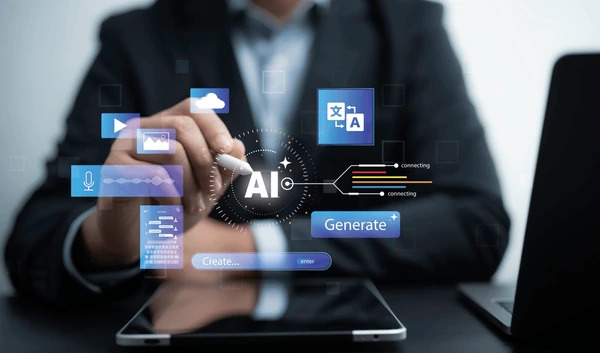
This creates a more spontaneous, frictionless, and personalized user experience. Executing CUI on a website can meaningfully boost customer satisfaction by providing 24/7 support, rapidly answering mutual queries, guiding users through tasks (like checkout), and finally leading to higher conversion rates.
The growth of ChatGPT-style models has made conversational interfaces mainstream.
Conversational UI swaps traditional navigation with smart, chat-based interactions.
Instead of clicking through pages, visitors can:
- Ask questions
- Explore services
- Get recommendations
- Support issues resolved instantly
AI chatbots can function as:
- Customer support assistants
- Product finders
- Virtual sales agents
This not only improves user experience but also intensely increases lead-generation potential.
-
Automated Design Generation (AIGD) From Idea to Website in Minutes
Automated Design Generation (AIGD) pulls Generative AI models to transform a humble text prompt or business description into an entirely structured, visually cohesive website in minutes. By analyzing the user’s intent, industry, and anticipated style, the AI promptly generates the site’s layout, creates primary content, selects suitable images, and ensures the design is mobile-responsive out of the box.
This vividly reduces the time and cost barrier for launching a web presence, turning the multifaceted procedure of design and development into a rapid, iterative workflow.
AI design platforms like Wix ADI, Elementor AI, and Framer AI permit websites to be created automatically through prompts.
With Automated Intelligent Graphic Design, AI can:
- Generate layouts based on brand style
- Suggest images and color palettes
- Create text and multimedia content
- Improve UX automatically
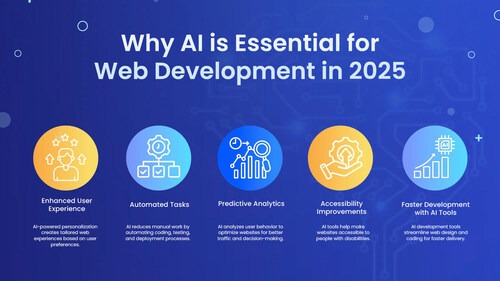
This concept has made web design faster, more accessible, and cost-effective, particularly for small businesses and startups.
-
Predictive UX & AI That Understands User Intent
“Predictive UX” is a preventive design tactic where AI and machine learning models analyze user behaviour (like clicks, dwell time, and search queries) to comprehend and forecast their goal or “intent” before they obviously state it.
By predicting the user’s next likely action, such as finishing a transaction or needing a precise piece of information, the system can proactively acclimate the interface by showing the most pertinent content, features, or suggestions. This creates a unified, hyper-personalized, and highly effectual user experience that minimizes cognitive load and friction.
Predictive UX uses AI analytics to detect patterns in user activity and predict what they might do next.
This allows:
- Anticipatory design (interfaces adjust before users take action)
- Smarter CTAs
- Optimized user flows
- Reduced bounce rates
For example:
- If a user hesitates before filling a form, AI can display micro-prompts.
- If a visitor looks for pricing, AI can highlight the pricing section automatically.
This intuitive behaviour elevates user experience to new levels.
-
Voice-First and Voice-Activated Web Design
Voice-First and Voice-Activated Web Design emphasises on optimizing websites and applications to be effortlessly navigated and interacted with chiefly using spoken commands rather than traditional mouse clicks or touch. This paradigm relies profoundly on Automatic Speech Recognition (ASR) and Natural Language Understanding (NLU) to precisely transcribe user speech and understand their intent.
The design prioritizes clear, brief audio feedback and a rationalized structure, making web access more manageable for users with disabilities and enabling hands-free interaction across devices like smart speakers and mobile phones.
With voice assistants such as Alexa, Google Assistant, and Siri becoming prevalent, voice interaction is becoming a major web design trend.
Modern AI web design includes:
- Voice-friendly content
- Voice navigation
- AI-driven voice search optimization
- Conversational voice UIs for apps and sites
Businesses targeting mobile-first users must now ponder how their websites “sound”, not just how they look.
-
AI-Enhanced Visuals and Media in Website Design
AI-Enhanced Visuals and Media in website design leverage artificial intelligence to optimize, personalize, and even produce the imagery and video content presented to users. AI tools can routinely accomplish tasks like image up-scaling, compression, and cropping to safeguard fast loading times while upholding quality across numerous devices.
More advanced applications include using AI to vigorously select the most engaging hero image or product video for a detailed user segment, or even generating wholly new, exclusive visual assets from a text prompt. This emphasis on intelligent media management safeguards visuals that are both high-performing and hyper-relevant, meaningfully improving the user experience and site performance.
AI tools like DALL·E, Midjourney, and Adobe Firefly have transformed visual creation.
New design concepts include:
- On-demand image generation
- AI-enhanced photo editing
- Automated video creation
- Dynamic visuals that adjust based on user data
These tools save thousands of design hours and permit even non-designers to generate striking visual content.
-
Hyper-Responsive Design Powered by AI
Hyper-Responsive Design Powered by AI represents the progress of traditional responsive design, moving beyond static breakpoints to propose a website that adapts not only to the screen size but also to the distinct user’s context and intent.
It leverages Machine Learning (ML) to analyze real-time data, such as location, time of day, browsing history, and device capabilities, to predict user requirements. The AI can enthusiastically customize the layout, prioritize content blocks, and optimize visual assets (like resizing and compressing images) in real-time, resulting in a truthfully personalized, unified, and high-performing experience that suggestively boosts engagement and conversion.
Responsive design used to mean adjusting layouts for diverse screen sizes. In the AI era, it means much more.
AI helps websites adapt to:
- User behaviour patterns
- Changing network speeds
- Individual device performance
- Dark/light mode preferences
- Accessibility requirements
This creates a really fluid, adaptive interface, customized for every user.
-
AI-Powered SEO & Content Optimization for Better Performance
AI-Powered SEO and Content Optimization uses machine learning to move beyond modest keyword matching, focusing on considerate user intent and semantic context to drive healthier search performance.
AI tools can quickly analyze vast amounts of Search Engine Results Page (SERP) data to deliver detailed, data-backed recommendations for content structure, optimal word count, and natural keyword integration.
This intelligence helps content creators close content gaps, fix technical SEO issues like broken links, and tailor their writing to please both search engine algorithms (like Google’s RankBrain and SGE) and the precise requirements of the target audience, eventually boosting organic traffic and visibility in AI-powered search results.
Search engines are now AI-driven — and so is SEO.
Modern websites use AI tools for:
- Automatic keyword optimization
- Real-time SEO audits
- Content generation and improvement
- Predictive search behaviour analysis
- Enhanced site performance with AI-driven CDN routing
AI safeguards that websites not only appear decent but also perform well on Google, leading to more organic traffic.
-
Ethical and Inclusive Web Design Through AI
Ethical and Inclusive Web Design Through AI emphasises on using artificial intelligence to actively decrease bias and improve accessibility in digital experiences for all users. AI tools can be leveraged to routinely audit websites for compliance with standards like WCAG (Web Content Accessibility Guidelines), generating features such as truthful alternative text for images and checking colour contrast in real-time.
Significantly, ethical AI development also demands transparency about data collection, protecting user privacy, and uninterruptedly auditing algorithms to confirm they don’t preserve or amplify societal biases against any user group, making the web a fairer and equitable space.
AI can evaluate websites for:
- Accessibility issues
- Gender and cultural biases
- Readability concerns
- Inclusivity gaps
Accessibility plugins with AI verification confirm compliance with global standards like WCAG, making websites more inclusive.
-
Continuous Improvement in Website Design Through AI Analytics
Constant Improvement in Website Design Through AI Analytics utilizes machine learning algorithms to regularly monitor and analyze huge datasets of user interactions, including heatmaps, conversion funnels, and A/B test results.
Unlike traditional analytics, AI can recognize subtle patterns and anomalies in user behaviour that human analysts might miss, providing highly detailed and actionable insights.
This permits the system to not only report on past performance but also to endorse and repeatedly deploy design and content changes (like optimizing call-to-action placement or modifying headlines) in real-time, creating a continuous feedback loop that drives ongoing optimization and healthier business outcomes.
In the past, websites were updated infrequently. In the AI era, improvement is incessant.
AI analytics tools:
- Track real-time user behaviour
- A/B test automatically
- Suggest layout improvements
- Optimize navigation and content
- Predict customer needs
This permits businesses to retain their sites fresh, relevant, and always optimized.
Final Thoughts: AI Is Not Replacing Designers — It’s Empowering Them
The era of AI has opened the door to quicker, smarter, and more dynamic web design. Designers can now emphasis on creativity, strategy, and storytelling while AI handles tedious tasks, optimization, and personalization.
Whether you’re a business owner, developer, or designer, embracing AI-driven web design will help you:
- Build better digital experiences
- Increase conversions
- Stay ahead of competitors
The forthcoming of web designing is intelligent, adaptive, and deeply user-centric, and the journey has only just begun.
FAQs on New Concepts of Web Designing in the Era of AI
-
How is AI transforming modern web design?
AI is transforming web design by automating repetitive tasks, generating layouts, personalizing content, improving user experience through predictive analytics, and enabling conversational interfaces. It helps create smarter, faster, and more intuitive websites with minimal manual effort.
-
What is AI-driven personalization in web design?
AI-driven personalization tailors website content to each user based on browsing behavior, past interactions, location, device type, and preferences. This increases engagement, reduces bounce rates, and boosts conversions.
-
Can AI replace human web designers?
No. AI can automate design tasks, generate content, and suggest improvements, but human creativity, strategy, and brand understanding remain irreplaceable. AI enhances a designer’s capabilities rather than replacing them.
-
What are AI-powered chatbots in web design?
AI chatbots provide conversational user interfaces that allow visitors to interact with websites more naturally. They help answer queries, guide users, suggest products, and even procedure basic support tasks, improving user experience and lead generation.
-
How does AI help in improving website user experience (UX)?
AI improves UX by analyzing user behaviour, predicting actions, optimizing navigation, adjusting layouts dynamically, speeding up loading times, and creating personalized journeys for each visitor.
-
What is automated design generation?
Automated design generation (AIGD) involves AI tools creating wide-ranging website layouts, colour schemes, images, and content based on prompts or brand information. Platforms like Framer AI and Wix ADI can generate websites in minutes.
-
How does AI impact SEO and website ranking?
AI tools optimize keywords, improve content quality, analyze user intent, perform SEO audits, and enhance site performance. Google algorithms are AI-based, so AI-powered SEO helps websites rank higher and stay competitive.
-
What is predictive UX design?
Predictive UX uses AI to analyze user behaviour and anticipate their next steps. For example, AI might highlight a pricing section when a user scrolls near it or display helpful prompts if somebody hesitates while filling a form.
-
How does AI help with accessibility in web design?
AI tools can scan websites for accessibility issues such as poor contrast, missing alt text, keyboard navigation problems, and readability concerns, helping make sites more inclusive and compliant with standards like WCAG.
-
Do businesses of all sizes benefit from AI web design?
Yes. AI tools are available for small businesses, startups, and large enterprises. From automated builders to AI chatbots and analytics, companies of any size can improve website performance and customer experience at a lower cost.
In Conclusion:
The era of AI has brought a groundbreaking shift in the world of web design. What once were essential hours of manual struggle can now be done smarter, faster, and with far greater precision thanks to artificial intelligence.
From automated design generation and predictive UX to personalized content and conversational interfaces, AI is reshaping how users interact with websites.
However, the real power of AI lies not in replacing designers but in empowering them. It frees creative minds from boring tasks, offers data-driven insights, and opens up new possibilities for innovation.
Businesses that embrace AI-driven web design will be able to deliver more dynamic, user-centric, and future-ready digital experiences.
As AI endures to advance, the websites of tomorrow will be more spontaneous, adaptive, and intelligent than ever before, making now the flawless time for designers and brands to adopt these new concepts.