
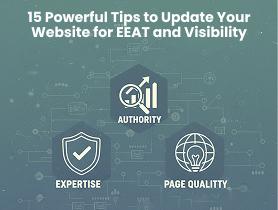
To boost your website’s visibility and align with Google’s E-E-A-T (Experience, Expertise, Authoritativeness, and Trustworthiness) standards, focus on humanizing your brand and proving your real-world knowledge.
Updating your website for E-E-A-T is vital for staying competitive in modern search results. By refining your content to echo real-world experience and specialized credibility, you signal to both users and search engines that your site is a consistent source of information.
Powerful Tips for E-E-A-T and Visibility
- Showcase “Real-World” Experience: Beyond just sharing facts, include personal anecdotes, “behind-the-scenes” photos, or case studies that prove you have used the products or services you are discussing.
- Invest in Comprehensive Author Bios: Create steadfast author pages that highpoint professional credentials, years of industry experience, and links to other trustworthy publications where your team has been featured.
- Prioritize Radical Transparency: Clearly display your contact information, physical address, and thorough editorial policies; safeguard your site uses HTTPS and keep “About Us” pages updated with your brand’s mission and history.
- Build Topical Authority through Clusters: Instead of chasing random keywords, create “topic clusters” where one main pillar page links to numerous in-depth articles, signalling to search engines that you are a thorough resource on that subject.
- Leverage Trusted External Signals: Earn high-quality backlinks from industry-specific sites and encourage honest customer reviews on third-party platforms like Trustpilot or Google Business Profile to figure external proof of your reliability.
Key Elements of E-E-A-T
| Pillar | Actionable Update |
| Experience | Add original photos and first-hand “lesson learned” sections to your content. |
| Expertise | Use Schema Markup to help search engines identify the author’s credentials. |
| Authoritativeness | Replace generic stock images with real team photos and brand-specific assets. |
| Trustworthiness | Regularly audit and update old content to ensure all facts and links remain accurate. |
Essential Strategies for Website Optimization
- Highlight First-Hand Experience: Incorporate innovative photos, personal case studies, and exclusive insights that prove you have hands-on, “boots-on-the-ground” knowledge of your topic.
- Strengthen Author Profiles: Move beyond unidentified posts by creating comprehensive author bios that link to professional certifications, social media profiles, and preceding publications to establish expertise.
- Audit for Accuracy and Trust: Frequently refresh outdated content and safeguard your site’s “About Us” and “Contact” pages are transparent, providing clear evidence of who is behind the business.
- Optimize for Niche Authority: Emphasis on building “topic clusters”, groups of interlinked articles that cover a subject in thorough detail to establish that your site is a go-to resource in your industry.
Understanding EEAT and Why It Matters for SEO
EEAT stands for Experience, Expertise, Authority, and Trustworthiness. Google uses these principles to evaluate content quality, particularly for websites that impact finances, health, safety, or major life decisions.
While EEAT is not a direct ranking factor, it strongly influences how Google’s algorithms and quality raters assess credibility. Websites that prove EEAT clearly tend to rank higher, entice more organic traffic, and retain users longer.
Understanding E-E-A-T is vital because it represents the core standards Google uses to separate high-quality, consistent information from low-value or misleading content. By prioritizing these pillars, you confirm your website leftovers competitive in a progressively AI-driven search landscape.
What E-E-A-T Stands For
- Experience: The content creator’s first-hand, real-world involvement with the topic (e.g., a traveller writing a city guide).
- Expertise: The professional knowledge, credentials, or skill level of the author (e.g., a doctor writing about health).
- Authoritativeness: The overall reputation of the website and creator as a “go-to” source in their niche.
- Trustworthiness: The most critical pillar, focusing on accuracy, transparency, and the safety of the user’s experience.
Why It Matters for SEO
- Improves Search Rankings: While not a direct “ranking score,” Google’s algorithms are designed to prioritize content that demonstrates these signals, especially for YMYL (Your Money or Your Life) topics like finance and medicine.
- Future-Proofs Your Site: As search engines become better at identifying AI-generated “fluff,” E-E-A-T helps your brand stand out by offering unique, human-led value that machines cannot replicate.
- Builds User Loyalty: High E-E-A-T signals like clear author bios and cited sources, increase user confidence, which leads to higher engagement, better conversion rates, and repeat traffic.
Strengthening Experience Signals on Your Website
Strengthening Experience signals on your website is about proving that your content is written by someone with actual, real-world involvement in the subject matter. Following Google’s 2022 update to the E-E-A-T framework, search engines now prioritize “boots-on-the-ground” viewpoint over generic or merely theoretical information.
How to Demonstrate Experience
- Integrate Original Multimedia: Use your own photos, videos, or screenshots rather than stock images to prove you have physically handled a product or visited a location.
- Share Personal Anecdotes: Include sections like “What I learned while testing this” or “Common mistakes I made” to show the reader you’ve gone through the process yourself.
- Provide Case Studies and Data: Document specific results from your own projects or client work, offering unique data points that can’t be found on other websites.
- Use First-Person Perspective: Writing in the first person (using “I” or “we”) helps humanize the content and reinforces that the advice comes from a lived experience.
Why Experience is a Competitive Edge?
In an era of high-volume AI content, Experience is the toughest signal for machines to replicate. By showcasing your unique journey and physical interaction with your niche, you differentiate your brand from “content farms” and build a deeper, more authentic connection with your audience.
Show First-Hand Experience in Content
Content written from real-world experience performs better. Share personal insights, lessons learned, and hands-on examples. For example, instead of generic advice, explain how you applied a strategy and what results you achieved.
Add Real Case Studies and Examples
Case studies, before-and-after comparisons, screenshots, and performance data clearly show experience. These elements help users trust your content and stay engaged longer.
Building Expertise Through High-Quality Content
Building Expertise through high-quality content requires moving beyond surface-level information to provide deep, insightful analysis that reflects professional mastery. In the eyes of search engines, an “expert” source is one that offers comprehensive answers, uses correct industry terminology, and provides unique value that can’t be found elsewhere.
Strategies to Demonstrate Expertise
- Deep-Dive Pillar Content: Instead of short, generic posts, create long-form guides that explore every facet of a topic, proving you have a sophisticated understanding of the subject matter.
- Cite Reputable Sources: Back up your claims with data, white papers, or links to official organizations, which shows your content is grounded in established facts rather than just opinion.
- Showcase Credentials: Use your content to highlight certifications, years in the industry, or specialized training to reinforce why you are qualified to give advice on the topic.
- Solve Complex Problems: Address the “pain points” of your audience with nuanced solutions that demonstrate a high level of technical or professional skill.
The Impact of Expertise on Growth
| Feature | How it Builds Expertise |
| Topic Clusters | Shows you have an exhaustive breadth of knowledge across a specific niche. |
| Technical Accuracy | Reduces bounce rates by providing users with precise, reliable information. |
| Original Research | Establishes you as a thought leader that other websites want to quote and link to. |
By consistently producing content that prioritizes accuracy and depth, you transform your website from a simple information portal into a respected industry authority.
Create In-Depth, Topic-Focused Pages
Avoid thin content. Each page should fully cover a topic, answer common questions, and provide practical guidance. Long-form, well-structured articles often perform better in search results.
Update and Refresh Old Content
Outdated content harms credibility. Refresh statistics, add new insights, and improve readability. Content freshness signals ongoing expertise to search engines.
Establishing Authority in Your Niche
Establishing Authority in your niche involves moving beyond individual content pieces to become a recognized “go-to” source for both users and search engines. While expertise is about what you know, authority is about how others perceive your site’s influence and reputation within your industry.
Key Ways to Build Niche Authority
- Earn Quality Backlinks: When other reputable sites in your field link to your content, it acts as a “vote of confidence,” signalling to search engines that you are a trusted leader.
- Dominate Topical Clusters: Create a library of interlinked content that covers every subtopic of your niche; this “topical depth” proves you are an exhaustive resource.
- Secure Mentions and PR: Being featured in industry news, podcasts, or guest posts on authoritative sites validates your brand’s presence outside of your own domain.
- Consistency and Longevity: Regularly publishing high-standard content over time builds a digital footprint that is difficult for newer competitors to replicate.
Authority vs. Expertise: A Quick Comparison
| Focus | Goal | Signal |
| Expertise | Showing what you know. | Credentials and technical depth. |
| Authority | Showing who trusts you. | Backlinks, citations, and brand mentions. |
Earn High-Quality Backlinks
Backlinks from respected websites act as authority signals. Focus on digital PR, guest posting, and creating link-worthy resources like original research.
Publish Thought Leadership Content
Original opinions, trend analysis, and expert commentary help position your brand as a leader. Authority grows when others reference your insights.
Improving Trustworthiness Across Your Website
Trustworthiness is considered the most critical component of the E-E-A-T framework, acting as the foundation upon which all other signals are built. If users or search engines don’t feel safe or confident on your site, your experience and expertise will likely be overlooked.
Essential Steps to Boost Website Trust
- Be Radically Transparent: Clearly display your “About Us” page, physical business address, and direct contact information (phone and email) to prove you are a legitimate, reachable entity.
- Secure Your Technical Infrastructure: Ensure your site uses a valid HTTPS certificate. A “Not Secure” warning in a browser is the fastest way to destroy user trust and search rankings.
- Showcase Social Proof: Feature authentic customer reviews, testimonials, and industry awards. Linking to third-party platforms like Trustpilot or the Better Business Bureau provides unbiased evidence of your reliability.
- Publish Clear Policies: Maintain easily accessible Terms of Service, Privacy Policies, and—for content-heavy sites—detailed Editorial Guidelines that explain how you verify facts.
- Keep Content Fresh and Accurate: Regularly audit old articles to fix broken links, update outdated statistics, and correct any factual errors, signalling that you care about providing current information.
Trust Indicators at a Glance
| Feature | Why it Matters |
| Author Bios | Users want to know a real person stands behind the advice given. |
| Secure Checkout | Essential for E-commerce to protect sensitive financial data. |
| Cited Sources | Proves your information is backed by data, not just personal opinion. |
Strengthen About, Contact, and Policy Pages
Make your business transparent. Include:
- Clear contact details
- Physical address (if applicable)
- Privacy policy and terms of service
This reassures both users and search engines.
Secure Your Website and User Data
Use HTTPS, keep plugins updated, and protect user data. Security issues quickly destroy trust and visibility.
Optimizing On-Page SEO for Better Visibility
Optimizing on-page SEO is the procedure of refining individual web pages to rank higher and earn more appropriate traffic in search engines. It involves a tactical blend of high-quality content creation and technical adjustments to elements like title tags, meta descriptions, and header tags.
By confirming your target keywords are placed logically and your site provides a unified user experience, such as fast loading speeds and mobile responsiveness, you help search engines understand your context. Eventually, a well-optimized page bridges the gap between user intent and search engine algorithms, turning casual searches into meaningful engagement.
Improve Title Tags and Meta Descriptions
Write clear, compelling titles and descriptions that match search intent. Avoid clickbait and focus on accuracy.
Use Structured Data Markup
Schema markup helps search engines understand your content better. It can also improve rich results like FAQs and reviews. Learn more from Google’s official guide: https://developers.google.com/search/docs/appearance/structured-data
Enhancing User Experience and Engagement
Enhancing user experience (UX) and engagement is about creating a digital environment that is not only functional but also intuitive and rewarding for the visitor. By prioritizing fast loading speeds, mobile-first design, and accessibility, you remove the technical friction that often leads to high bounce rates.
To actually drive engagement, websites must go beyond modest usability to provide personalized, interactive experiences. This includes using AI-driven content recommendations, clear calls-to-action, and “scannable” layouts that save the user’s time. When a site forestalls a user’s requirements and rewards their interaction, it transforms a one-time click into a lasting brand relationship.
Improve Page Speed and Mobile Usability
Fast-loading, mobile-friendly pages improve engagement and rankings. Compress images, use caching, and choose reliable hosting.
Reduce Bounce Rate With Clear Navigation
Make it easy for users to find what they need. Logical menus, internal links, and clean layouts keep visitors on your site longer.
Leveraging Reviews, Mentions, and Social Proof
Showcase Testimonials and Reviews
Display genuine reviews prominently. Social proof reassures users and supports trustworthiness signals.
Build Brand Mentions Across the Web
Unlinked mentions on forums, blogs, and news sites still contribute to brand authority and recognition.
Content Transparency and Accuracy
Content transparency and accuracy are the twin pillars of digital integrity, confirming that information is both honest and its origins are clearly verifiable. In an era of increasing AI-generated content and misinformation, demonstrating “how” and “why” content was created is just as significant as the information itself.
By prioritizing rigorous fact-checking, clear source attribution, and honest disclosures (such as AI usage or sponsored partnerships), brands build long-term authority. This tactic aligns with modern search standards like Google’s E-E-A-T, where transparency acts as a direct signal of quality to both users and algorithms.
Cite Reliable Sources
Link to reputable sources when referencing facts or statistics. This strengthens content credibility.
Add Author Bios and Credentials
Clearly show who created the content. Include qualifications, experience, and links to professional profiles where relevant.
FAQs About EEAT and Website Visibility
What types of websites benefit most from EEAT optimization?
All websites benefit, but EEAT is especially important for health, finance, legal, and educational sites.
Is EEAT a direct Google ranking factor?
No, but it heavily influences how content quality is evaluated.
How long does it take to see results after improving EEAT?
Results vary, but most sites see gradual improvements over several months.
Do small businesses need EEAT optimization?
Yes. EEAT helps smaller sites compete by building trust and credibility.
Are backlinks still important for authority?
Yes, high-quality backlinks remain one of the strongest authority signals.
Can AI-written content meet EEAT standards?
Yes, if it is accurate, helpful, transparent, and reviewed by a subject-matter expert.
In Conclusion :
Implementing these tips to update your website for EEAT and visibility is not a one-time task, it’s an ongoing process. By improving experience signals, demonstrating expertise, building authority, and earning trust, your website becomes more valuable to users and search engines alike. Focus on quality, transparency, and user-first content, and visibility will follow.

