
Introduction to Local AEO in 2026
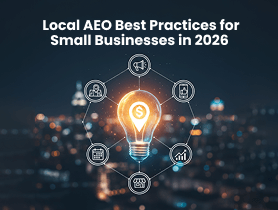
Local AEO (Answer Engine Optimization) refers to optimizing your digital presence so that search engines, especially AI-driven answer systems like Google’s Search Generative Experience (SGE) can accurately retrieve and present your business when users ask local queries.
For small businesses in 2026, mastering Local AEO is essential to compete in highly localized search results and attract quality local customers.
What Is Local AEO?
Local AEO goes beyond traditional SEO by focusing on how AI, context, and intent influence search outcomes. In 2026, search engines increasingly rely on semantic understanding and AI models to interpret user queries, especially in local contexts.
AEO vs SEO: Key Differences
While SEO focuses on ranking pages for keywords, AEO focuses on being the definitive answer for specific local questions. SEO drives traffic; AEO captures answers and featured result placements.
Why It Matters for Small Business?
Local discovery — when a user searches “best café near me” or “24-hour mechanic in Ahmedabad” — can directly drive foot traffic, calls, or purchases. Local AEO helps your business show up where it counts most.
Why Local AEO Matters More Than Ever
Local search has changed dramatically. In 2026, customers no longer scroll endlessly through blue links. Instead, they ask questions and expect instant, accurate answers from AI-powered search engines. This shift has made Local AEO best practices for small businesses in 2026 a critical growth strategy.
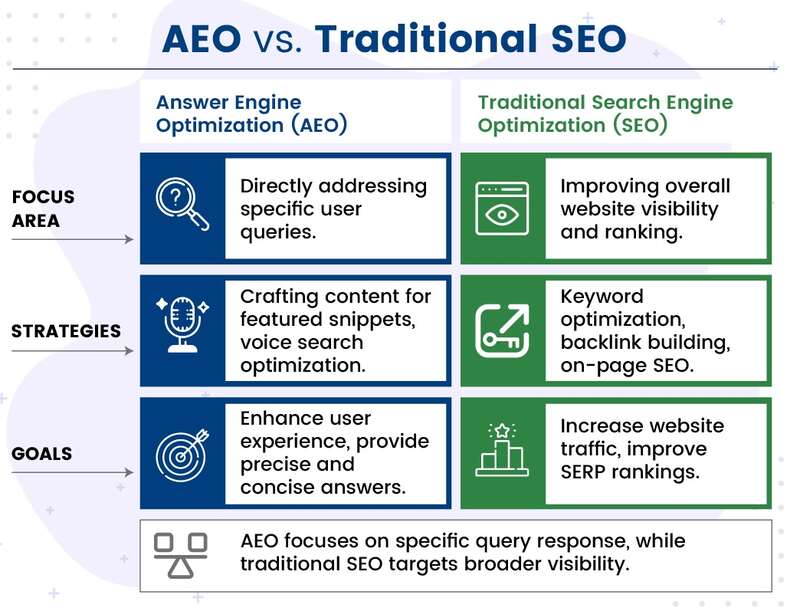
Answer Engine Optimization (AEO) focuses on making your business the best possible answer to local questions such as “best dentist near me” or “open bakery in downtown tonight.” For small businesses, this means higher visibility, more calls, and increased foot traffic without relying solely on paid ads.
The State of Local Google Search in 2026
Search behaviour continues evolving rapidly, putting greater emphasis on immediately accessible, context-rich answers.
In 2026, Local Google Search has evolved from a list of nearby results into an AI-driven recommendation engine that prioritizes real-time engagement and conversational intent.
The traditional “Local Pack” is now heavily integrated with AI Overviews, which synthesize business data, recent reviews, and live social signals to provide direct answers like, “The best quiet café with outdoor seating open now.”
Key characteristics of the 2026 local landscape include:
- Conversational Discovery: Search has shifted from robotic keywords to natural queries, as users interact with Google through voice and visual prompts (like Google Lens) to identify storefronts and services instantly.
- Zero-Click Dominance: With AI providing hours, menus, and even booking capabilities directly on the search page, the Google Business Profile has become a “digital storefront” where most customer conversions happen without a website visit.
- Hyper-Local Precision: The algorithm now heavily weights “Experience” (from E-E-A-T), favoring businesses that post frequent updates, high-quality video content, and receive detailed reviews mentioning specific services and locations.
- Visual-First Search: Short-form videos and user-generated photos are critical ranking factors, as AI increasingly uses visual data to match businesses with a user’s aesthetic or functional preferences.
Search Trends Shaping Local Visibility
AI-generated snippets, voice assistants, and SGE-type experiences now dominate local query responses, rewarding highly structured, accurate, and locally relevant content.
Voice & Mobile Search Influence
Mobile and voice searches have grown, with users asking conversational queries like, “Where can I get gluten-free pizza near me now?” Businesses must align content with natural language patterns.
Core Components of Local AEO (29 Stunning Checklist of Local AEO)
To improve Local AEO, small businesses need to align multiple components:
In 2026, Local Answer Engine Optimization (AEO) is the practice of ensuring your business is the “chosen” answer for AI-powered assistants (like Gemini, ChatGPT, or Siri) and Google’s AI Overviews. Unlike traditional SEO, which aims for a list of links, AEO focuses on zero-click visibility and direct query resolution.

Here are the core components of a successful Local AEO strategy:
1. Structured Data & Schema Markup
This is the “language” of AI. To be selected as an answer, your technical foundation must include:
- LocalBusiness Schema: Providing explicit data on your NAP (Name, Address, Phone), coordinates, and price range.
- Service & FAQ Schema: Helping AI extract specific answers about your offerings or common customer concerns.
- OpeningHours Specification: Ensuring real-time accuracy for queries like “Who is open for an emergency plumbing repair right now?”
2. Conversational Content Architecture
AI engines prioritize content that mirrors how humans speak.
- Q&A Formatting: Restructuring headers as questions (e.g., “What is the best way to maintain a HVAC in [City]?”) followed by immediate, 40–60 word concise answers.
- Natural Language Processing (NLP): Using semantic keywords and synonyms rather than repetitive keyword stuffing to satisfy the intent behind a query.
3. Entity-First Consistency
In 2026, Google treats your business as an “Entity” rather than just a website.
- Knowledge Graph Alignment: Your information must be identical across your website, Google Business Profile (GBP), social media, and local directories.
- Verified Citations: Mentions on authoritative local news sites, Reddit, or niche directories act as “votes of confidence” for the AI to trust your data.
4. Review Sentiment & Detail
AI models “read” reviews to understand your business’s reputation and specific strengths.
- Attribute-Rich Reviews: Encouraging customers to mention specific services and locations in their feedback (e.g., “Best gluten-free pizza in downtown Chicago”) helps the AI match you to highly specific prompts.
- Review Velocity & Responses: Regular new reviews and active business responses signal that your data is fresh and reliable.
5. On-Page Local Optimization
Add city names, localized service descriptions, and structured data to your website.
6. Off-Page Signals & Local Citations
Ensure your business appears on local directories with consistent NAP (Name, Address, Phone) details.
7. Reviews & Reputation Signals
Positive feedback improves visibility and trust, both for users and AI systems.
8. Google Business Profile (GBP) Optimization
Your GBP is central to local search success.
9. Complete & Accurate Business Info
Fill out all business fields: address, hours, photos, services, and contact details.
10. Categories, Attributes & Services
Select primary and secondary categories that match what users search for most.
11. GBP Posts & Updates
Regularly post updates, offers, and promotions to improve recency signals.
12. Local Keyword Strategy
Keywords now emphasize local intent and conversational specifics.
13. Geo-Modifiers & Intent Keywords
Use keywords like “near me”, specific neighborhoods, and landmarks.
14. Long-Tail Local Queries
Examples include: “best vegan breakfast in Ahmedabad” or “affordable wedding photographer near Ahmedabad.”
15. Localized Content Creation
Create pages that answer local questions and showcase expertise.
16. Blog Posts with Local Intent
Write about local events, tips, and guides, e.g., “Top markets to visit in Gujarat this winter.”
17. Location Pages Optimization
If your business has multiple locations, create unique pages for each area served.
18. Review & Reputation Management
Reviews now influence AI answer selection.
19. Encouraging Reviews Ethically
Ask satisfied customers to leave reviews, without incentives that violate guidelines.
20. Responding to Reviews Professionally
Answer both positive and negative reviews promptly and respectfully.
21. Local Link Building Techniques
Backlinks from local sources help AEO relevance.
22. Local Partnerships & Sponsorships
Work with community organizations to earn featured mentions.
23. Community-Driven Content Collaborations
Create blog posts, events, or newsletters featuring local partners.
24. Mobile & Voice Search Readiness
With rising voice search, optimize for conversational queries and fast mobile performance.
25. Voice-Friendly FAQs
Write FAQ sections that mirror how people speak their searches.
26. Fast Mobile Interfaces
Ensure your website loads quickly and is easy to navigate on mobile devices.
27. Technical AEO for Local Businesses
Technical optimization supports better AI interpretation.
28. Schema & Structured Data
Implement LocalBusiness schema, service schema, and review markup.
29. Page Speed & UX Signals
Faster sites improve rankings and reduce bounce rates.
Measuring Local AEO Performance
Track tangible improvements. Measuring Local AEO (Authorized Economic Operator) Performance involves tracking how effectively a national customs program balances trade facilitation with supply chain security.
Because AEO programs rely on a “trust-but-verify” partnership between customs and private businesses, measurement focuses on both the operational efficiency for the trader and the risk reduction for the government.
Key Performance Indicators (KPIs)
To gauge success at a local level, customs administrations typically monitor several core metrics:
-
Trade Facilitation Speed: Measuring the average release time for AEO shipments compared to non-AEO shipments. A successful program should show significantly faster clearance for “trusted” partners.
-
Physical Inspection Rates: Tracking the percentage of consignments selected for examination. A lower “hit rate” for AEOs indicates that the system is successfully prioritizing higher-risk, non-certified cargo.
-
Compliance and Accuracy: Monitoring the number of errors or infractions found in AEO declarations. High compliance rates validate the initial certification and ongoing monitoring processes.
-
Program Growth and Reach: Tracking the total number of certified operators and the percentage of total trade volume handled by AEOs. This reflects the program’s impact on the overall national economy.
Continuous Monitoring
Performance is not a one-time assessment; it requires periodic reviews (often every 6 to 12 months) and post-clearance audits to ensure that the operator continues to meet international security standards.
Locally, this data is used to justify continued funding for the program and to negotiate Mutual Recognition Agreements (MRAs) with other countries, which extend these local benefits to a global scale.
Common Challenges & Solutions
Small budget? Limited tech skills? Prioritize foundational actions like GBP optimization and consistent NAP to build momentum.
Future of Local AEO Beyond 2026
Expect even more influence from AI assistants, personalized search pathways, and real-time recommendations based on location, behaviour, and intent.
Beyond 2026, Local AEO will transition from simply answering questions to executing actions through autonomous “Agentic AI.” This shift marks the move from a “Search and Discover” era to a “Delegate and Fulfill” era, where AI assistants don’t just recommend a business—they interact with it on the user’s behalf.
The following trends will define Local AEO after 2026:
-
The Rise of Agent-to-Business (A2B) Interaction
Optimization will shift from human-readable content to machine-executable data.
- Autonomous Booking: AI agents will autonomously negotiate appointments, check real-time inventory, and complete transactions without the user ever seeing a website.
- API-First SEO: Businesses will need to provide “hooks” or clean data feeds (like accessible APIs or RSS) so AI agents can pull live pricing and availability instantly.
-
Hyper-Personalization via “Contextual Anticipation”
Search will move from reactive to predictive, using real-time environmental and biometric data.
- Anticipatory Suggestions: Instead of a user searching for “coffee,” an AI agent might suggest, “I’ve noticed you’re low on caffeine and walking past a café with your favorite oat-milk latte in stock—should I order it now?”
- Zero-Party Data Pacts: Users will trade specific preferences (e.g., “I only like quiet shops”) for highly tailored local results, making niche “persona-based” content more valuable than broad keywords.
-
Visual and Spatial Discovery (The AR Layer)
As wearable AR glasses and smart devices mature, Local AEO will become physically integrated into the environment.
- AR Overlays: Points of interest will be “optimized” for visual recognition. Pointing a device at a storefront will instantly overlay AI-synthesized sentiment analysis, live wait times, and personalized “loyalty” offers.
- Digital Twins: Businesses may maintain “Digital Twins”—3D models or rich spatial data—that allow AI engines to “walk” through a store virtually to confirm accessibility or layout for a user.
-
Sentiment and “Vibe” as Ranking Factors
AI will go beyond reading text to understanding the emotional nuance of a business’s reputation.
- Multi-Modal Signals: Rankings will be influenced by the collective “mood” of video reviews, social media mentions, and live community discussions on platforms like Reddit or niche local forums.
- Brand “Entity” Trust: The AI will evaluate a brand’s ethical standing and community impact, prioritizing businesses that align with the user’s documented values (e.g., sustainability or local sourcing).
Frequently Asked Questions (FAQ)
-
What does AEO stand for in local search?
AEO stands for Answer Engine Optimization, optimizing digital content to be included as direct answers in search results.
-
Is Local AEO the same as local SEO?
Not exactly. Local SEO focuses on ranking; AEO focuses on being the best answer for user queries.
-
How can small businesses improve their Local AEO in 2026?
By optimizing Google Business Profile, creating local content, managing reviews, and using structured data.
-
Do reviews impact Local AEO?
Yes, positive reviews and proper management improve trust and visibility in local answer features.
-
Is voice search important for Local AEO?
Absolutely, many local queries are asked verbally, making conversational optimization vital.
-
How often should I update my GBP?
Regularly, new posts, offers, and updated details help maintain relevance and freshness signals.
In Conclusion :
Local AEO is no longer optional, it’s essential for small businesses aiming to compete in local markets in 2026. By optimizing business profiles, creating high-quality localized content, managing reputation, and adapting to AI search trends, you’ll not just rank, you’ll be the answer.